
“A strait just 33 km wide can still hold the world’s economy hostage.”
The Strait of Hormuz crisis flared again this week as the US and Iran traded strikes and tankers hit mines in the waterway. Between 17 and 18 November 2026, Iranian drones targeted US bases in the Gulf, US jets hit Iranian missile sites, and several ships caught fire.
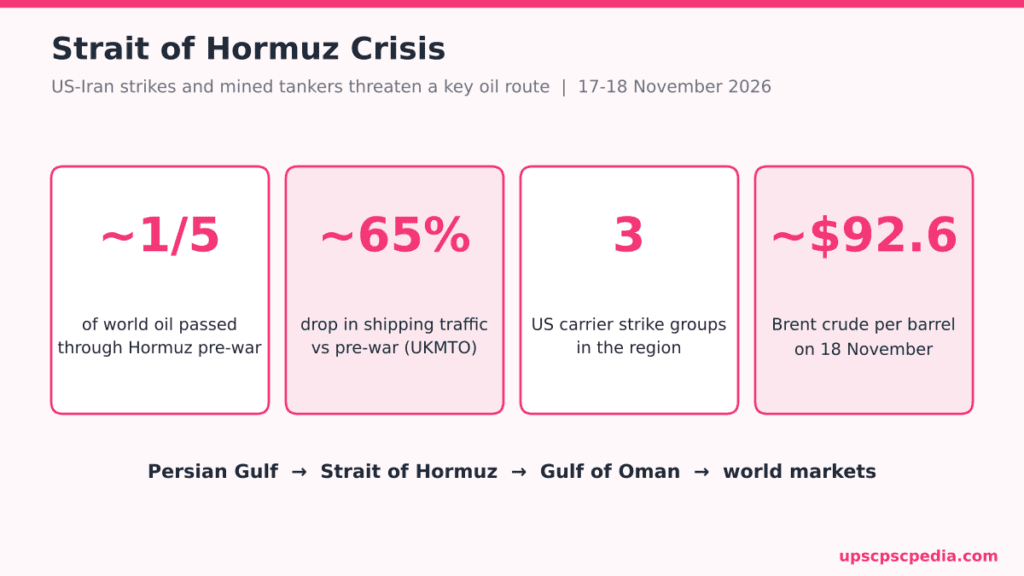
Why should anyone outside the Gulf care? Before the war, about one-fifth of the world’s oil supply passed through this narrow channel, according to Al Jazeera. Every flare-up here travels straight to fuel prices, shipping costs and inflation in countries like India.
The latest round also comes as the US and Israel reportedly debate whether to restart larger military action against Iran. That makes this week a warning sign, not a one-off.
What Happened?

Here is the sequence of events, based on reports from Euronews, CBS News and Al Jazeera:
- 17 November: Iran’s Revolutionary Guards (IRGC) said they launched a drone attack on a US radar system at Sheikh Isa Air Base in Bahrain. Bahrain and US Central Command (CENTCOM) said they intercepted the drones without damage.
- 17 November, evening: US fighter jets struck IRGC missile launch sites on Iran’s Qeshm Island. A US military official called it self-defence. A local Iranian official said the strikes did not damage homes or businesses.
- 17 November: Iranian forces claimed that three tankers hit naval mines. Euronews put the number at five or more ships, all on routes Iran calls “unauthorised”.
- 18 November: Bahrain and Kuwait said they intercepted fresh Iranian attacks. Kuwait’s foreign ministry called them “a dangerous escalation.”
- 18 November: ADNOC reported that an attack hit one of its ships in the strait overnight. One crew member went missing and 11 suffered injuries.
The IRGC also claimed it shot down a US MQ-1 drone near Qeshm. Independent sources have not confirmed this.
What Is the Strait of Hormuz Crisis?

Let’s simplify this. The Strait of Hormuz links the Persian Gulf to the Gulf of Oman and the open sea. Oil and gas from Saudi Arabia, Iraq, Kuwait, Qatar, the UAE and Iran must pass through it.
The crisis began after the US and Israel struck Iran on 28 February 2026. Iran then effectively closed the strait, letting only some ships through.
Today, both sides claim control. Iran says ships must use its approved routes, stay in touch with its forces and keep navigation systems on. The US, meanwhile, runs a naval blockade of Iranian ports and says it escorts ships.
Think of it like a toll road that two rival guards both claim. Each sets different rules, and drivers who follow one guard risk punishment from the other.
Key Facts at a Glance
| Indicator | Figure | Source |
|---|---|---|
| Share of world oil through Hormuz (pre-war) | About one-fifth | Al Jazeera |
| Shipping traffic now vs pre-war | About 65% lower | UKMTO weekly report |
| Crossings in 7 days to 11 November | 308 (139 out, 169 in) | UKMTO |
| War-risk insurance premium | 7.5–10% of hull value (was 1–3%) | S&P Global |
| US carrier strike groups in region | Three | CENTCOM, via CBS News |
| Brent crude on 18 November | About $92.6 a barrel | HDFC Sky |
Why the Strait of Hormuz Crisis Matters
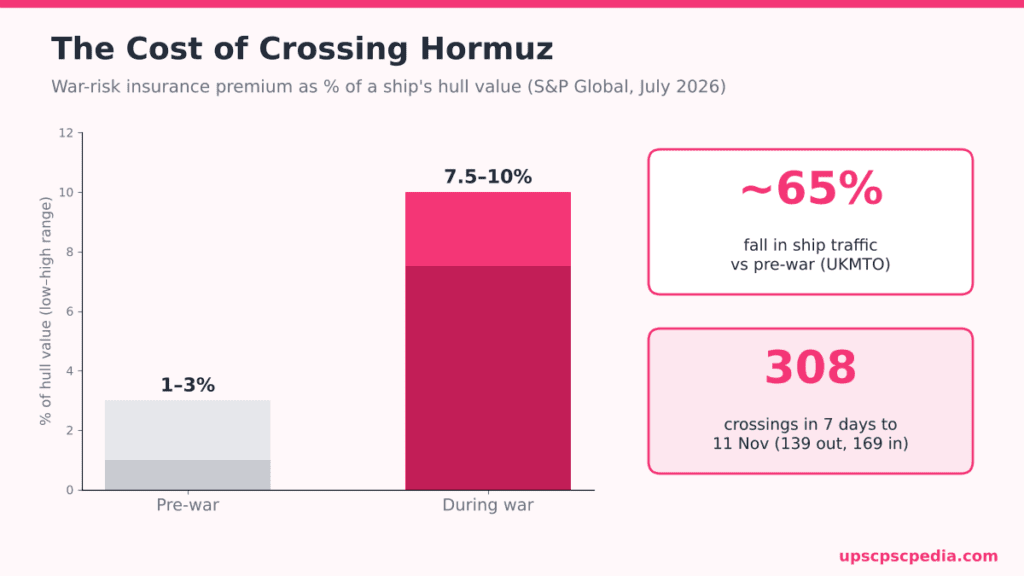
Shipping costs are soaring. Acting US Navy Secretary Hung Cao told senators that insuring a single transit now costs $64 million. Al Jazeera noted that nobody has independently verified this figure. Still, S&P Global data shows war-risk premiums have jumped several times over.
Oil prices stay on edge. Brent slipped about 0.5% on 18 November because US crude stocks rose, HDFC Sky reported. However, analysts warned that any further escalation could quickly push prices up again.
Bypass routes face attacks too. Saudi Arabia’s East-West pipeline can carry about 7 million barrels a day around Hormuz. Yet the Houthis claimed drone attacks on two of its pumping stations.
India has a direct stake. Iran has exempted ships from India, China, Iraq and Qatar from some of its restrictions, Al Jazeera reported. Even so, higher freight and insurance costs raise India’s import bill. We explained this link earlier in our post on energy shocks and India’s economy.
Challenges and Concerns
- Mines are hard to clear. Even after a ceasefire, minesweeping can take weeks.
- Rival claims create confusion. Ship captains face two sets of rules from two armed powers.
- Risk of a wider war. CENTCOM chief Adm. Brad Cooper met Israel’s army chief this week, and the two allies reportedly discussed restarting bigger operations.
- Gulf states sit in the line of fire. Bahrain hosts the US Fifth Fleet. In Kuwait, Iran’s army said its drones targeted Patriot air defences at Ali Al-Salem Air Base.
A Balanced View
Washington describes its strikes as limited self-defence against Iranian attacks on US personnel. President Trump has also said the military campaign is effectively over and that the US Navy escorts ships safely.
Tehran tells a different story. Iran says it responds to US drones violating its airspace and insists it controls safe passage. It also holds talks with Oman and Qatar, though the outcome remains unclear.
Independent analysts sit somewhere in between. One market analyst told Al Jazeera the strait is “not open by any pre-war definition of the word.”
What Happens Next?
Four signals will show where the Strait of Hormuz crisis goes from here:
- Watch whether the US and Israel decide to resume larger strikes on Iran.
- Track Oman and Qatar’s mediation for any deal on safe passage.
- Follow oil prices and insurance rates, which react within hours.
- For India, monitor fuel prices and the rupee. Our post on the falling rupee explains how oil shocks hit the currency.
Conclusion
The Strait of Hormuz crisis shows how a narrow strip of water can shape the wider world. Air strikes near Qeshm and mines in shipping lanes affect fuel bills in Patna, Lucknow and Ranchi.
Diplomacy still has room to work, but each new strike shrinks that space. Until both sides agree on safe passage, global markets will keep holding their breath.
What do you think? Can mediation by Oman and Qatar end the Strait of Hormuz crisis, or will force decide the outcome? Share your view in the comments below. 👇


Pingback: Benghazi Drone Attack: Why a Russian Warship Sank in a Libyan Port - upscpscpedia.com
Pingback: New Urea Plants: Why India Approved Six Projects Worth ₹54,000 Crore - upscpscpedia.com