
“A war fought over Ukraine’s fields just sank a warship in North Africa.”
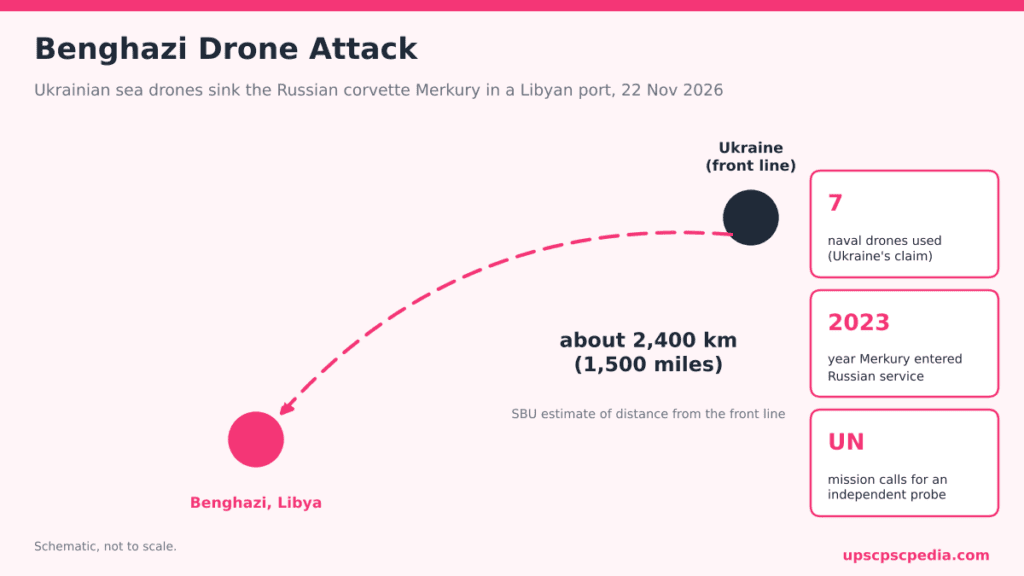
The Benghazi drone attack of 22 November 2026 shows how far the Russia-Ukraine war has spread. On Sunday night, sea drones struck the Russian Navy corvette Merkury while it sat docked in Benghazi, a port in eastern Libya. By the next morning, satellite images showed the ship capsized, with only its bow above water.
Ukraine’s security service, the SBU, claimed the strike on Monday. President Volodymyr Zelensky praised it. Libya, which has no part in the war, reacted with anger and asked the United Nations to investigate.
This is not just another naval incident. It drags a divided African country into a European war, and it raises hard questions about sovereignty and the Mediterranean’s security.
What Happened?

The Merkury had stopped in Benghazi to refuel and take on supplies on its way back to Russia. Libya’s eastern government said the visit fell under a maritime cooperation deal with Moscow.
Then the drones came. Here are the key claims, as reported:
- Ukraine’s version: According to Kyiv Post, the SBU said seven explosive-laden naval drones, launched from a “mother ship”, hit two targets. They sank the Merkury and struck the Russian support vessel Angara at sea. The SBU added that a Ka-27 helicopter on the corvette was destroyed.
- Libya’s version: Two eastern Libyan military officials told AP that defenders intercepted at least four drones and two hit the corvette. Reports say about 10 people suffered minor injuries.
- Zelensky’s view: He called it “an exemplary Ukrainian operation”.
The SBU also noted that Benghazi lies roughly 1,500 miles (about 2,400 km) from the front line. That distance is what makes this Benghazi drone attack so striking.
| Key fact | Detail |
|---|---|
| Date | Night of 22 November 2026 |
| Place | Benghazi port, eastern Libya |
| Ship | Merkury, Steregushchiy-class corvette, in service since 2023 |
| Drones (Ukraine’s claim) | 7 naval drones |
| Drones (Libyan officials) | At least 4 intercepted, 2 hit |
| Injuries reported | About 10, all minor |
| Distance from front line | About 2,400 km (SBU estimate) |
What Is a Naval Drone, and Why Libya?
Let’s simplify this.
A naval drone is a small, unmanned speedboat packed with explosives. An operator steers it from far away, often by satellite link, and rams it into a target. Ukraine has used such drones for years to hit Russian ships in the Black Sea.
Think of it like a remote-control toy boat, only it carries a bomb and costs a tiny fraction of the warship it can sink.
Why Libya? The country has been split since the 2011 uprising that ended Muammar Gaddafi’s rule. A UN-recognised government sits in Tripoli in the west. A rival administration, backed by General Khalifa Haftar, controls the east, including Benghazi. Haftar’s forces have close ties with Moscow, and Russia uses eastern Libya as a foothold in the Mediterranean.
This is not the first such incident linked to Libya:
- In December 2025, Ukraine said it hit a Russian-linked oil tanker in the Mediterranean.
- In March 2026, Russia blamed Ukrainian sea drones launched from Libya for an attack on the gas tanker Arctic Metagaz. Kyiv did not claim that attack.
- On 21 November 2026, a drone hit the Russian cargo ship Sparta II in the Baltic. Finland said Ukraine was probably behind it.
Like the Kerch Bridge attack earlier this month, the Benghazi drone attack shows Ukraine taking the fight to Russian assets far from the trenches.
Why the Benghazi Drone Attack Matters

The strike matters for several reasons.
- The war has gone global. A Russian warship is no longer safe even in a friendly foreign port.
- Sea drones are changing naval warfare. Cheap unmanned boats can now threaten ships worth far more.
- Libya’s fragile peace faces new strain. Each side now accuses the other of hosting foreign fighters.
- Shipping risks rise. The Mediterranean carries huge volumes of trade, and attacks near ports raise insurance costs. Combined with the Strait of Hormuz crisis, sea lanes look less safe than at any time in years.
How Did Different Sides React?
The reactions show how messy the politics are.
- Eastern Libya (Benghazi): Prime Minister Osama Hammad’s government opened a joint investigation with Russia. It asked the UN to probe suspicions that the drones came from western Libya, and it asked Kyiv to explain itself.
- Western Libya (Tripoli): The Government of National Unity condemned the attack and said Libya must not become an arena for foreign wars, as Kyiv Independent reported.
- Russia: Kremlin spokesman Dmitry Peskov said Moscow had taken note of Zelensky’s statement.
- The UN: Its mission in Libya called for an immediate, independent and transparent investigation, according to IBTimes UK.
A Balanced View

Ukraine argues that Russian warships anywhere are fair military targets while Russia keeps attacking Ukrainian cities. The SBU called both ships legitimate targets, and Kyiv said the Angara carried weapons. Supporters see the strike as a clever answer to a bigger enemy.
Critics see a dangerous precedent. Libya is a sovereign country that is not at war with anyone over Ukraine. Eastern Libyan officials allege that Ukrainian drone teams operate from bases in western Libya, including Misrata. Nobody has proven that claim, but if true, it would turn Libya’s own split into a proxy battlefield.
Analyst Jalel Harchaoui of the RUSI think tank called the strikes “exceptionally brazen and provocative”. Both readings can hold some truth at once.
What Happens Next?
Watch for these developments:
- The UN and Libyan investigations into where the drones came from.
- Any Russian response, including stronger port defences or retaliation.
- New tension between Libya’s rival governments in Tripoli and Benghazi.
- More strikes on Russian ships far from Ukraine, which Kyiv officials have hinted at.
The Benghazi drone attack also lands at a delicate diplomatic moment, just days after the Trump-Xi-Putin summit in Shenzhen.
Conclusion
One capsized ship tells a bigger story. The Benghazi drone attack proves that modern wars do not stay inside borders. Cheap drones can reach distant ports, and weak states like Libya can get pulled in without choosing a side. For India, which depends on safe sea lanes for trade and energy, the lesson is clear: maritime security now starts far from home.
What do you think? Was the Benghazi drone attack a fair military strike or a dangerous breach of Libya’s sovereignty? Share your view in the comments below. 👇


