
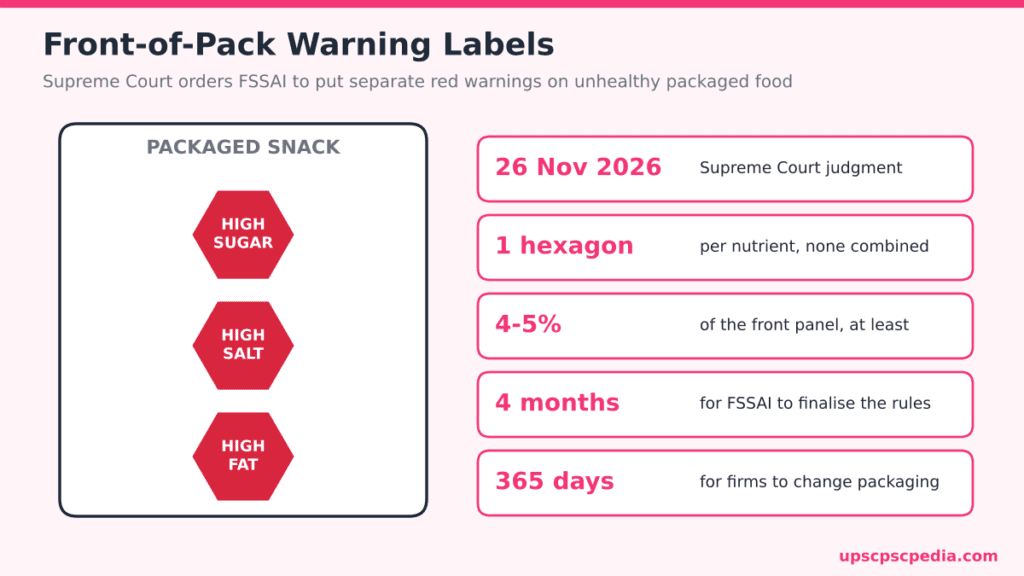
A snack packet can no longer hide its secrets in tiny print.
On 26 November 2026, the Supreme Court ordered FSSAI to bring in front-of-pack warning labels for packaged foods that carry too much sugar, salt or fat. Each problem nutrient will get its own red hexagon on the front of the pack.
Most of us check the price and the expiry date. Very few of us flip the packet over and read the nutrition table. The court wants the key warning right where our eyes land first.
The ruling also ends a long tug-of-war. The case ran for more than two years, and the judges openly asked why the regulator needed so much time. Now the clock is ticking for FSSAI and for food companies.
What Happened?
A bench of Justices J.B. Pardiwala and K. Vinod Chandran delivered the verdict on 26 November 2026. It came in a public interest litigation that 3S and Our Health Society filed to seek mandatory warnings on unhealthy packaged foods.
Here is what the court directed, as Bar & Bench and The Pioneer report:
- One hexagon per nutrient. A product high in sugar and salt will show two separate red hexagons, not one combined symbol.
- Clear words. Each hexagon will say “High Sugar”, “High Salt” or “High Fat”, along with a standard picture.
- Big enough to notice. Each warning should cover at least 4-5% of the main display panel.
- Total, not just added. FSSAI must count total sugars and saturated fat, not only added sugar and added fat.
- Fresh thresholds. The regulator must rework the cut-offs instead of copying the table in the Dietary Guidelines for Indians, 2024.
- No loopholes. FSSAI must publish a clear list of exempt foods. It must also watch for firms that tweak recipes with additives just to dodge a label.
What Are Front-of-Pack Warning Labels?
Let’s simplify this.
Today, nutrition facts sit in a small table on the back of the pack. You need time, good eyesight and some maths to make sense of them.
Front-of-pack warning labels flip that idea. They put a simple, bold signal on the front. One glance tells you whether a biscuit or a cold drink crosses a healthy limit.
Think of it like a traffic signal at a busy crossing. You don’t need to know how the signal works. You just see red, and you stop to think.
Several countries already use this tool. The court pointed to Chile, Israel and Canada as models. Chile, for example, tightened its “high sugar” limit from 22.5 g to 10 g per 100 g between 2016 and 2019.
How Did the Case Get Here?
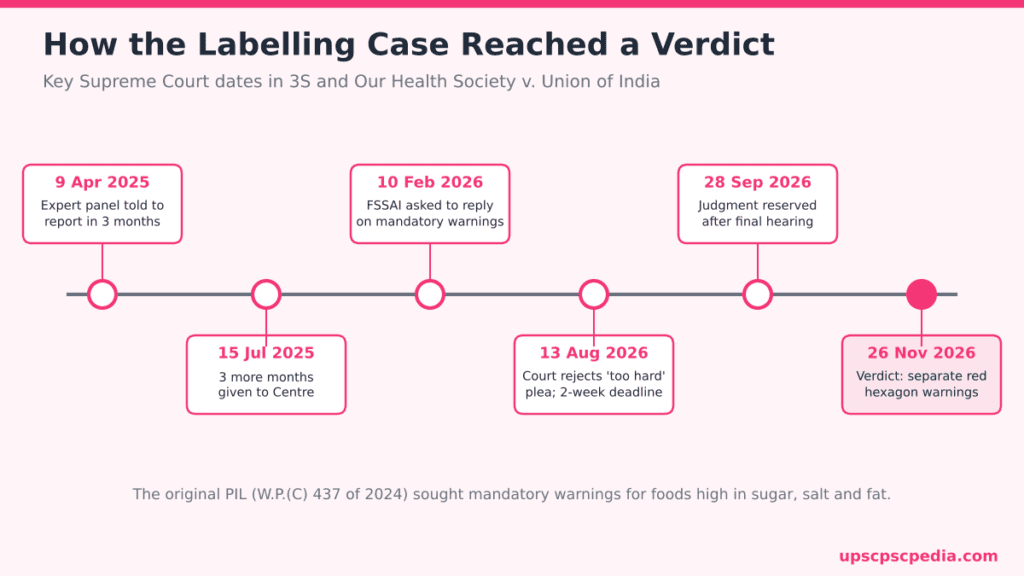
The petition dates back to 2024. Since then, the court has pushed the government again and again.
| Date | What happened |
|---|---|
| 9 Apr 2025 | Court asks an expert committee for recommendations within three months |
| 15 Jul 2025 | Centre gets three more months |
| 10 Feb 2026 | Court asks FSSAI to respond on mandatory warnings within four weeks |
| 13 Aug 2026 | Court rejects the claim that global standards are hard to match; gives two weeks for a final decision |
| 28 Sep 2026 | Court reserves judgment after questioning a one-year voluntary period |
| 26 Nov 2026 | Court issues final directions on separate red-hexagon warnings |
At the September hearing, Justice Pardiwala asked what FSSAI had done in the four years since 2022, as LiveLaw reported. He also asked the regulator, “Why do you need so much time?”
What Changed From FSSAI’s Plan?
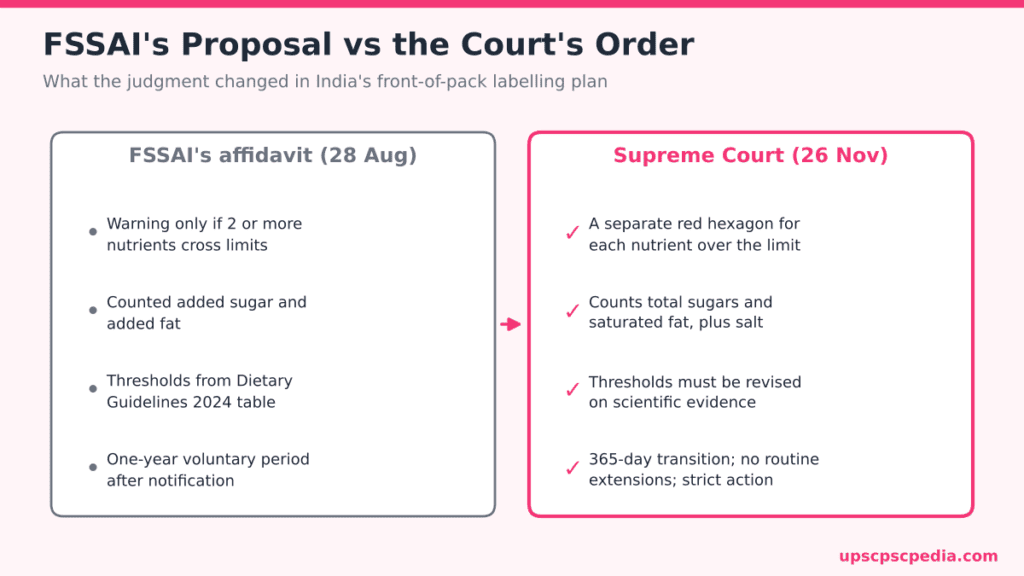
FSSAI had its own proposal. In an affidavit dated 28 August, it suggested a red hexagon only when a product crossed limits for two or more nutrients. It also built its limits on added sugar and added fat. Later, it moved to a one-nutrient trigger, yet it still wanted a one-year voluntary phase.
The court went further on three points:
- It asked for a separate warning for each nutrient.
- It shifted the focus to total sugars and saturated fat.
- It said manufacturers should not ordinarily get extensions after the 365-day transition.
Why does “total sugar” matter? A fruit drink can carry plenty of natural sugar and still claim “no added sugar”. Counting the total closes that gap.
Why Front-of-Pack Warning Labels Matter
India’s eating habits are changing fast. In its 13 August order, the court cited the Economic Survey 2025-26. The Survey found that the ultra-processed food market grew by over 150% between 2009 and 2023, according to the SCC Online Blog. Over roughly the same period, obesity reportedly doubled.
Children worry the judges most. The court also relied on a UNICEF report. It found that the share of overweight school-age children rose from 2% to 10% between 2000 and 2022.
The bench tied the issue to the Constitution as well. It linked clear food information to Article 21 (right to life, which includes health) and Article 47 (the State’s duty to improve public health). We saw a similar health-first push in India’s plan for central oversight of antimicrobial drugs. The court’s wide reading of Article 21 also echoes the debate in the Harish Rana passive euthanasia case.
Challenges and Concerns
- Setting the right limits. The court itself warned about “label fatigue”. If limits are too low, nearly every packet gets a warning. If they are too high, harmful products slip through.
- Cost for small firms. New packaging costs money. Small brands may feel the pinch more than big companies.
- Clever reformulation. Some firms may swap sugar for additives to escape a label. The court has asked FSSAI to watch for this.
- Enforcement. India sells lakhs of packaged products. Checking them all needs testing labs and trained staff.
A Balanced View
Supporters say front-of-pack warning labels give shoppers a fair chance to choose. Public health groups have pushed for them for years. They argue that a clear warning nudges both buyers and makers.
On the other side, the food industry has often raised concerns about costs. Firms also worry that warnings may scare buyers away from products that can fit into a balanced diet. The government, too, had argued that matching international standards was difficult. However, the court did not accept that view.
The truth likely sits in the middle. Labels inform people, but they cannot replace nutrition education, better school meals or regular exercise.
What Happens Next?
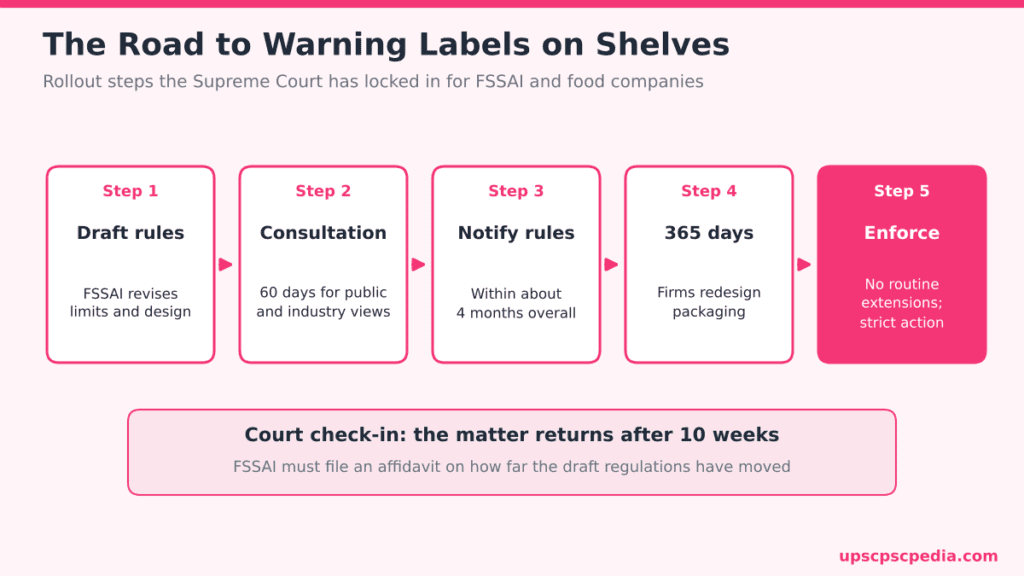
FSSAI has proposed about four months to finalise the rules, including 60 days of public consultation. Once it notifies the rules, companies get 365 days to change their packaging.
Meanwhile, the court will take up the matter again after ten weeks. At that point, FSSAI must file an affidavit on its progress, as Morung Express reported.
So, if everything runs on time, the red hexagons could become mandatory on shelves by around early 2028. That is a rough estimate based on the two deadlines.
Conclusion
The Supreme Court has turned a slow policy debate into a firm timeline. Front-of-pack warning labels will not make anyone eat healthy overnight. Still, they put honest information on the front of the pack, where every shopper can see it.
What do you think? Will a red “High Sugar” hexagon change what goes into your shopping basket? Share your view in the comments below. 👇


