
Every grain of rice starts with a sack of fertiliser, and India still buys too many of those sacks from abroad.
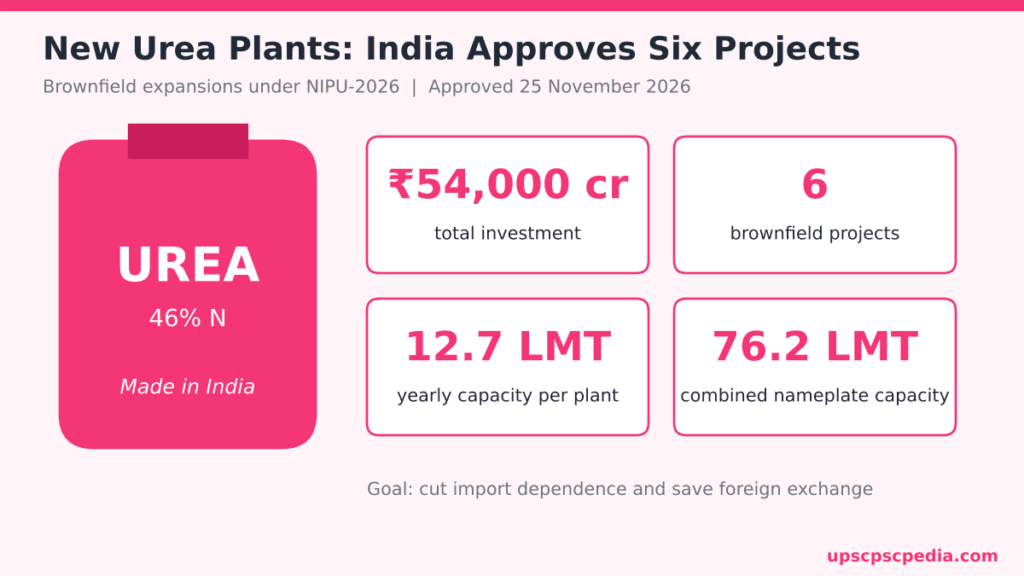
On 25 November 2026, the Centre cleared six new urea plants worth about ₹54,000 crore. It is the biggest fertiliser push since the government brought in a fresh urea investment policy in July.
Urea is the most widely used fertiliser on Indian farms. Yet India still imports roughly a quarter of what its farmers need. That gap drains foreign exchange and leaves farmers exposed whenever global prices jump.
The timing matters too. Tension in the Gulf has rattled energy and shipping routes this month, as we explained in our post on the Strait of Hormuz crisis. Urea plants run on natural gas, and much of that gas reaches India by sea. So any step toward home-grown fertiliser now carries extra weight.
What Happened?
The Ministry of Chemicals and Fertilizers announced the approvals on Wednesday, 25 November. All six projects fall under the National Investment Policy for Urea, 2026 (NIPU-2026).
Here are the key numbers:
- Total investment: about ₹54,000 crore, or roughly ₹9,000 crore per project.
- Capacity: each plant targets 12.7 lakh metric tonnes (LMT) of urea a year.
- Combined size: about 76.2 LMT a year on paper, or 7.62 million tonnes.
- Type: two projects replace ageing plants, while four expand existing complexes.
- Owners: a mix of public sector, private and cooperative companies.
The ministry linked the decision to the Atmanirbhar Bharat goal of cutting import dependence, according to The News Mill’s ANI-based report.
Which Six New Urea Plants Got the Green Light?

The projects stretch across five states, from Punjab in the north to Tamil Nadu in the south.
| Plant | Location | Ownership | What changes |
|---|---|---|---|
| Madras Fertilizers (MFL) | Chennai, Tamil Nadu | Public sector | Replaces a plant over 60 years old |
| National Fertilizers (NFL) | Nangal, Punjab | Public sector | Replaces a 50–55-year-old unit; 4.73 to 12.7 LMT |
| KRIBHCO (KFL) | Shahjahanpur, Uttar Pradesh | Cooperative | Expands a 1995 plant |
| Matix Fertilisers | Panagarh, West Bengal | Private | Expands a 2017 plant |
| Chambal Fertilisers (CFCL) | Gadepan, Kota, Rajasthan | Private | Expands a complex running since 1994 |
| Indian Potash (IIPL) | Jagdishpur, Uttar Pradesh | Private | Adds capacity at a 1988 plant |
West Bengal stands out here. Reports note that the state currently has only one urea plant, so Panagarh’s expansion matters for eastern India.
What Is NIPU-2026?
Let’s simplify this. NIPU-2026 is the rulebook that tells companies how much the government will pay them for the urea they make.
The Cabinet Committee on Economic Affairs approved it on 15 July 2026. It replaced the New Investment Policy of 2012, which had expired in 2019. According to The Tribune, the policy aims to add about 10 million tonnes of yearly capacity.
Its main features are:
- It separates fixed costs (land, machines, loans) from energy costs (gas).
- It offers a return on equity band of 12% to 16%.
- It converts fixed costs into rupees after four years, which protects firms from currency swings.
- It aims to make brownfield replacements bankable, so lenders feel safe funding them.
Think of it like a long shop lease with a fixed rent range. The shop owner can take a bank loan to build, because the income is predictable. In the same way, a clear return band helps fertiliser firms borrow thousands of crores.
Why Build on Old Sites Instead of New Ones?

“Brownfield” simply means building on a site that already hosts a plant. The land, gas pipelines, rail sidings and trained workers already exist. That cuts both cost and delay.
The government estimates that each brownfield project saves about ₹225 crore a year. Over eight years, that adds up to roughly ₹1,800 crore per project.
Energy use tells the rest of the story. Nangal’s old unit burns about 6.498 Gcal of energy per tonne of urea. The industry average is 5.95 Gcal, and the new energy norm is 5 Gcal. A modern plant uses less gas for every sack, which lowers the subsidy bill and cuts safety risks at old units.
Why It Matters

India needs about 400 LMT of urea every year. Domestic output has grown, but it still falls short.
- Production stood at 225 LMT in 2014-15.
- It hit a record 314.07 LMT in 2023-24.
- It slipped to 293.30 LMT in 2025-26.
- Reassessed capacity rose from 207.54 LMT to an estimated 269.42 LMT a year in 2026-27.
These new urea plants could narrow that gap in several ways:
- Food security: steady fertiliser supply protects sowing seasons from global shocks.
- Foreign exchange: fewer imports mean less pressure on the rupee, a theme we covered in Rupee Falling Amid Global War.
- Subsidy savings: efficient plants need less gas, so the government pays less per tonne.
- Regional balance: new capacity in Bengal and Uttar Pradesh brings supply closer to big farming belts.
The approach has a track record. Under the 2012 policy, India set up six plants at Ramagundam, Gorakhpur, Sindri, Barauni, Panagarh and Gadepan-III, adding 76.2 LMT a year.
Challenges and Concerns
The plan looks strong on paper, but a few questions remain open.
- Gas dependence: India imports a large share of its natural gas. So the new urea plants swap one import (urea) for another (LNG). Officials are exploring coal gasification as an alternative, and the Talcher project in Odisha should be ready by December 2027.
- Smaller net gain: Chennai and Nangal replace old units, so real added capacity will be lower than 76.2 LMT.
- No deadlines yet: the announcements do not give construction or commissioning dates.
- Soil health: agronomists have long warned that cheap, subsidised urea encourages overuse. More supply does not fix that imbalance by itself.
A Balanced View
Supporters see a practical, low-cost route to self-reliance. Building on old sites avoids land fights and long delays. Efficient plants also burn less gas than the ones they replace.
Critics, however, point to the bigger picture. Fertiliser security still rests on imported gas. Some experts also argue that India should push balanced nutrient use and nano-fertilisers alongside more capacity.
Both views hold some truth. Capacity solves the supply problem, while smarter use tackles the demand side.
What Happens Next?
The companies will now line up financing and start detailed engineering. Meanwhile, two other big projects continue on the ground: the Talcher coal-gasification plant in Odisha and the Assam Valley Fertilizers and Chemicals plant at Namrup in Assam.
Watch for three things in 2027:
- Construction timelines from each company.
- Long-term gas supply deals for the plants.
- Any more approvals to reach the full 10-million-tonne goal.
Conclusion
The six new urea plants show a clear shift. India wants to grow more of its fertiliser at home, using old sites and cleaner, efficient technology. If the projects finish on time, farmers could face fewer shortages and the country could save on imports.
Still, the real test lies ahead. Gas supply, soil health and delivery speed will decide whether this push truly pays off. India has already shown it can boost exports and output, as our post on India’s record exports in October 2026 showed.
What do you think? Will new urea plants make India truly self-reliant in fertiliser, or does the real answer lie in using less urea? Share your view in the comments below. 👇


