
A weak antibiotic does not just fail one patient. It trains the germ to beat the next one.
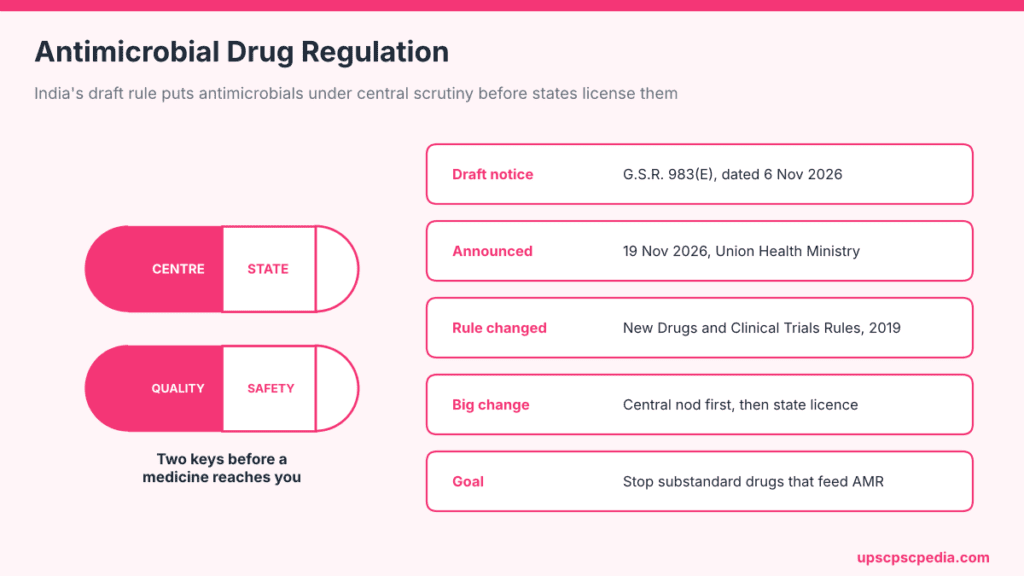
That simple idea sits behind India’s newest step on antimicrobial drug regulation. On 19 November 2026, the Union Health Ministry proposed a key change. Every antimicrobial medicine should clear a central check before any state licenses its manufacture.
The timing tells its own story. The proposal arrived during World AMR Awareness Week, which runs from 18 to 24 November. It also comes a year after India launched its second National Action Plan on antimicrobial resistance (AMR).
So why does a licensing change matter so much? India ranks among the countries hardest hit by drug-resistant infections. And poor-quality medicines quietly add fuel to that fire.
What Happened?
The ministry has released a draft notification, G.S.R. 983(E), dated 6 November 2026. It amends the New Drugs and Clinical Trials Rules, 2019. On 19 November, the ministry made the proposal public and invited objections and suggestions from industry and citizens.
Here is what the draft does:
- It adds antimicrobials to the definition of “new drug” under Rule 2(1)(w)(v) of the 2019 rules.
- Manufacturers must first get permission from the Central Licensing Authority.
- Only then can they apply to a State Licensing Authority for a manufacturing licence.
- The central review will look at bioavailability/bioequivalence (BA/BE) and stability studies.
The ministry also gave its reason. As The Hans India reported, authorities had granted some antimicrobial licences without proper scrutiny of these studies.
A second draft, under the Drugs Rules, 1945, targets bulk drugs. It creates a separate licence for wholesale trade in bulk drug substances. This includes substances under the NDPS Act, 1985. A competent person must personally supervise such sales.
What Is Antimicrobial Resistance?
Let’s simplify this.
Antimicrobials are medicines that kill germs or stop them from growing. The group includes antibiotics, antivirals, antifungals and antiparasitic drugs. Resistance sets in when germs change and stop responding to these medicines.
Think of it like a lock and key. A medicine is a key that breaks the germ’s lock. If a germ keeps meeting a weak key, it slowly changes its lock. Soon, even the strong key fails.
Low-quality drugs speed up this process. A tablet with too little active ingredient may never reach the dose that kills germs. A drug that loses strength on the shelf does the same. The surviving germs then grow back tougher. That is why this round of antimicrobial drug regulation targets quality, not just prescribing habits.
How Does the New Antimicrobial Drug Regulation Work?
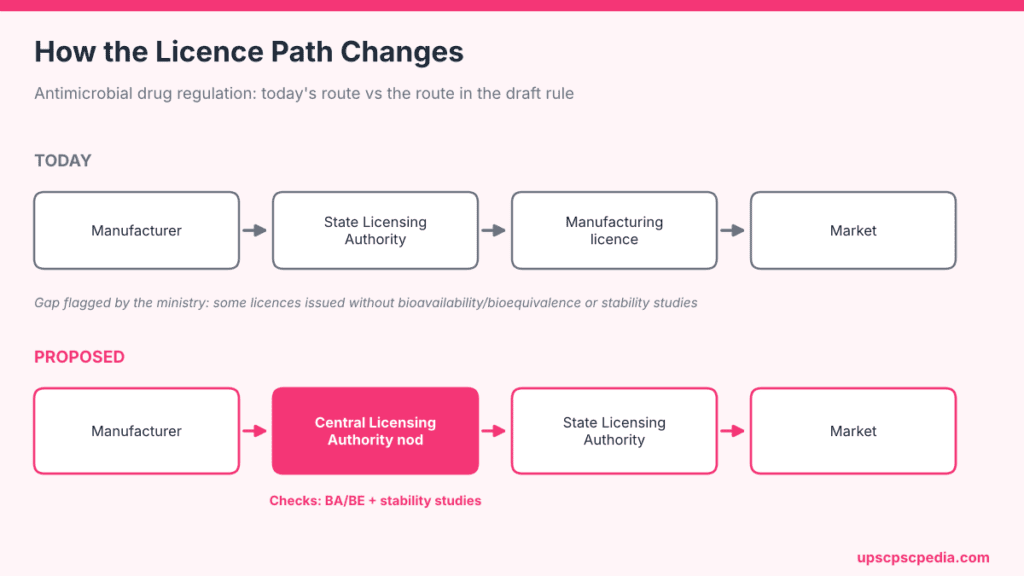
In short, the Centre checks the science, and the state still issues the licence. The table below shows the shift.
| Point | Current practice | Under the draft |
|---|---|---|
| First approval | State Licensing Authority | Central Licensing Authority |
| Legal category | Regular formulation | “New drug” |
| BA/BE and stability studies | Not always checked, says the ministry | Checked at the central level |
| Manufacturing licence | State | Still the state |
| Inspections and enforcement | State | Still the state |
This two-step model keeps states in the picture. However, it adds one common national filter before any antimicrobial reaches a factory line.
Why It Matters
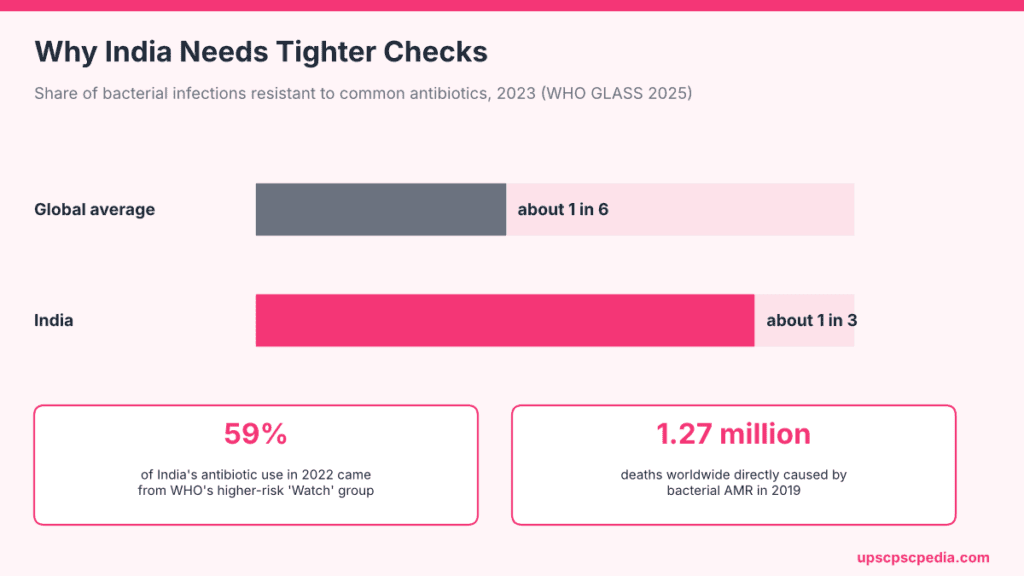
The numbers explain the urgency. According to WHO’s GLASS 2025 report, about one in three bacterial infections in India resisted common antibiotics in 2023. The global figure stood at about one in six, as Drishti IAS summarised.
- Bacterial AMR directly caused 1.27 million deaths worldwide in 2019.
- In 2022, 59% of India’s antibiotic use came from WHO’s “Watch” group, which carries a higher resistance risk.
- Union Health Minister J P Nadda launched NAP-AMR 2.0 (2025–29) on 18 November 2025, as Down To Earth reported. It gives each key ministry its own plan and budget.
Trust also matters beyond hospitals. India’s export push, visible in its record October 2026 exports, depends on buyers trusting what the country ships. Uniform quality checks on medicines can only help that reputation.
Challenges and Concerns
Policy analysts point to several hurdles for the new antimicrobial drug regulation:
- Uneven capacity: Some states have far fewer drug inspectors and testing labs than others.
- Possible delays: An extra central step could slow approvals if the regulator lacks staff.
- Cost for small firms: Small manufacturers may struggle to pay for BA/BE and stability studies.
- Shortage risk: If many small firms exit, some essential antibiotics could run short.
- Limited reach: The rule fixes quality, not misuse. It does not touch over-the-counter sales, careless prescribing or antibiotic use in farm animals.
A Balanced View
Supporters call this a long-overdue fix. One national standard means a patient in Bihar and a patient in Kerala get antibiotics tested to the same bar. It also closes a gap the ministry itself has admitted.
Critics rarely oppose the goal. Instead, they question delivery. Central approval works only when the regulator has enough people, labs and digital systems. Drugs fall under the Concurrent List, so the Centre and states share this space. Because the draft leaves licensing and enforcement with states, it may ease federal worries.
Finally, no single rule can beat AMR. The fight follows a “One Health” approach that links human, animal and environmental health. That same joined-up thinking shows up in global talks such as COP31 in Antalya.
What Happens Next?
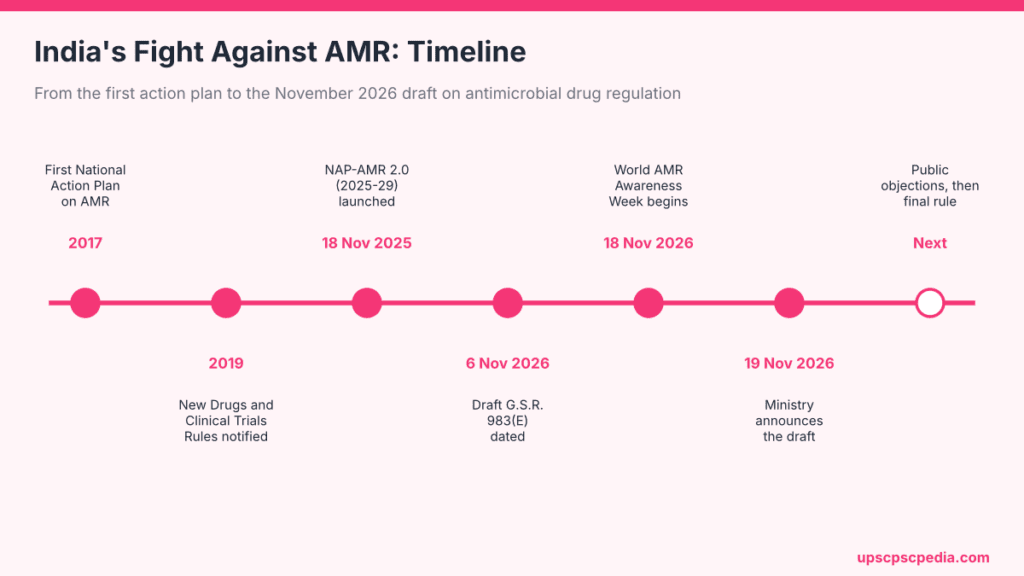
The draft now enters a consultation stage. Here is the likely path:
- Stakeholders send objections and suggestions to the ministry.
- The ministry reviews them and may revise the text.
- The Centre issues a final notification with a start date.
- Regulators then decide how to handle antimicrobials already on the market.
Watch also for funding of state drug labs. Without it, the new antimicrobial drug regulation could look strong on paper but move slowly on the ground.
Conclusion
India has a serious AMR problem, and bad medicine makes it worse. The draft puts a central quality gate in front of every new antimicrobial licence. At the same time, it leaves states in charge of the factory floor. Backed by labs, staff and quick digital approvals, antimicrobial drug regulation could become one of India’s quieter but most important health reforms.
What do you think? Should the Centre control approvals for all antimicrobials, or should states keep more power? Share your view in the comments below. 👇


Pingback: Packaged Drinking Water Safety: What the Bisleri Case Means for You - upscpscpedia.com
Pingback: SAMPADA Survey: What India's New Anaemia and B12 Data Reveals - upscpscpedia.com
Pingback: Front-of-Pack Warning Labels: What the Supreme Court Ordered and Why It Matters - upscpscpedia.com
Pingback: Ebola Outbreak in Congo: Why 12,000 Cases Have Alarmed the World - upscpscpedia.com