
“Neighbours cannot pick each other, but they can pick how they talk.” That is the real test of the Nepal PM India visit, which begins in New Delhi on 22 November 2026.
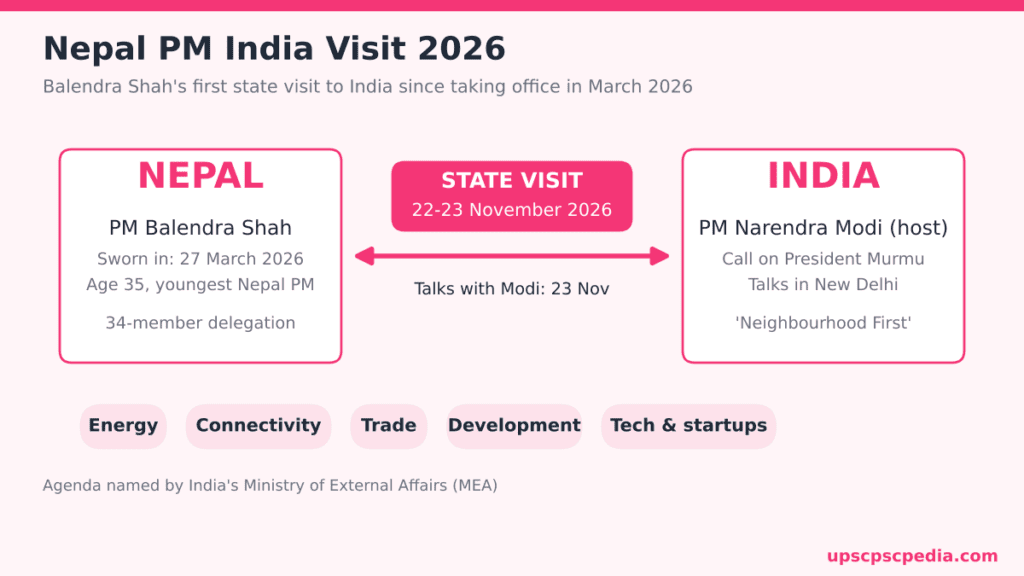
Nepal’s Prime Minister Balendra Shah lands in India today for a two-day state visit. It is his first trip to India since he took office in March 2026. He comes at the invitation of Prime Minister Narendra Modi, with a 34-member delegation.
Why does this matter now? Shah rode a youth wave to power. Just months ago, his remarks on the border dispute caused a chill in New Delhi. So this visit is about more than handshakes. It is a reset moment for two countries that share an open border and deep family ties.
For exam aspirants, the Nepal PM India visit also links many topics at once: neighbourhood policy, energy trade, connectivity and boundary disputes. Let us break it down.
What Happened?
On 20 November, India’s Ministry of External Affairs (MEA) announced the state visit for 22-23 November. MEA spokesperson Randhir Jaiswal said Shah will receive all state honours. He also called it “a very important visit for us,” as The Tribune reported.
Here is the plan, based on official briefings and media reports:
- 22 November: Shah arrives in New Delhi. External Affairs Minister S. Jaishankar is set to call on him.
- 23 November: Delegation-level talks with PM Modi, a joint press conference and a lunch that Modi will host.
- Both leaders plan to jointly inaugurate energy projects and exchange bilateral agreements, according to Business Standard, citing PTI.
- Shah will also call on President Droupadi Murmu, pay tribute at Rajghat and attend a Nepal-India Business Forum.
- Reports say the two leaders may flag off the Ayodhya-Janakpur Express.
The officials have not yet named the projects or the agreements. So we should wait for the joint statement before drawing big conclusions.
Who Is Balendra Shah?
Let’s simplify this. Shah is a former rapper and an ex-mayor of Kathmandu. He is 35, which makes him Nepal’s youngest Prime Minister.
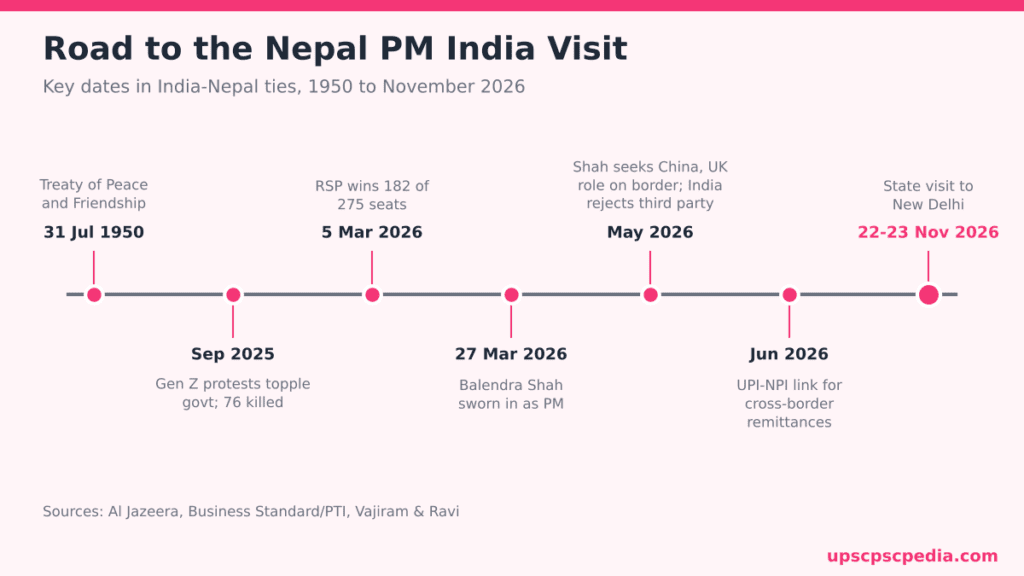
His rise came after a political earthquake. In September 2025, youth-led protests against corruption and joblessness toppled Nepal’s government. Seventy-six people died in that unrest. Shah did not take part directly, but he openly backed the protesters.
Then came the 5 March 2026 election. His Rastriya Swatantra Party (RSP) won 182 of the 275 seats, Al Jazeera reported. He took the oath on 27 March 2026. We covered the youth movement in detail in our post on India–Nepal relations after the Gen Z revolution.
| Date | Event |
|---|---|
| 31 July 1950 | India and Nepal sign the Treaty of Peace and Friendship |
| September 2025 | Gen Z protests topple Nepal’s government |
| 5 March 2026 | RSP wins 182 of 275 seats |
| 27 March 2026 | Balendra Shah becomes Prime Minister |
| May 2026 | Shah seeks a China and UK role on the border; India rejects it |
| June 2026 | UPI-NPI link starts for cross-border remittances |
| 22-23 November 2026 | Shah’s state visit to India |
Why the Nepal PM India Visit Matters
Think of it like two houses that share a courtyard. Each family runs its own home, but they share the water, the power and the main gate. When one side stops talking, both feel the strain.
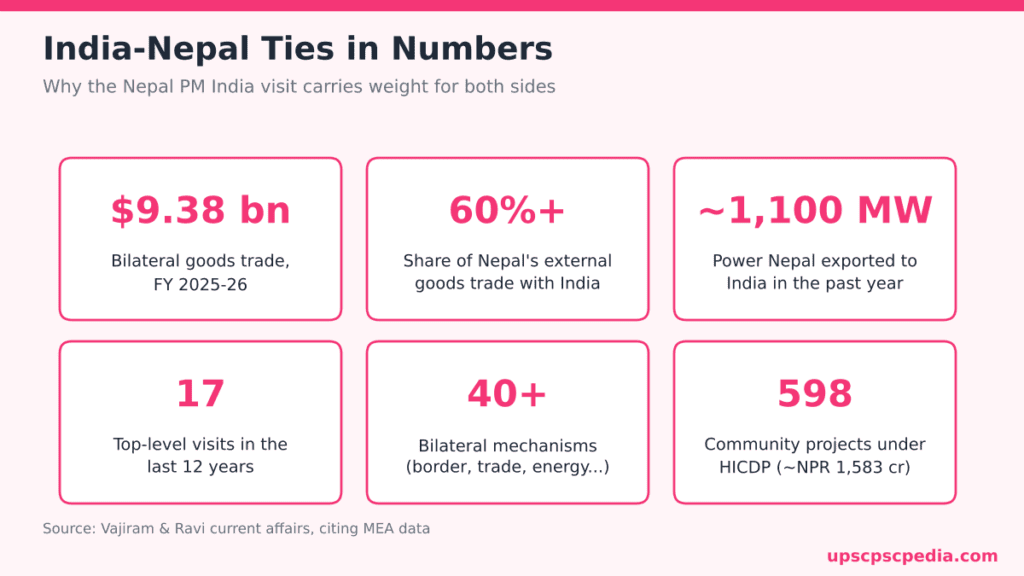
The numbers show how close the ties run:
- Trade: Bilateral goods trade reached about $9.38 billion in FY 2025-26. That is over 60% of Nepal’s external goods trade.
- Power: Nepal exported about 1,100 MW of electricity to India last year. It also sent power to Bangladesh through the Indian grid.
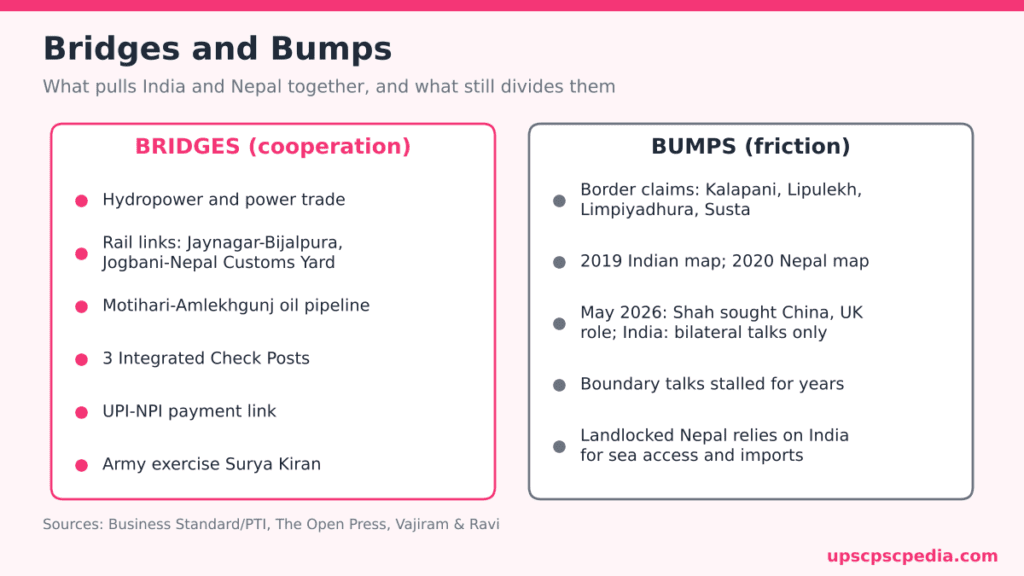
- Connectivity: Rail links such as Jaynagar-Bijalpura, three Integrated Check Posts and the Motihari-Amlekhgunj oil pipeline already work.
- Money: The UPI-NPI linkage, launched in June 2026, lets people send money across the border directly.
- People: India offers about 1,500 scholarships to Nepali students every year.
Moreover, Nepal is landlocked. Its sea access runs through India. That makes steady ties vital for Kathmandu. For India, a stable Nepal secures its Himalayan flank. It also fits the “Neighbourhood First” approach, much like India’s outreach at the ASEAN-India Summit 2026.
Challenges and Concerns
However, the relationship carries old scars.
- Border dispute: Nepal claims Kalapani, Lipulekh and Limpiyadhura. India says these areas belong to Uttarakhand. Susta is another disputed patch.
- Map row: India published a political map in November 2019. Nepal’s Parliament endorsed a revised map in 2020 that includes the three areas.
- The May 2026 remark: Shah sought China and the UK’s involvement in the border issue. Within days, New Delhi rejected any third-party role and pointed to existing bilateral mechanisms.
- Stalled talks: Boundary dialogue has stayed frozen for years.
- The China factor: Nepal also balances ties with Beijing. Any tilt draws close attention in New Delhi.
A Balanced View
Both sides have reasons to hope and reasons to stay cautious.
On the positive side, the two countries already run more than 40 bilateral mechanisms. They have held 17 top-level visits in the last 12 years. Energy trade keeps growing, and new areas like startups, technology and cricket add fresh links.
On the other hand, Shah’s voters expect him to stand firm on sovereignty. A young leader with a reformist image cannot look soft at home. Meanwhile, India wants clear signals that Kathmandu will keep border talks strictly bilateral.
So the smart reading of the Nepal PM India visit is this: progress on power, rail and trade is likely. A breakthrough on the boundary is not.
What Happens Next?
Watch for these outcomes of the Nepal PM India visit after the talks on 23 November:
- The names and capacity of the energy projects that the two leaders inaugurate.
- The list of agreements the two sides exchange.
- Any line on the boundary issue in the joint statement.
- Fresh steps on rail links, such as the Ayodhya-Janakpur Express.
India has used similar high-level meetings to push practical deals, as seen in the recent India-Japan 2+2 dialogue.
Conclusion
The Nepal PM India visit is a chance to move from awkward headlines to practical gains. Power lines, rail tracks and digital payments already bind the two nations. The border question remains the hard knot. Still, a warm first visit can build the trust that tough talks will need later.
In short, this Nepal PM India visit tests whether a new generation of leadership in Kathmandu can work closely with New Delhi without giving up its own voice.
What do you think? Can India and Nepal grow energy and trade ties while the border dispute stays unresolved? Share your view in the comments below. 👇


