
“Markets climb on stories and fall on doubts.” On Friday, 20 November 2026, doubt won, and the AI stock sell-off turned into a rout across Wall Street.
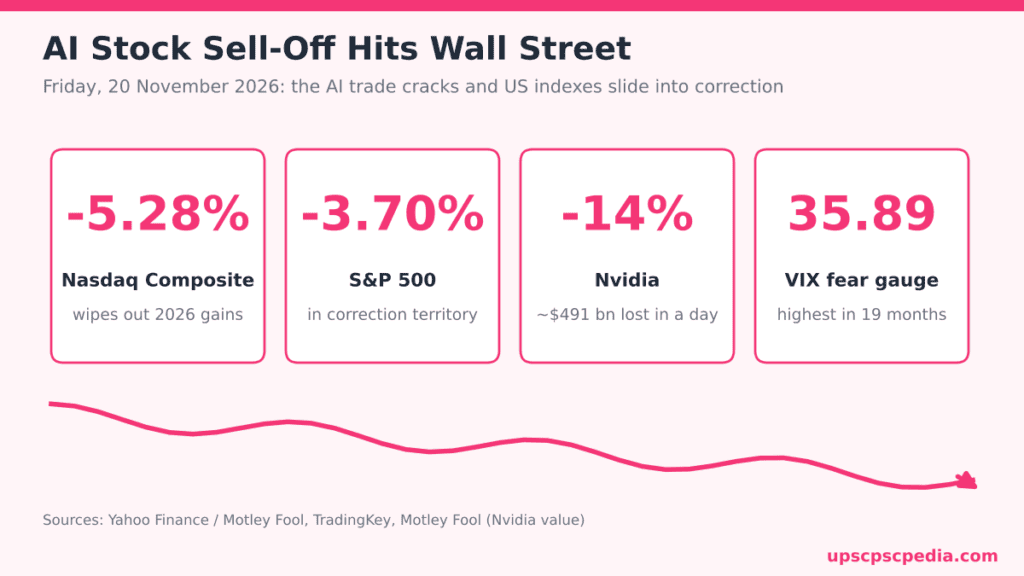
The Nasdaq Composite crashed 5.28% in a single session. The S&P 500 fell 3.70% and slipped into what traders call a correction. Nvidia, the poster child of the artificial intelligence boom, lost about 14% of its value in one day.
Why should an Indian aspirant care? Because money moves across borders in seconds. A shock in New York can hit tech jobs, foreign investment and the rupee back home. The AI stock sell-off also raises a bigger question: is the AI boom a lasting shift or a bubble?
What Happened?

Wall Street had a brutal Friday. Here are the closing numbers, as Yahoo Finance reported, carrying Motley Fool data:
- Nasdaq Composite: down 5.28% to 22,617.73. It erased all its gains for 2026.
- S&P 500: down 3.70% to 6,910.39. That marked its seventh straight losing day.
- Dow Jones: down 1.93% to 48,147.33.
- VIX “fear gauge”: jumped to 35.89.
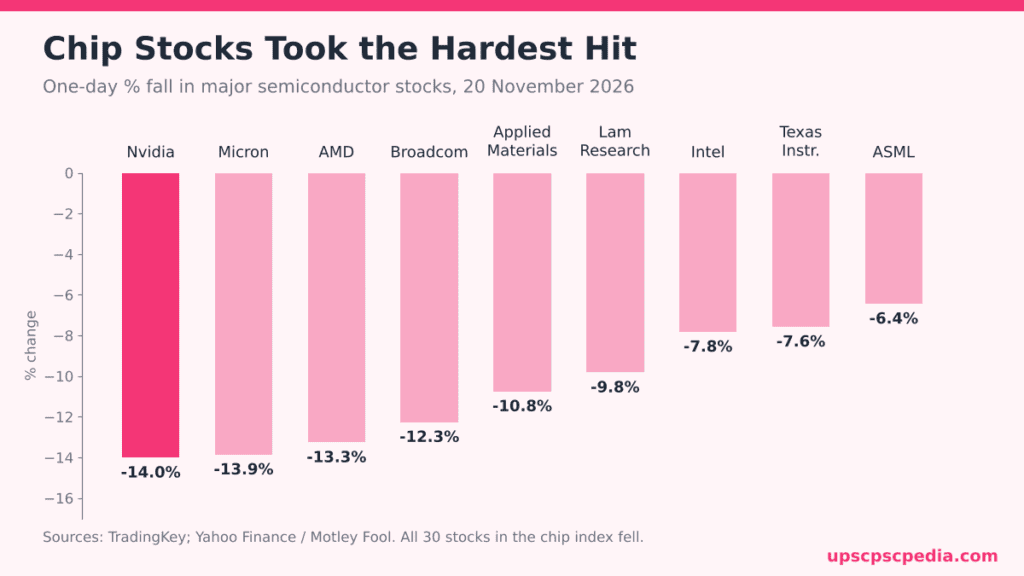
Chip stocks took the hardest hit. The Philadelphia Semiconductor Index dropped 10.73%, and all 30 of its stocks fell, according to TradingKey. Micron fell nearly 14%, AMD over 13% and Broadcom over 12%.
Nvidia closed at about $125.53. It shed roughly $491 billion in market value in one day, Motley Fool estimated. The stock now trades about 48% below its record close of 6 October.
What Is a Market Correction?
Let’s simplify this. A correction means an index has fallen at least 10% from its recent peak. Traders usually call a fall of 20% or more a bear market.
Think of it like a crowded hill station during holiday season. Prices for hotels keep rising as more tourists arrive. Then one bad news report about landslides spreads. Suddenly, everyone wants to leave at once, and prices crash. Stock markets work the same way. When many investors share one exciting story, a single doubt can send them all rushing for the exit.
On Friday, the Nasdaq 100 briefly fell more than 20% below its 6 October high during the day. It closed just short of that line, with a 19.84% drop.
What Triggered the AI Stock Sell-Off?

No single event caused this fall. Instead, several worries piled up over a few weeks.
| Date (2026) | Event |
|---|---|
| 6 October | Nvidia and the Nasdaq 100 hit record closing highs |
| 11 November | Jensen Huang resigns as Nvidia CEO |
| 17 November | The Wall Street Journal reports an SEC investigation into Nvidia |
| 17 November | Nvidia posts strong quarterly results, but the slide continues |
| 19 November | Anthropic shares debut on the stock market |
| 20 November | Reuters reports the SEC is reviewing possible accounting issues; markets plunge |
Here are the main pressure points, based on media reports:
- Leadership shock: Co-founder Jensen Huang quit on 11 November amid reports about his personal relationships. We explained the leadership debate in our post on the glass cliff effect and the Nvidia CEO row.
- SEC probe reports: Reuters, citing two people familiar with the matter, said SEC staff are looking at possible accounting issues. No regulator has alleged wrongdoing. The SEC declined to comment.
- Financing worries: Nvidia’s guarantees for customers stood at $118 billion at quarter-end, Motley Fool reported. Critics question such “circular” funding in the AI sector.
- Rival chip plans: South Korean media reported that Google wants to buy high-bandwidth memory directly for its own AI chips.
- Fresh listings: Anthropic’s shares gave back most of their first-day gains on day two.
- Geopolitics: Uncertainty over US policy on Iran added to the nervous mood.
Why the AI Stock Sell-Off Matters
First, AI stocks now carry huge weight in US indexes. So when they fall, retirement savings and pension funds feel it too.
Second, the fall spread beyond tech. Bitcoin dropped about 4.6%, and gold also slipped. Meanwhile, money moved into safer areas such as energy, utilities and consumer staples.
Third, it matters for India. Global investors often pull money from emerging markets when fear rises. That can weigh on Indian shares and the rupee, a link we explored in Rupee Falling Amid Global War. Indian IT firms also depend heavily on US tech spending.
A Balanced View
There are two ways to read this AI stock sell-off.
The worried view: Prices ran far ahead of profits. Leadership turmoil, a regulatory cloud and complex financing deals suggest deeper cracks. For many, this brings back memories of the dot-com bust of 2000.
The calmer view: Nvidia’s business still looks strong on paper. Its revenue rose 103% to $115.8 billion last quarter, Motley Fool noted. Also, an SEC investigation does not mean a company broke the law. Many probes end without any charges.
The truth likely sits in between. AI demand looks real, but investors are now asking harder questions about prices, governance and accounting.
What Happens Next?
Watch these signals in the coming weeks:
- Any official word from the SEC or Nvidia on the reported probe.
- Whether the Nasdaq slips into a full bear market.
- How big tech firms talk about AI spending plans for 2027.
- Moves by the US Federal Reserve, since market stress can shape rate decisions.
- Foreign investor flows into India and other emerging markets.
Conclusion
The AI stock sell-off shows how fast confidence can turn into fear. One week, AI looked unstoppable. The next, the biggest chipmaker lost hundreds of billions in value. Even so, one bad week does not end a technology shift. It simply reminds investors that no story, however exciting, can ignore basics like governance and earnings.
For students of the economy, this AI stock sell-off offers a live lesson in bubbles, regulation and global contagion.
What do you think? Is the AI boom a bubble that has started to burst, or just a healthy pause? Share your view in the comments below. 👇


