
“You buy bottled water so you can stop worrying. This week, the worry came back.”
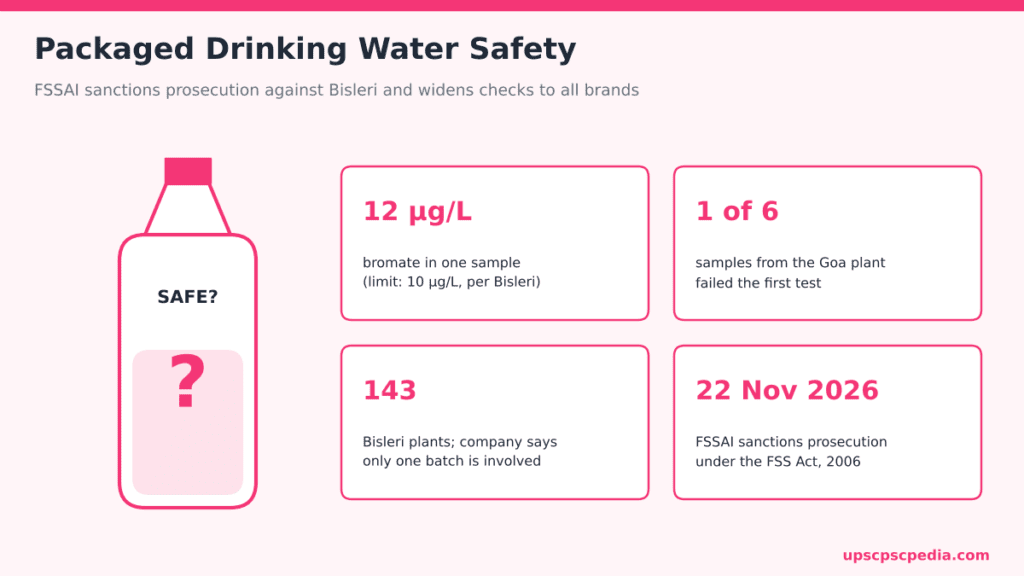
That is why packaged drinking water safety has suddenly become a national talking point. On 22 November 2026, the Food Safety and Standards Authority of India (FSSAI) sanctioned prosecution against Bisleri International, the country’s best-known bottled water brand, over one sample it called “unsafe”.
A day later, the regulator widened its net. Reports said FSSAI had started collecting and testing samples from other packaged water brands across India. Bisleri, for its part, insists its water is safe and that the problem involved one old batch.
So who is right, and should you worry about the bottle in your bag? Let’s walk through the facts.
What Happened?

FSSAI announced the action on Sunday, 22 November, under the Food Safety and Standards Act, 2006. According to Business Standard, a sample from Bisleri’s premises failed the bromate limit in the first test. After Bisleri appealed, a referral laboratory also called the sample unsafe. This time, it cited polynuclear aromatic hydrocarbons (PAHs).
Bisleri’s own account, reported by Free Press Journal, adds more detail:
- FSSAI took six samples from its Goa plant on 30 September 2025.
- Five samples met every standard.
- One showed bromate at 12 micrograms per litre, against a limit of 10.
- The referral lab found bromate within limits but flagged PAHs.
- An independent FSSAI-approved lab also found bromate within limits, the company says.
Bisleri says the issue concerns one September 2025 batch from Goa, one of its 143 plants. It also says it never received an official notice. The company thought the matter had closed after it sent its own test results in February 2026.
| Date | What happened |
|---|---|
| 30 Sep 2025 | FSSAI collects six samples from Bisleri’s Goa facility |
| 22 Nov 2025 | Bisleri files an appeal (as per the company) |
| 2 Feb 2026 | Bisleri sends independent test results to FSSAI’s western office |
| 22 Nov 2026 | FSSAI sanctions prosecution under the FSS Act, 2006 |
| 23 Nov 2026 | Reports say FSSAI is testing other brands nationwide |
What Are Bromate and PAHs?
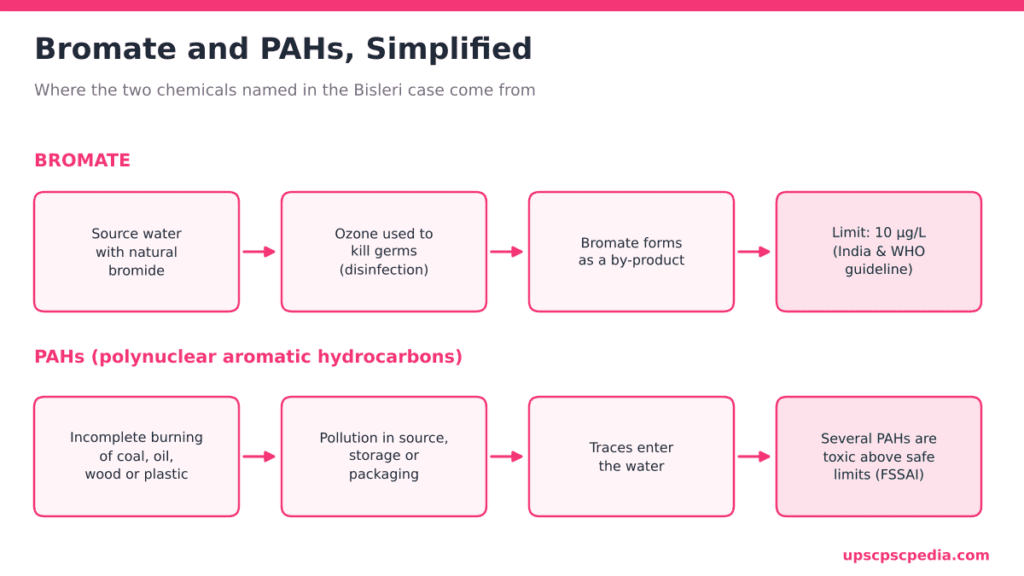
Let’s simplify this.
Bromate forms when water that naturally contains bromide meets ozone. Many bottlers use ozone to kill germs. So the very step that makes water germ-free can also create a little bromate. India’s limit, like the WHO guideline, is 10 micrograms per litre, because long-term exposure at high levels may raise cancer risk.
PAHs are a family of chemicals that form when coal, oil, wood or plastic burn incompletely. FSSAI noted that several PAHs can turn toxic above safe limits. They can reach water through polluted sources, poor storage or packaging.
Think of it like a pressure cooker. It makes rice soft and safe, but leave it on too long and the bottom burns. Ozone works the same way: the right dose cleans the water, while too much leaves an unwanted by-product.
Why Packaged Drinking Water Safety Matters
Millions of Indians drink bottled water every day, on trains, at weddings, in offices and in hospitals. Many city families with poor tap supply depend on 20-litre jars. For them, packaged drinking water safety is not a lifestyle issue. It is a basic health need.
The case also tests the regulator. FSSAI has stepped up enforcement in recent weeks. In the same announcement, it suspended two licences and ordered action against spice and food firms over pesticide residues and other failures. Much like India’s push for tighter antimicrobial drug regulation, the message is simple: big brands get no free pass.
Here is what the wider probe could mean:
- For consumers: more confidence, if FSSAI runs open tests and publishes results.
- For brands: pressure to tighten ozone control, source checks and storage.
- For small bottlers: a tougher squeeze, since many regional units lack advanced labs.
Challenges and Concerns
The case raises fair questions on both sides.
First, the two labs did not flag the same problem. The first test pointed to bromate, while the referral lab pointed to PAHs. Critics may ask why the final ruling rests on a chemical the first lab did not report.
Second, there is the timeline. More than a year passed between sampling and prosecution. A batch made in September 2025 has almost certainly left shop shelves. An unnamed government source told Republic World that authorities recalled the affected batches and that later tests found no further concerns.
Third, communication. Bisleri says no official notice reached it. If that is correct, it points to a gap in how the regulator informs companies.
Finally, India has a huge informal water market. Fake or unlicensed bottlers often worry experts more than big brands do. A crackdown that only catches famous names would miss the bigger risk, just as patchy enforcement lets public safety failures like stampedes repeat.
A Balanced View

FSSAI’s case rests on lab reports under the law. The regulator has a duty to act when a sample fails, whoever made it. At the same time, Bisleri has every right to defend itself in court. The company says it runs over 90 tests across a 10-step process.
Nobody has shown that Bisleri water on shelves today is unsafe. The finding covers one sample from one batch. Still, a single failed sample can point to a process weakness worth fixing. Good packaged drinking water safety needs both strict regulators and careful companies, and both things can be true at once.
What Happens Next?
Several steps now lie ahead:
- Court proceedings under the FSS Act, where both sides will present lab evidence.
- Results from FSSAI’s nationwide testing of other packaged water brands.
- Possible recalls or licence action if more samples fail.
- A likely debate on publishing test results so buyers can compare brands.
Reports suggest the scrutiny could reach big names such as Kinley and Aquafina, along with regional brands. This nationwide probe is a real test of packaged drinking water safety rules. Watch whether FSSAI shares the results publicly.
Conclusion
The Bisleri case is less about one company and more about trust. Packaged drinking water safety depends on clean sources, careful treatment and honest testing. It also depends on a regulator that acts quickly and explains itself clearly.
For now, calm caution makes sense. Buy sealed bottles that show an FSSAI licence number and the BIS mark, keep them out of direct sunlight, and follow official updates.
What do you think? Should FSSAI publish brand-wise test results to improve packaged drinking water safety? Share your view in the comments below. 👇


