

“Old friends rarely need a reason to meet. This time, the world handed them several.”
The fourth India-Japan 2+2 dialogue opens in Tokyo on 19 November 2026, with the foreign and defence ministers of both countries at one table. Defence Minister Rajnath Singh and External Affairs Minister S. Jaishankar meet Japan’s Defence Minister Shinjiro Koizumi and Foreign Minister Toshimitsu Motegi.
The timing stands out. The talks come just two days after the Quad leaders met in Manila. On the same day, US President Donald Trump meets Chinese President Xi Jinping in Shenzhen. According to Business Standard, both New Delhi and Tokyo are watching that meeting closely.
So this is not a routine catch-up. Both countries want to know who they can rely on as old rules weaken and supply chains wobble.
What Happened?

The two Indian ministers reached Tokyo on 18 November. Rajnath Singh received a Guard of Honour at Japan’s Ministry of Defence. He then toured JS Natori, a Mogami-class frigate, at Yokosuka, ThePrint reported.
Jaishankar, meanwhile, met former Prime Minister Fumio Kishida. Kishida now chairs the Japan-India Association, a body that dates back to 1903. Later, Jaishankar spoke at the Raisina Tokyo forum.
The main meeting takes place on 19 November. Around it, the ministers have lined up several other talks:
- A Singh–Koizumi bilateral meeting, their third this year after New Delhi (August) and Cebu (October).
- The 19th India-Japan Foreign Ministers’ Strategic Dialogue between Jaishankar and Motegi.
- A review of decisions from the 15th annual summit (August 2025) and the 16th (July 2026).
What Is a 2+2 Dialogue?
Let’s simplify this. A 2+2 format brings two ministers from each side into one room: foreign affairs and defence. Diplomats and defence planners hear the same message at the same time. As a result, decisions do not stall between two ministries.
Think of it like a family meeting where both the person who manages the money and the person who guards the house attend. Nobody has to “check with the other side” later, so plans move faster.
India holds such talks with only a handful of close partners, including the US, Japan, Australia and Russia. Here is how the India-Japan 2+2 dialogue has grown, based on Japan’s Foreign Ministry records and news reports:
| Round | Date | Venue | Key takeaway |
|---|---|---|---|
| 1st | 30 November 2019 | New Delhi | Format launched at ministerial level |
| 2nd | 8 September 2022 | Tokyo | Talks continued in Japan |
| 3rd | 20 August 2024 | New Delhi | Agreed to update the 2008 security declaration; progress on UNICORN transfer |
| 4th | 19 November 2026 | Tokyo | Defence technology, maritime security, economic security |
Why the India-Japan 2+2 Dialogue Matters Now

Jaishankar set the tone a day earlier. Speaking in Tokyo, he described five shifts in today’s world, as Business Standard reported:
- Countries now use energy, market access, technology and finance as weapons.
- Rules and norms are wearing away quickly.
- Fierce competition pushes players to take bigger risks.
- Nations want to reduce dependence on any single supplier.
- Trusted partners and shorter supply chains offer the way out.
He also called economic security “probably the overriding priority today for both countries.”
For India, Japan fits this picture well. Japan brings capital and advanced technology. India brings scale, skilled workers and a huge market. In August 2025, the two sides adopted a new Joint Declaration on Security Cooperation. Japan also set a goal of about 10 trillion yen (roughly $67 billion, as The Tribune reported) in private investment in India over ten years.
The meeting also connects to India’s wider outreach in the region. Our recent explainer on the ASEAN-India Summit 2026 shows how New Delhi is building ties across Southeast Asia at the same time.
What Is on the Table?
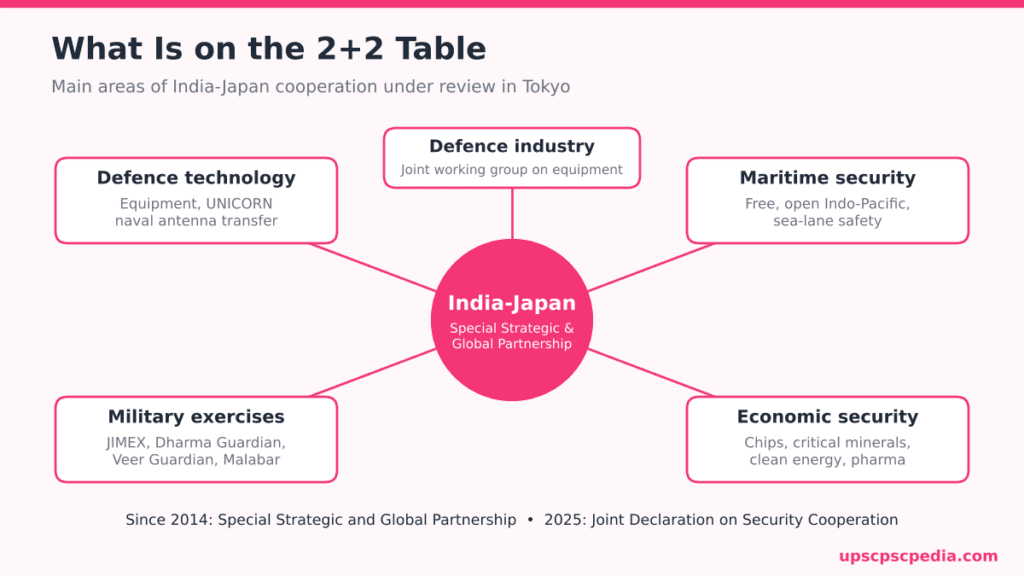
Officials from both sides have pointed to five broad areas:
- Defence technology: joint work on equipment, including the transfer of UNICORN, a Japanese naval antenna system.
- Maritime security: keeping sea lanes in the Indo-Pacific free and open.
- Military exercises: drills such as JIMEX (navies), Dharma Guardian (armies) and Veer Guardian (air forces), plus the multilateral Malabar exercise.
- Defence industry: a joint working group that links companies on equipment and technology.
- Economic security: semiconductors, critical minerals, clean energy and pharmaceuticals, areas Jaishankar named in his speech.
Challenges and Concerns
Still, the road has bumps. First, defence trade between the two countries remains modest. Long talks on Japan’s US-2 amphibious aircraft never turned into a deal.
Second, Japan relaxed its strict limits on arms exports only in recent years. Joint projects therefore move slowly.
Third, the US-China equation is shifting. If Washington and Beijing reach a broad deal, Tokyo and New Delhi may need to recalibrate. We covered that wider picture in our post on the Trump Xi Putin summit.
Finally, India guards its strategic autonomy. It keeps close ties with Russia and avoids formal alliances, which limits how far any security partnership can go.
A Balanced View
Supporters see the India-Japan 2+2 dialogue as a steady pillar in an unsteady region. Two democracies with no border dispute and no clash of interests can plan for the long term.
Sceptics, however, point out that these meetings often produce more statements than ships or factories. They argue that investment pledges and defence projects need faster delivery.
Both views hold some truth. The real test lies in what follows the joint statement, not the statement itself.
What Happens Next?
- Both sides usually release a joint statement after each India-Japan 2+2 dialogue. Expect one after the 19 November meeting.
- Watch for any new defence-technology projects, supply-chain agreements or expanded exercise plans.
- The outcomes will feed into the next annual summit between the two prime ministers.
Conclusion
The fourth India-Japan 2+2 dialogue arrives at a moment when trust has become a scarce resource. India and Japan have few quarrels and many shared worries. That makes them natural partners in a world that feels less predictable each month.
Yet friendship alone will not build frigates, chip plants or secure supply chains. Delivery will decide whether this partnership grows from warm words into hard results.
What do you think? Should India deepen defence ties with Japan, or keep its options more open? Share your view in the comments below. 👇


Pingback: Nepal PM India Visit: What Balendra Shah's First State Trip Means for Ties - upscpscpedia.com