
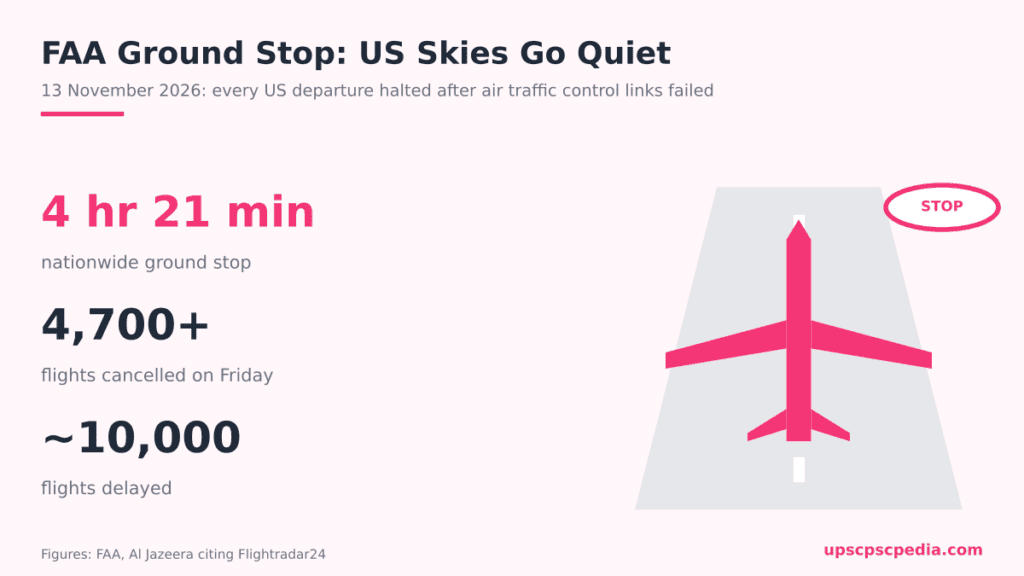
“The world’s busiest sky went quiet, and no enemy fired a single shot.” That is the strange story of the FAA ground stop that froze air travel across the United States on 13 November 2026.
For more than four hours, not one commercial flight could take off from a US airport. Planes already in the air landed. Everyone else waited at the gate.
The cause was not a storm or an attack. Officials blamed old, overloaded communication equipment inside the air traffic control network. In other words, the world’s largest aviation system tripped over its own wires.
Why should a reader in India care? Because the same problem, ageing tech running critical systems, can hit any country. Let’s understand what went wrong.
What Happened?
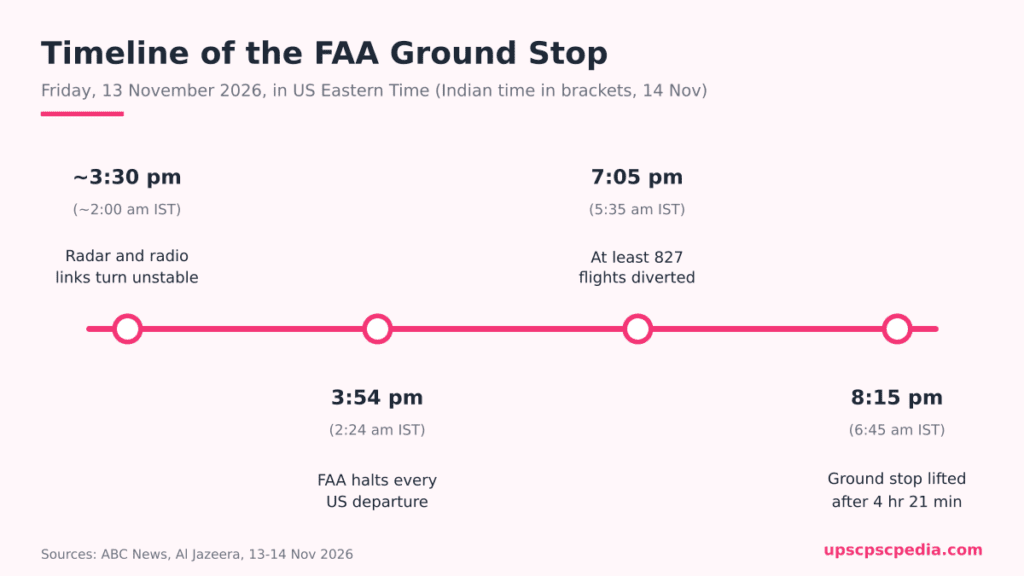
On Friday afternoon, 13 November, controllers began to see unstable radar and radio signals. The Federal Aviation Administration (FAA) then ordered a nationwide ground stop. It covered every US airport, as the FAA’s own statement confirmed.
Here is how the evening unfolded (US Eastern Time, with Indian time alongside):
| Time (ET, 13 Nov) | Time (IST, 14 Nov) | Event |
|---|---|---|
| Shortly after 3:30 pm | About 2:00 am | Radar and radio links start to wobble |
| 3:54 pm | 2:24 am | FAA halts all departures nationwide |
| 7:05 pm | 5:35 am | At least 827 flights diverted |
| 8:15 pm | 6:45 am | FAA lifts the ground stop |
The FAA ground stop lasted about 4 hours and 21 minutes. According to Al Jazeera, it was the longest ground stop in 25 years.
What Is an FAA Ground Stop?
Let’s simplify this. A ground stop is an order that keeps planes on the ground at their departure airports. Controllers use it when they cannot safely handle more aircraft in the sky.
Usually, a ground stop covers one airport for a short time, often because of bad weather. A nationwide FAA ground stop is very rare. It shuts every departure in the country at once.
Think of it like a city traffic control room that suddenly loses its radios and camera feeds. The police cannot see or talk to the junctions. So they stop new cars from entering the roads until the screens come back. Cars already on the road finish their trips carefully.
That is exactly what the FAA did. About 3,500 planes were in the air when the order came, Transportation Secretary Sean Duffy said. All of them landed.
Why Did It Happen?
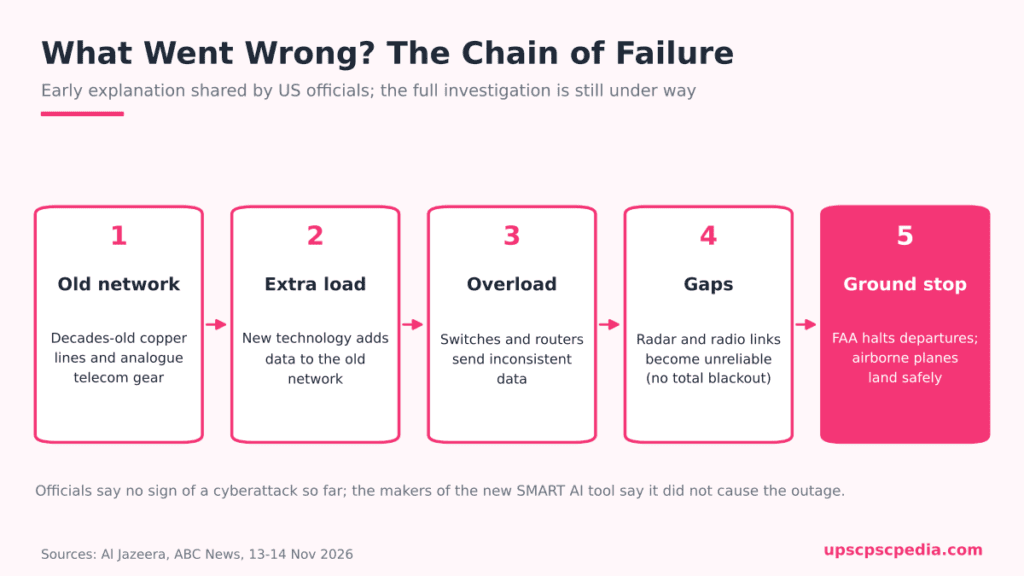
Investigators are still working out the full cause. However, officials have shared an early picture:
- Overloaded hardware: Duffy said switches and routers got overloaded with data and began sending inconsistent information.
- Old wiring: He pointed to copper telephone lines and analogue telecom gear that date back decades.
- New tech on old roads: Officials later admitted that new technology added to the network overloaded its older parts, as Al Jazeera reported.
- No total blackout: Radar and communications never failed completely. They became unreliable, and that was enough to stop flights.
What about a cyberattack? Homeland Security Secretary Markwayne Mullin said nothing pointed to one. Bloomberg, citing an official, reported that the FBI did not suspect criminal activity either.
Some questions also surround a new AI tool called SMART. The FAA had announced its expansion to all en-route centres on 10 November. Its maker, Air Space Intelligence, said the ground stop did not result from SMART. Duffy agreed, but Mullin said officials could not rule anything out yet. We looked at the wider debate on AI in our post on the Oracle layoffs and AI taking jobs.
How Big Was the Disruption?
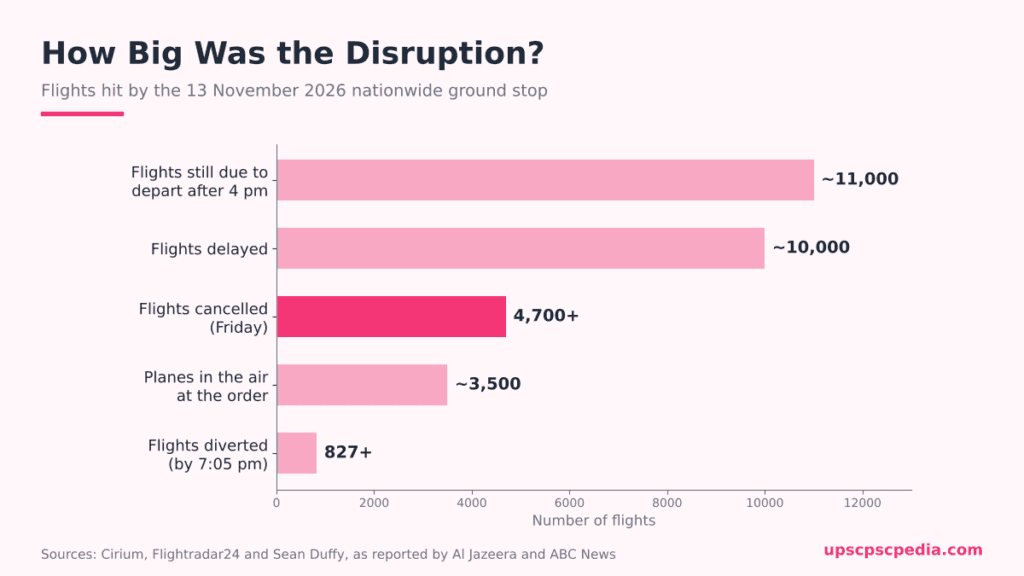
The numbers show the scale of the FAA ground stop:
- About 11,000 flights carrying over 1.5 million passengers were still due to leave after 4 pm, according to Cirium data cited by Al Jazeera.
- Flightradar24 counted more than 4,700 cancellations and about 10,000 delays on Friday.
- Airlines also cancelled around 700 Saturday flights in advance.
- Sports teams, from the NBA to college squads, saw their travel plans collapse.
International flights faced case-by-case decisions. Interestingly, Air India said its New York, Newark and San Francisco services ran on schedule.
Why the FAA Ground Stop Matters
This event is about more than one bad Friday. It raises three larger issues.
1. Ageing public infrastructure. A Government Accountability Office report in September 2026 had already warned about copper cables from the 1960s. The warning did not lead to fixes in time.
2. The cost of modernisation. Duffy called the situation an emergency. He has called for about $50 billion in air traffic control upgrades. Congress approved $12.5 billion last year, and the administration asked for $30.1 billion more on Friday, Al Jazeera reported.
3. Safety versus convenience. Experts broadly agree that grounding flights was the safe choice. Still, the episode shows how one weak link can freeze an entire economy’s movement.
A Balanced View
The government’s side is clear. Duffy said US airspace remains the safest in the world, and he insisted “it is safe to fly.” Officials stress that no plane faced danger and that every airborne flight landed safely.
Critics see a deeper failure. House Democratic leader Hakeem Jeffries called the outage an “unprecedented breakdown,” ABC News reported. Senator Tammy Duckworth demanded a full investigation. Aviation experts also asked why backup systems did not take over at once.
Both views hold some truth. The safety system worked as designed. But it should never have needed to.
What Happens Next?
Here is what to watch in the coming weeks:
- Investigation: The FAA and other agencies will try to pin down the exact cause, including any role of software updates.
- Congressional hearings: Senator Maria Cantwell said the Senate Commerce Committee will review the technology problems.
- Funding fight: Lawmakers must decide on the extra money for new radios, radar links and fibre lines.
- Thanksgiving test: Duffy expects normal operations before the holiday rush, which starts in under two weeks.
Meanwhile, other countries will study the episode closely. India’s own aviation boom depends on reliable control systems too. Our post on crowd safety and stampedes in India shows how quickly weak systems turn into crises.
Conclusion
The FAA ground stop did not cost a single life, and that matters. Controllers made a cautious call, and pilots brought thousands of planes down safely.
Yet the outage exposed a hard truth. Modern economies run on invisible networks, and many of those networks are older than the people who operate them. Fixing them costs money, but ignoring them costs more.
What do you think? Should governments treat old public infrastructure as a national security risk? Share your view in the comments below. 👇


