
Hunger shows on the plate. Hidden hunger shows only in the blood.
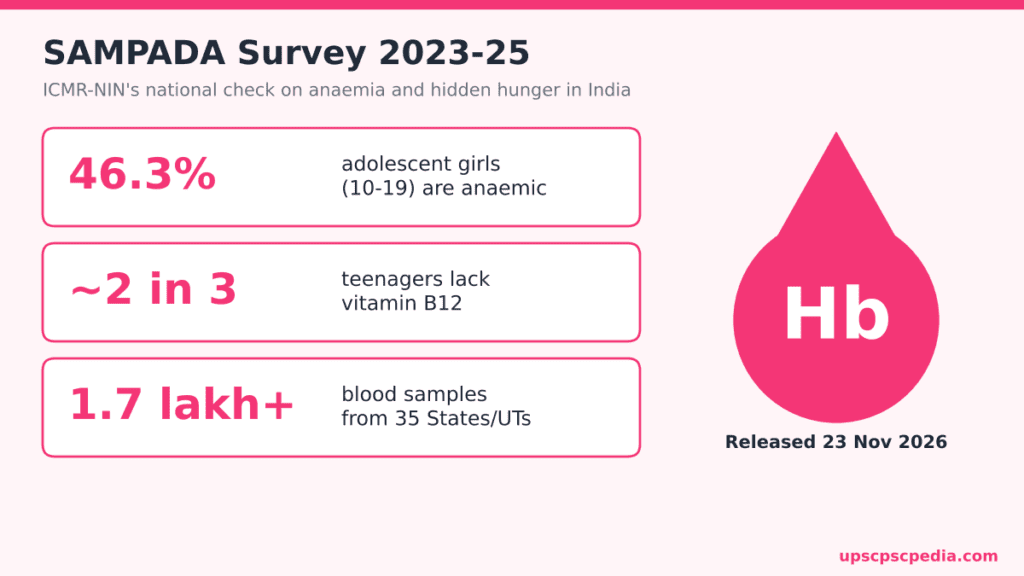
The new SAMPADA survey from ICMR’s National Institute of Nutrition has just put numbers on that hidden hunger. It finds that about two in three Indian teenagers lack enough vitamin B12, and nearly one in two adolescent girls is anaemic.
ICMR-NIN released the findings on 23 November 2026. Within a day, the numbers were on front pages and in political debates across the country. That alone tells you how much they matter.
Why now? India has run anaemia programmes for decades, yet the problem refuses to go away. Policymakers needed fresh, accurate data to see what is working. This survey gives them exactly that, and it also changes some old assumptions.
What Happened?
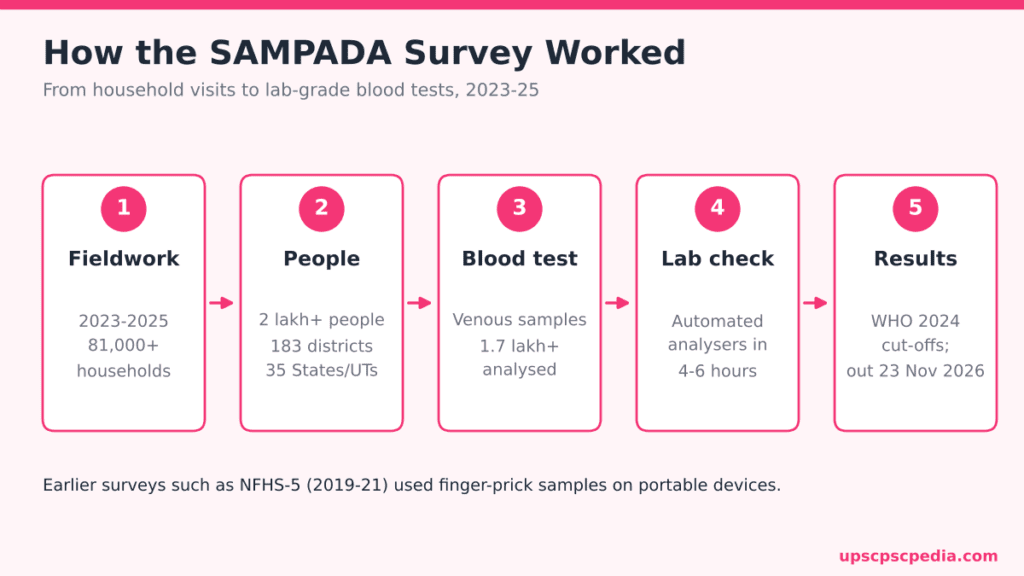
On 23 November, ICMR-NIN in Hyderabad published the first results of a huge nutrition study. Teams collected data between 2023 and 2025. The scale is striking:
- More than 2 lakh people surveyed
- 183 districts across 35 States and Union Territories
- Over 81,000 households visited
- More than 1.7 lakh blood samples analysed
The headline results came fast. According to The South First, 46.3% of girls aged 10-19 are anaemic. Among boys of the same age, the figure is 22.8%. Vitamin B12 deficiency, however, hits both sexes almost equally: 65.4% of girls and 66.1% of boys.
What Is the SAMPADA Survey?
Let’s simplify this. SAMPADA stands for Survey for Assessment of Markers of Population health, Activity, Diet, and Anthropometry. In plain words, it checks what Indians eat, how active they are, how their bodies measure up, and what their blood says.
What sets the SAMPADA survey apart is how it tested blood. Field teams drew venous blood, the kind taken from a vein in your arm. Automated lab machines then measured haemoglobin within four to six hours. Researchers also used the newer WHO 2024 cut-offs, which change by age, sex and pregnancy status.
Think of it like weighing gold. A roadside scale gives you a rough idea. A jeweller’s scale gives you the exact figure. Earlier big surveys, such as NFHS-5 (2019-21), used finger-prick (capillary) samples on portable devices. SAMPADA used the jeweller’s scale.
Key Numbers From the SAMPADA Survey

Here is a quick snapshot of the main findings, as reported by ETV Bharat and The South First:
| Group | Anaemia | Vitamin B12 deficiency |
|---|---|---|
| Children (12-59 months) | 41.8% | – |
| Children (5-9 years) | 31.3% | – |
| Adolescent girls (10-19) | 46.3% | 65.4% |
| Adolescent boys (10-19) | 22.8% | 66.1% |
| Women (15-49) | 55.9% | 57.4% |
| Pregnant women | – | 63.1% |
| Elderly women (60+) | 55.7% | – |
| Elderly men (60+) | 44.7% | – |
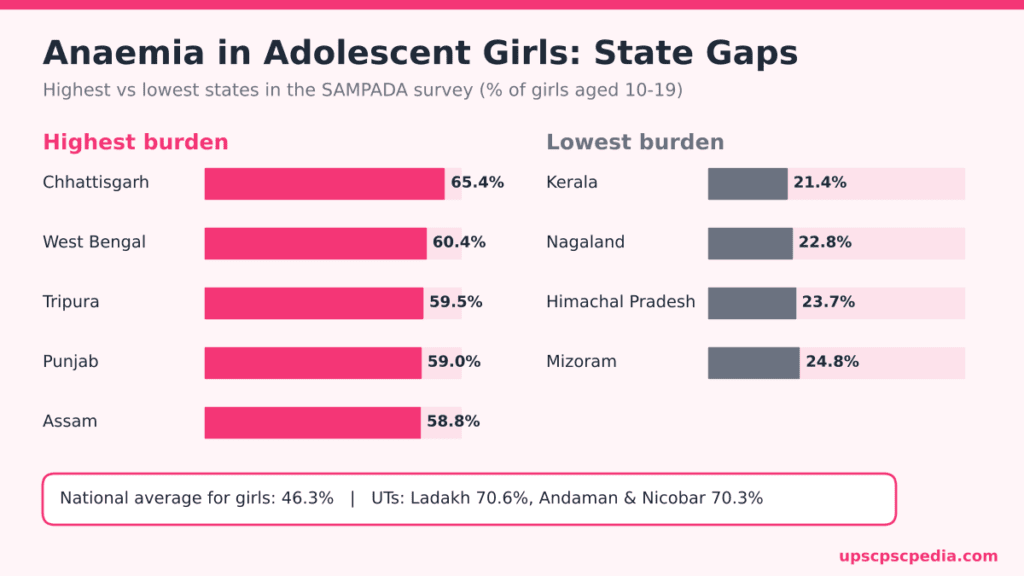
The state picture varies a lot. Among adolescent girls, Chhattisgarh (65.4%) and West Bengal (60.4%) top the list. Kerala sits at the other end with 21.4%. Ladakh (70.6%) and the Andaman and Nicobar Islands (70.3%) report the highest rates among UTs.
Why It Matters
First, the SAMPADA survey changes the story on anaemia’s causes. Iron deficiency explains roughly half of anaemia cases in women, girls and young children. Infections, inherited blood disorders and chronic inflammation make up much of the rest.
Second, B12 deficiency now looks like a separate, very large problem. The survey found B12 deficiency at similar levels in anaemic and non-anaemic people. So B12 shortage seems to add little to anaemia itself. Still, the body needs B12 for nerves, brain development and healthy pregnancies.
Third, the data helps target money better. Programmes such as Anaemia Mukt Bharat lean heavily on iron and folic acid tablets. Yet folate deficiency in girls stands at only 8.6%. Meanwhile, B12, which comes mainly from milk, eggs, fish and meat, gets far less attention.
Finally, girls carry a double burden. Their anaemia rate is twice that of boys, and 36.3% of them lack iron. That gap feeds into risky pregnancies later in life. Our earlier piece on the menstrual leave debate touched on how women’s health shapes work and education too.
Challenges and Concerns
The numbers raise some hard questions:
- Diet gaps: Many Indians eat little or no animal food. Without fortified foods, B12 stays hard to get.
- Comparison confusion: NFHS-5 put anaemia among women aged 15-49 at 57%. SAMPADA puts it at 55.9%. Different methods and cut-offs mean the two figures are not a like-for-like trend.
- Regional inequality: A 30-point gap between Andhra Pradesh (51.9%) and Kerala (21.4%) among girls shows that one national scheme cannot fit all.
- Non-iron causes: Tablets alone cannot fix anaemia linked to infections or genetic disorders like thalassaemia.
A Balanced View
There is good news inside the worry. As Newsage reported, overall anaemia looks lower than earlier national surveys suggested. Severe anaemia stays under 2% in most age groups. Around half of anaemic women and three-fourths of anaemic men have only mild anaemia.
Critics, however, see little reason to celebrate. Opposition leaders used the state rankings to question the government’s nutrition record. A better method also does not mean a better ground reality. Whatever the test, the SAMPADA survey still finds that a large share of Indians lacks key nutrients.
Both sides have a point. The data is more accurate, which helps. Yet accuracy only matters if it changes policy.
What Happens Next?
The findings could shape the next round of nutrition policy. Possible steps include:
- Wider fortification of staples, such as rice, wheat flour and milk, with B12
- A rethink of the iron-folic acid approach in Anaemia Mukt Bharat
- State-specific plans for high-burden states like Chhattisgarh and West Bengal
- More screening for infections and blood disorders
This also links to a wider health theme we covered recently: India’s push for central control over antibiotics in our post on antimicrobial drug regulation. In both cases, better data and smarter rules go hand in hand.
Conclusion
The SAMPADA survey gives India its clearest look yet at hidden hunger. It shows that anaemia is not just an iron problem. It also shows that B12 deficiency quietly affects most young people, rich or poor, urban or rural.
The challenge now is simple to state but hard to deliver. India must turn sharp data into sharp action, state by state and plate by plate.
What do you think? Should India make B12-fortified foods compulsory, or focus on changing diets? Share your view in the comments below. 👇


