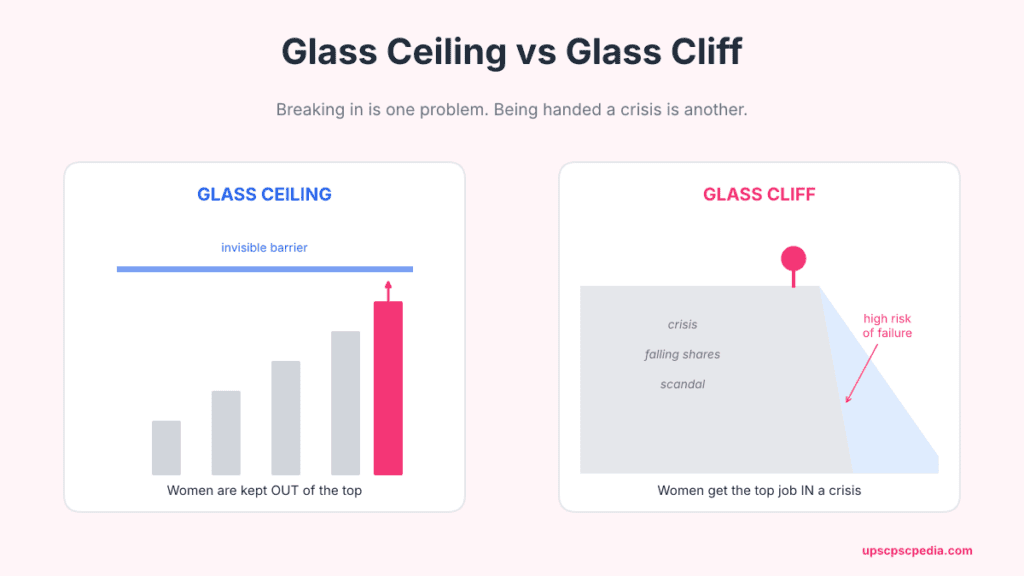


“When the house is on fire, they finally hand her the keys.” That, in one line, is the glass cliff effect.
For years, the big question about women in leadership was simple. Why do so few of them reach the top? That is the famous glass ceiling.
But there is a second question people ask less often. When do women finally get the top job? And what condition is the company in when they do?
The answer has a name: the glass cliff effect. And this month, the leadership row at Nvidia, the world’s most valuable chipmaker, has brought it back into the conversation.
What Is the Glass Cliff Effect?
Let’s simplify this.
The glass cliff is the idea that organisations are more likely to give women top jobs when they are already in trouble. That is when the risk of failure is highest.
Two British psychologists, Michelle Ryan and Alex Haslam of the University of Exeter, coined the term in 2005. They studied the FTSE 100, the largest companies on the London Stock Exchange. They found that firms that appointed women to their boards were more likely to have been performing badly in the months before.
In short:
- Glass ceiling: organisations keep women out of the top
- Glass cliff: organisations let women in, but at the edge of a drop
Think of it like becoming captain of a ship that is already taking in water. You did get the job. But if the ship sinks, history will remember that it sank under you.
The Nvidia Row: What Happened?
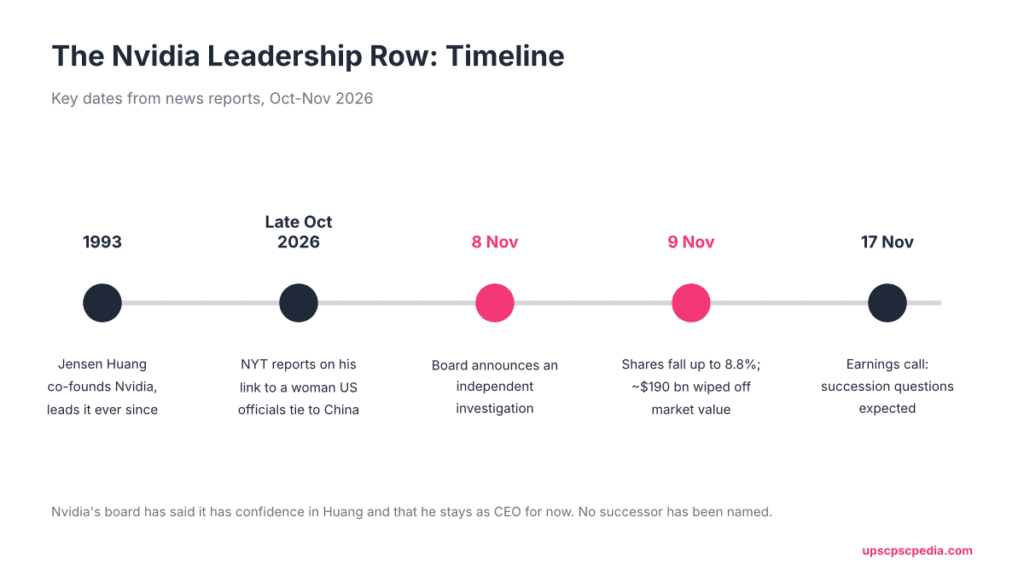
Jensen Huang co-founded Nvidia in 1993 and has been its only CEO. Under him, it became the engine of the global AI boom.
Then came the reports. In late October, The New York Times reported on Huang’s personal relationship with a former executive of a Singapore-based data-centre firm. US officials reportedly believe she was passing information to China.
The fallout came quickly:
- 8 November: Nvidia’s board announced an independent investigation
- 9 November: Shares fell as much as 8.8% during the day, wiping out roughly $190 billion in market value
- Board stand: The board said it has confidence in Huang, and he stays as CEO for now
So where does the glass cliff come in?
Nvidia has not publicly named a successor. As the media began asking “who could replace Huang?”, the most-discussed name was Colette Kress, Nvidia’s CFO since 2013. She is the most visible member of his team and appears beside him on every earnings call.
To be clear, the board has not appointed anyone. But the scenario fits the glass cliff almost too well. If the board handed a woman the top job now, she would take over a company with a falling share price, a founder-shaped culture, an ongoing probe and US-China tensions in the background.
That is exactly why commentators started talking about the glass cliff effect.
Real-World Examples of the Glass Cliff
Nvidia is not the first case. Researchers and journalists have pointed out the pattern many times before.
| Leader | Role | The “cliff” |
|---|---|---|
| Theresa May | UK Prime Minister (2016) | Took charge right after the Brexit vote |
| Mary Barra | CEO, General Motors (2014) | A huge vehicle-recall crisis broke soon after |
| Marissa Mayer | CEO, Yahoo (2012) | Yahoo had already lost ground to Google |
The effect goes beyond companies, too. Research by Ryan, Haslam and colleagues found that in politics, parties more often field women in hard-to-win seats.
Why Does the Glass Cliff Effect Happen?
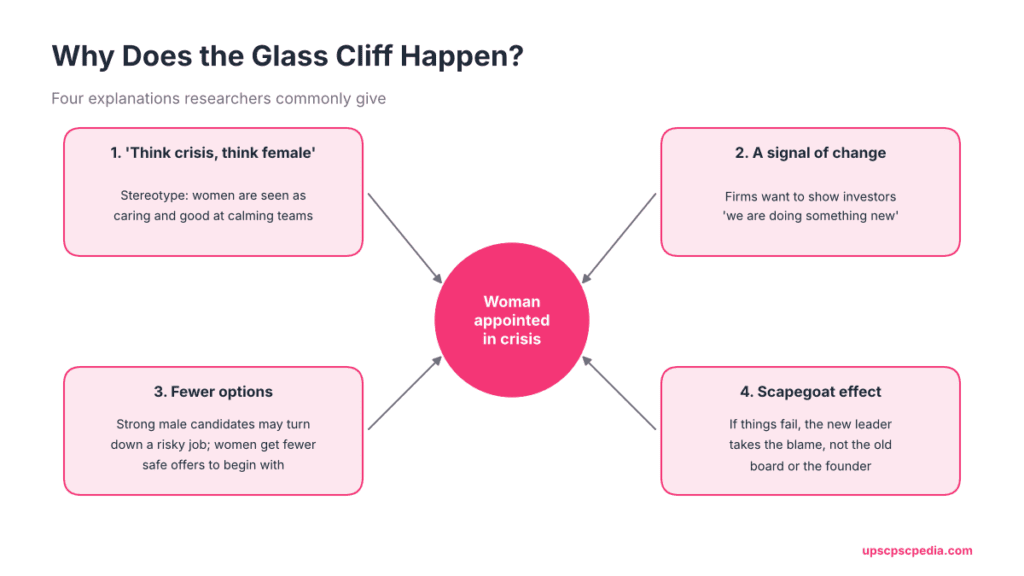
Researchers point to a few overlapping reasons:
- “Think crisis, think female”: People often stereotype women as caring and good at managing people. Boards may see those qualities as useful during a crisis.
- A signal of change: Appointing a woman tells investors and the public that the company is trying something new.
- Fewer options: Men with strong networks often get safer offers, so they can say no to risky jobs. Women have fewer such offers to begin with.
- The scapegoat effect: If things go wrong, the new leader takes the blame, not the old board.
What About India?
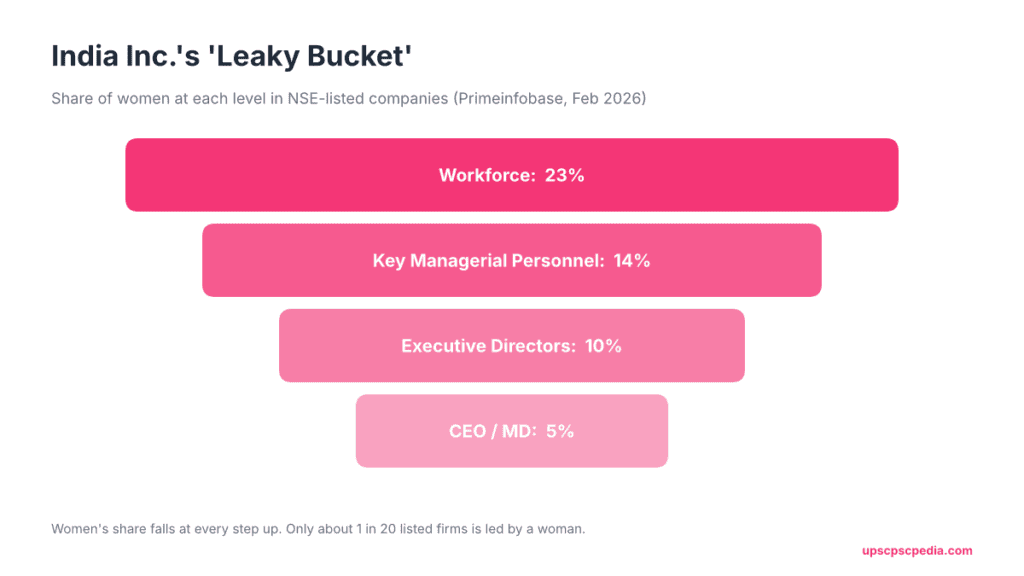
India’s problem is still largely the glass ceiling, not yet the cliff.
- Under the Companies Act, 2013, listed companies must have at least one woman director. Today, about 98% of NSE-listed firms meet this rule.
- But women hold only about 5% of CEO or MD posts in these companies (Primeinfobase, 2026).
- In August 2026, the government told the Lok Sabha that India’s top 500 listed companies had just 9 women CEOs and 25 women MDs.
Experts call this the “leaky bucket”. Women make up 23% of the workforce in listed firms, but their share drops at every step up the ladder.
So there is a real risk here. As more Indian women reach the top, we should watch when and how they get there, and not just whether they do.
This is not only a corporate problem. In politics, the Women’s Reservation Bill is trying to fix the same gap through a 33% quota in legislatures. And at the workplace level, debates like menstrual leave in India show how far offices still have to go to meet women’s needs.
A Balanced View
To be fair, not everyone agrees on how strong the glass cliff effect is.
- Some studies, including a 2007 study of US firms, found no clear glass cliff in CEO appointments.
- Some women knowingly accept risky roles because they see a real chance to lead and turn things around. Mary Barra, for example, went on to lead GM for over a decade.
- Crisis jobs come with risk for anyone. The real question is whether boards offer them to women more often and judge women more harshly when they fail.
Conclusion
The glass cliff effect reminds us that equality is not just about getting a seat at the table. It is also about getting a fair table to sit at.
Whatever happens to Jensen Huang, the Nvidia row has raised an uncomfortable question for boardrooms everywhere, including India’s. Do boards give women leadership as a reward, or only as a rescue mission?
Real progress will show when women lead companies in good times too.
What do you think? Is the glass cliff real, or just bad timing? Share your view in the comments below. 👇



Pingback: Trump Xi Putin Summit in Shenzhen: Why the First Three-Way Meeting Matters - upscpscpedia.com
Pingback: AI Stock Sell-Off: Why Nvidia's Crash Pushed Wall Street Into Correction - upscpscpedia.com