
A virus without a vaccine has met a region without peace.
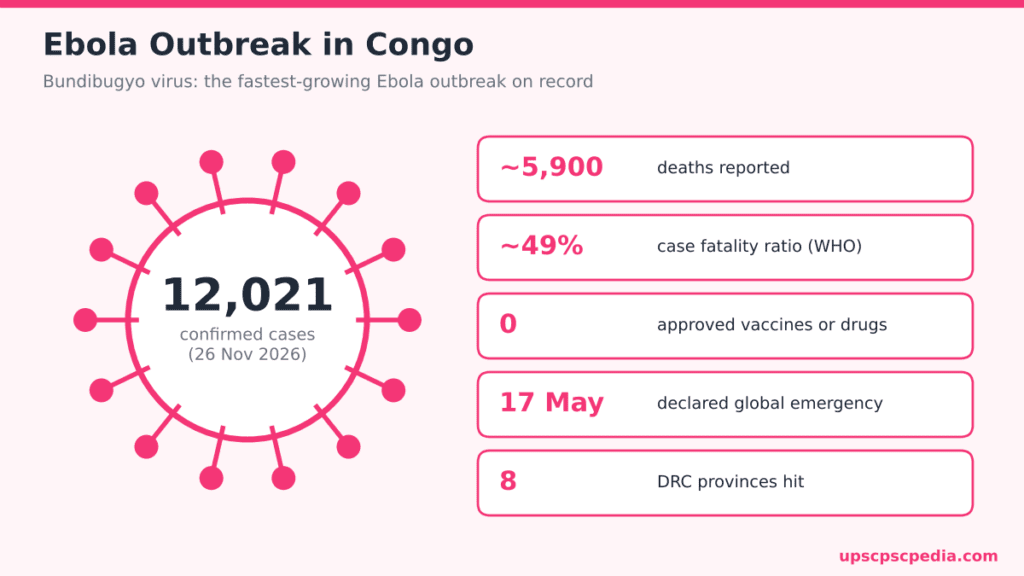
The Ebola outbreak in Congo crossed 12,021 confirmed cases on 26 November 2026, and nearly half of those patients have died. Euronews describes it as the fastest-growing Ebola outbreak in history.
This is not the familiar Zaire strain that the world learned to fight with vaccines. The culprit is the rarer Bundibugyo virus, and no approved vaccine or medicine exists for it.
The timing makes things worse. Fresh fighting in Ituri province trapped health workers this week, and some teams had to pull back. That is why health experts across the world are watching eastern Congo so closely right now.
What Happened?
The Democratic Republic of the Congo’s (DRC) health ministry reported 12,021 confirmed cases on 26 November. News reports put the death toll at about 5,900.
Violence added to the alarm. On Tuesday, 24 November, about a dozen people reached safety in Bunia after three days trapped in a hospital in Akwe amid crossfire. The group included two WHO staff members and Congolese health officials.
Then, on Thursday, fighting resumed between the army and an armed group called the CRP. The clashes hit Iga-Barrière, a mining town about 25 km north of Bunia, and pushed families towards the city.
WHO’s Ebola incident manager, Dr Catherine Smallwood, said the fighting had cut teams off from some communities. She added that it also disrupted the tracking of people exposed to the virus and left some treatment centres short of staff.
What Is the Bundibugyo Virus?
Let’s simplify this.
Ebola is not one single virus. It is a group of related viruses that cause severe, often deadly illness with fever and bleeding. Bundibugyo is one member of this group. Scientists first identified it in Uganda in 2007.
The virus spreads through direct contact with the blood or body fluids of a sick person, or of someone who has died from it. It does not float through the air like the flu.
Think of it like a fire that spreads only by touch. Each patient can pass it to the people who nurse, wash or bury them. Break that contact, and the fire runs out of fuel.
Here lies the problem. The licensed Ebola vaccine, Ervebo, targets the Zaire strain, not Bundibugyo. WHO has backed trials of new candidate vaccines and treatments, but none has approval yet.
How Did the Ebola Outbreak in Congo Grow So Fast?
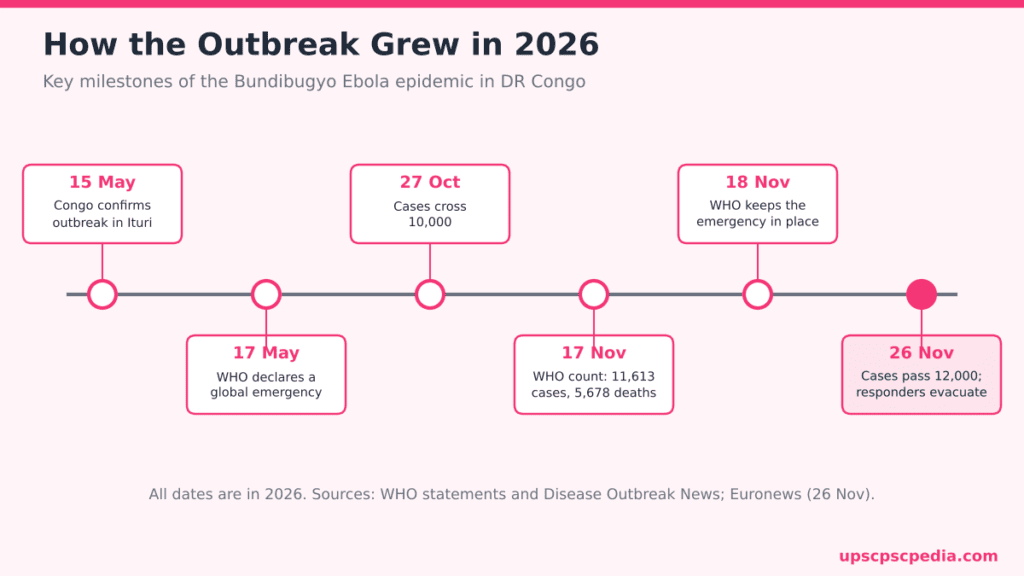
The outbreak started quietly in Ituri province in April and May. Within six months, it had spread across eight provinces.
| Date (2026) | What happened |
|---|---|
| 15 May | DRC confirms a Bundibugyo outbreak in Ituri province |
| 17 May | WHO declares a Public Health Emergency of International Concern (PHEIC) |
| 27 Oct | Confirmed cases cross 10,000 |
| 17 Nov | WHO count reaches 11,613 cases and 5,678 deaths |
| 18 Nov | WHO chief keeps the emergency in place after a third expert committee meeting |
| 26 Nov | Cases pass 12,000; responders evacuate near Bunia |
The virus also crossed borders. Uganda reported its first imported cases in Kampala in May, according to WHO’s emergency statement. Kenya has confirmed 9 cases and 2 deaths, all from one cluster. Nigeria had one imported case, and that patient recovered after evacuation to Switzerland.
Where Is It Hitting Hardest?
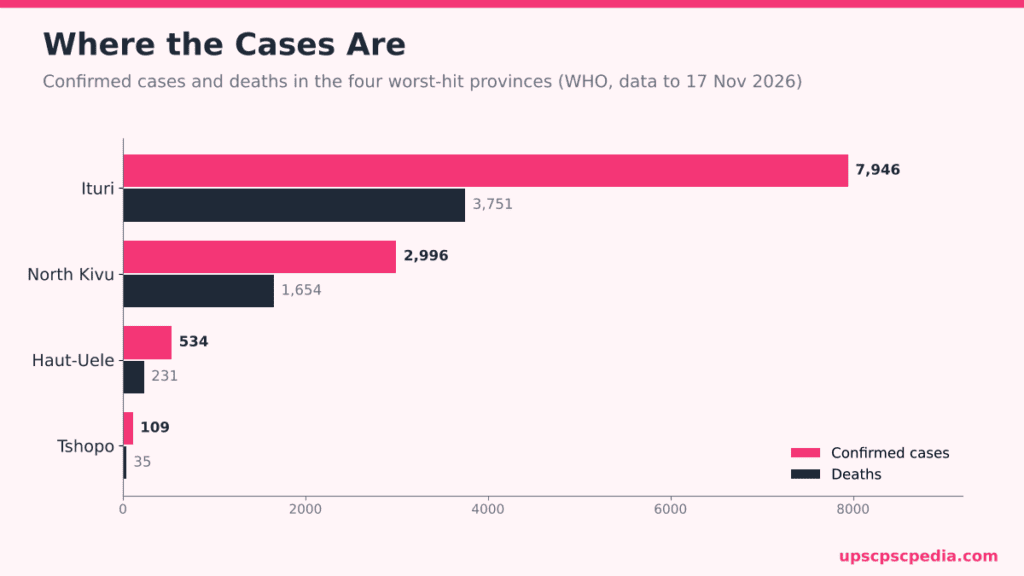
WHO’s 20 November update shows cases in 68 health zones across eight provinces. The virus is still actively spreading in 48 of them.
- Ituri: 7,946 cases and 3,751 deaths. This is the epicentre.
- North Kivu: 2,996 cases and 1,654 deaths. Its fatality rate of 55% is the highest.
- Haut-Uélé: 534 cases and 231 deaths.
- Tshopo: 109 cases and 35 deaths.
Overall, the case fatality ratio stands at 48.9%. In simple words, roughly one in two confirmed patients has died.
Why It Matters
- Record scale. Euronews reports that this is the deadliest of Congo’s 17 Ebola outbreaks. It is also on track to pass the roughly 11,000 deaths of the 2014-16 West African epidemic.
- Global risk. WHO rates the risk as “very high” in the DRC and “high” in Kenya and Nigeria. Countries with strong travel links to the region but weak health systems also face high risk.
- A test with no vaccine. The world beat recent Zaire-strain outbreaks partly with vaccines. This time, health workers must rely on old-school tools such as isolation, tracing and safe burials.
- Lessons for India. Public health threats ignore borders. India’s own push to tackle antimicrobial resistance shows why strong surveillance matters long before a crisis hits.
The crisis also tests the UN system at a delicate moment, as our explainer on the UN Secretary-General race shows.
Challenges and Concerns
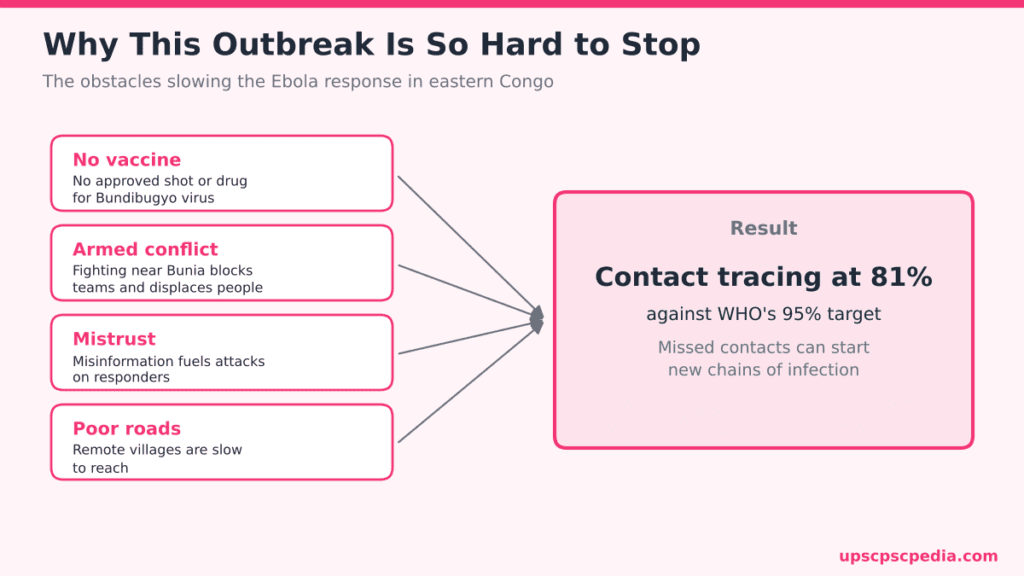
Several problems feed the Ebola outbreak in Congo at the same time:
- Armed conflict. More than 100 armed groups operate in eastern Congo. Thomas Lubanga, whom the International Criminal Court convicted in 2012 of recruiting children under 15, founded the CRP last year.
- Mistrust. Misinformation has turned some residents against responders, and some have attacked them.
- Poor roads. Teams struggle to reach remote villages quickly.
- No vaccine or cure. Doctors can offer only supportive care.
- Gaps in tracing. WHO says contact tracing covers 81% of contacts, against a 95% target. Every missed contact can start a new chain of infection.
A Balanced View
The picture is grim, but not hopeless. South Kivu and Sud-Ubangi have reported no new cases for more than 42 days. Kenya has not seen a new case since 19 October.
WHO has also kept a measured tone. In May, it said the outbreak did not meet the criteria for a pandemic emergency. It also advises countries against closing borders or restricting trade with affected nations. Health experts often argue that such bans hurt local economies and can discourage countries from reporting cases.
Critics, however, may ask whether the global response has moved fast enough for an outbreak that is breaking records. Funding, security and community trust will decide the answer.
What Happens Next?
- WHO plans to issue updated temporary recommendations for the DRC and other countries in the coming days.
- Its priorities include early detection, safe burials, community outreach and cross-border checks.
- Responders must lift contact tracing from 81% towards the 95% target.
- Officials usually declare an Ebola outbreak over only after 42 days pass with no new cases.
In short, security on the ground will shape how fast the Ebola outbreak in Congo slows down.
Conclusion
The Ebola outbreak in Congo shows what happens when a deadly virus meets war, mistrust and a missing vaccine. The numbers are rising, yet a few calmer provinces prove that health teams can stop the virus. The world now needs to back the health workers who keep going into danger zones.
What do you think? Should the world do more to protect health workers in conflict zones during outbreaks like this? Share your view in the comments below. 👇

