
When a court shuts one door, a determined trade policy simply walks through another.
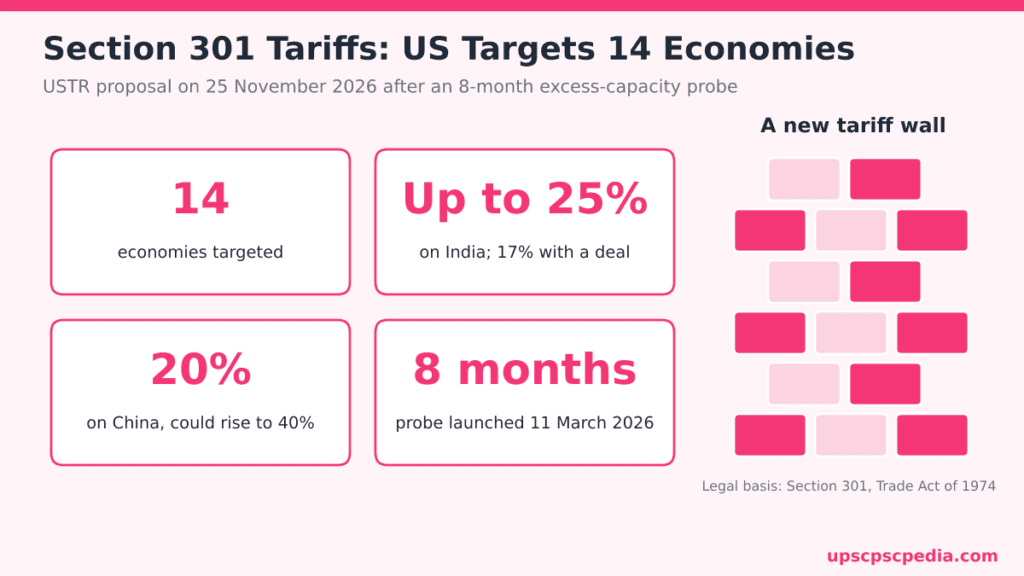
On 25 November 2026, Washington proposed fresh Section 301 tariffs on 14 economies, from China and the European Union to India and Vietnam. The move rebuilds much of America’s tariff wall nine months after the US Supreme Court struck down the earlier version.
This is not a small trade spat. The list includes most of America’s biggest trading partners in Asia and Europe. Asian stocks slipped on the news, and MSCI’s global share index fell 0.5%, according to Reuters figures cited by The Next Web.
For India, the stakes are direct. The proposal names an Indian rate of up to 25%, and New Delhi has already pushed back.
What Happened?
The Office of the US Trade Representative (USTR), led by Jamieson Greer, released findings from an eight-month probe. The probe began on 11 March 2026 and examined 16 economies for “structural excess capacity” in manufacturing.
USTR concluded that 14 of them follow practices that, in its words, “burden or restrict U.S. commerce.” It spared Mexico and Norway for now.
The 14 economies are:
- East Asia: China, Japan, South Korea, Taiwan
- Europe: the European Union, Switzerland
- South and Southeast Asia: India, Bangladesh, Cambodia, Indonesia, Malaysia, Singapore, Thailand, Vietnam
The tariffs remain a proposal for now. USTR will take public comments and hold a hearing first. A US official told Reuters the duties may not start before January.
What Are Section 301 Tariffs?
Let’s simplify this. Section 301 is a clause in the US Trade Act of 1974. It lets the USTR investigate a foreign country’s trade practices and punish ones it finds “unreasonable.”
Until February, President Trump had leaned on a different law, the International Emergency Economic Powers Act (IEEPA). He used it for the “Liberation Day” and “reciprocal” tariffs of 2025. The Supreme Court ruled against those duties in February 2026, which pushed the White House toward Section 301 tariffs instead. We traced the earlier phase in our post on US tariffs and the WTO crisis.
The key difference? Section 301 needs a formal investigation, a written finding and a chance for public comment. That makes it slower, but harder to overturn in court.
How High Are the Proposed Rates?
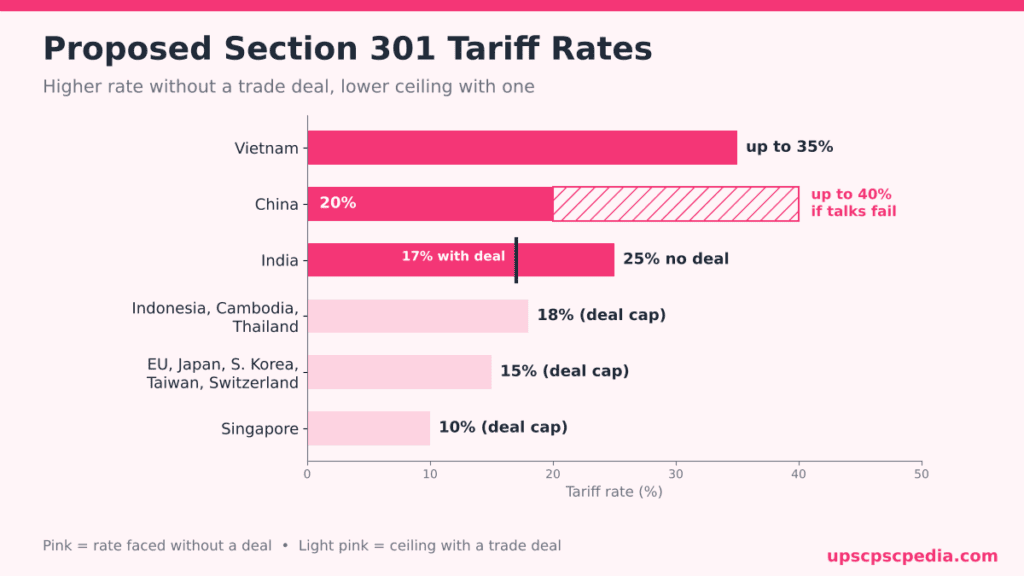
The rates follow a two-tier design. Countries face a higher rate without a trade deal and a lower ceiling with one.
| Economy | Proposed rate | Notes |
|---|---|---|
| China | 20% | Could rise to 40% if trade talks fail |
| Vietnam | Up to 35% | Highest rate on the list |
| India | Up to 25% | Falls to 17% with a trade deal |
| Indonesia, Cambodia, Thailand | 18% with a deal | Southeast Asian exporters |
| EU, Japan, South Korea, Taiwan, Switzerland | 15% with a deal | Matches existing deal caps |
| Singapore | 10% with a deal | Lowest ceiling |
Think of it like a teacher who announces a heavy fine for late homework, then quietly says the fine halves if you sign a promise. The higher number creates pressure; the lower one rewards a deal.
The new duties will not pile on top of everything. They will not stack on the forced-labour tariffs imposed in July, or on existing duties on cars, steel and aluminium.
Why Did the US Target These Economies?
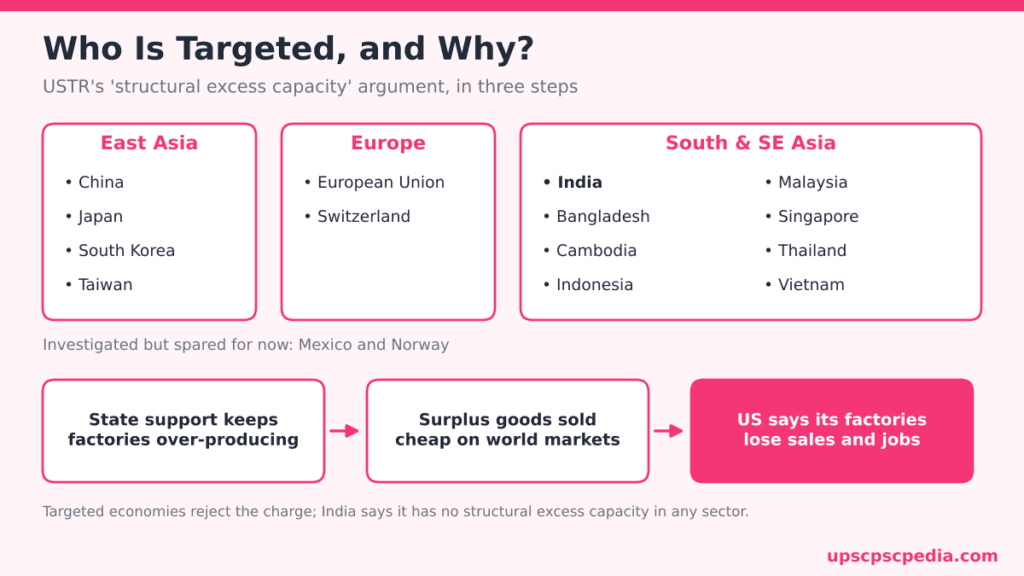
Washington’s core charge is “excess capacity.” In plain words, the US says these countries make far more than they can sell at home, often with state support. The surplus then floods world markets at low prices and hurts American factories.
USTR’s notice gives country-specific reasons:
- China and Japan: loss-making carmakers kept alive by support.
- EU: large goods surpluses run by Germany and Ireland with the US.
- India: industrial expansion plans, weak labour protections, financial repression and market-access barriers, according to Business Standard. It flagged pharmaceuticals and medical devices, steel, solar and ICT.
What Do Section 301 Tariffs Mean for India?
India’s Department of Commerce responded within hours. It said India has no structural excess capacity in any sector and that it “engaged constructively” with the probe. It also called the notice “under examination.”
New Delhi wants these issues settled inside the ongoing Bilateral Trade Agreement talks. The ministry repeated its commitment to an early deal, as Business Standard reported.
Some context helps here:
- In February, an interim India-US framework had set India’s tariff at 18%.
- The Supreme Court ruling then removed the legal base for that rate.
- India already pays a separate 10% Section 301 duty, and the new rate would be calculated net of it.
The Delhi think tank GTRI took a sharper line. It called the 17% offer “bait” and urged India to reject a one-sided deal.
Challenges and Concerns
The plan raises worries on several fronts.
- Higher prices: tariffs usually raise costs for importers, and many pass them on to consumers.
- Trade truce risk: the US-China truce expires on 10 January. China’s foreign ministry called overcapacity “a false issue,” though it did not threaten retaliation.
- Supply chains: firms that moved from China to Vietnam, India or Thailand now face fresh duties too.
- Political pushback: a Reuters/Ipsos poll after the midterms found 62% of respondents would back repealing Trump’s tariffs.
A Balanced View
Supporters in Washington say subsidised overproduction is real, especially in steel, cars and solar. They argue Section 301 tariffs give US factories a fairer fight. Greer also said the caps match deals partners already signed.
Critics see the old reciprocal tariffs returning under a new legal label. Trading partners say the charge ignores their own market conditions. Economists also warn that tariffs often hit the importing country’s consumers hardest.
The truth may sit in between. Overcapacity worries are genuine, yet blanket duties can hurt allies along with rivals.
What Happens Next?
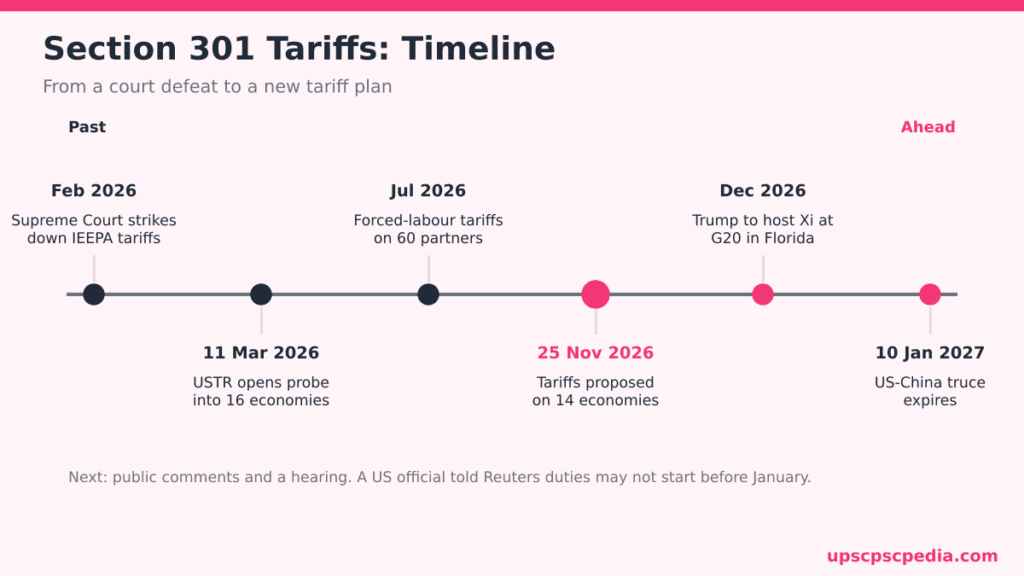
The coming weeks will decide how much bite these duties carry.
- USTR collects public comments and holds a hearing.
- Trump plans to host Xi Jinping at the G20 summit in Florida next month, after their Shenzhen meeting covered in our Trump Xi Putin summit post.
- The US-China truce expires on 10 January.
- India and the US try to close the first tranche of their trade deal.
Conclusion
The Section 301 tariffs show that America’s tariff push has survived its biggest legal defeat. The tool has changed, but the goal of pressuring partners into deals has not. For exporters from Hanoi to Delhi, the next two months matter a great deal.
India now faces a real choice. It can sign a deal at 17% or hold out against terms it calls unfair.
What do you think? Should India accept the 17% offer to secure a trade deal, or stand firm against Section 301 tariffs? Share your view in the comments below. 👇


