
One flash in orbit could switch off the maps, money and messages we use every day.
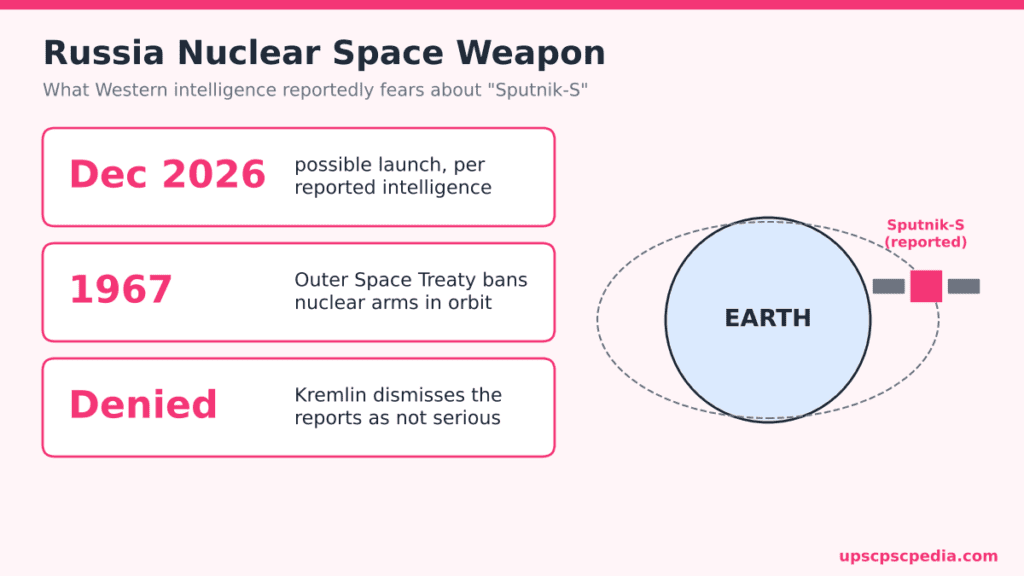
That is why reports of a Russia nuclear space weapon have rattled governments this week. Western intelligence agencies reportedly believe Moscow could launch a nuclear-armed satellite, called Sputnik-S, as early as December 2026.
The Kremlin calls the reports baseless. No public evidence shows that a launch is imminent. Still, NATO leaders and Germany’s chancellor have spoken out, and the story now leads world headlines.
Why does this matter so much? Because space is no longer just about astronauts and rockets. Banks, farmers, airlines and armies all depend on satellites. A single blast up there could hurt life on the ground everywhere.
What Happened?

On 22-23 November 2026, a joint investigation by German broadcasters WDR and NDR and the newspaper Süddeutsche Zeitung made the claim public. According to The Moscow Times, the report said:
- NATO members shared intelligence about a satellite called Sputnik-S.
- Russia reportedly assembled it several years ago and stored it near Moscow.
- It could reach orbit within 60 days, possibly in December.
- It could become ready for use soon after launch.
The warning did not come out of nowhere. In October 2026, the US Defense Intelligence Agency said Russia was developing a satellite meant to carry a nuclear weapon. Back in February 2024, the White House had also confirmed a “troubling” Russian anti-satellite capability.
What Is a Russia Nuclear Space Weapon?

Let’s simplify this. A Russia nuclear space weapon, as described in the reports, would be a satellite carrying a nuclear device. It would not target cities. Instead, it could explode in orbit and wipe out other satellites.
Think of it like a smoke bomb in a crowded hall. It may not hit anyone directly. Yet everyone inside struggles to see or breathe. A nuclear blast in orbit works in a similar way. It sends out a burst of energy and charged particles. These particles can linger and slowly fry the electronics of many satellites, friend or foe.
History shows the risk. On 9 July 1962, the US tested a nuclear bomb about 400 km above the Pacific. The test, called Starfish Prime, knocked out streetlights in Hawaii, around 1,400 km away. It also damaged several satellites over the following months.
A US intelligence assessment warned that such a weapon could disrupt thousands of satellites. Those satellites support:
- GPS and navigation
- Banking and card payments
- Weather forecasts
- Phone and internet links
- Air traffic control and emergency services
Why the Russia Nuclear Space Weapon Report Matters
First, it would break a key treaty. The 1967 Outer Space Treaty bans nuclear weapons in Earth’s orbit. Russia, the US, China and India have all signed it. A launch would shatter one of the oldest arms control rules.
Second, it would hurt everyone, not just Russia’s rivals. A blast cannot pick targets. Russian, Chinese and Indian satellites would face the same danger as American ones.
Third, it fits a wider pattern of rising tension. NATO and Russia are already at odds over the war in Ukraine. Our recent posts on the Kerch Bridge attack and the Trump Xi Putin summit show how fast this rivalry keeps shifting.
For India, the stakes are high too. India runs its own navigation system, NavIC, plus many communication and weather satellites. Any blast in low orbit would put these assets at risk.
Key Facts at a Glance
| Item | Detail |
|---|---|
| Reported name | Sputnik-S |
| Possible launch | As early as December 2026 (reported) |
| Source of claim | Western intelligence, via German media |
| Treaty at stake | Outer Space Treaty, 1967 |
| Russia’s response | Denial; Kremlin says reports are not serious |
| Earlier US warning | White House, February 2024; DIA, October 2026 |
Challenges and Concerns
The biggest problem with a Russia nuclear space weapon is simple: nobody can easily stop such a weapon once it reaches orbit. Shooting it down could itself trigger a blast or create debris.
Other concerns include:
- Weak treaty checks: The Outer Space Treaty has no inspection system. Nobody can look inside another country’s satellite.
- Failed UN effort: In April 2024, Russia vetoed a US-Japan draft resolution at the UN Security Council that urged countries not to place nuclear arms in orbit.
- No backup plan: Experts told The National News Desk that the US has no ready system to replace GPS quickly.
- Arms race risk: Other powers may feel pushed to build their own space weapons in response.
A Balanced View
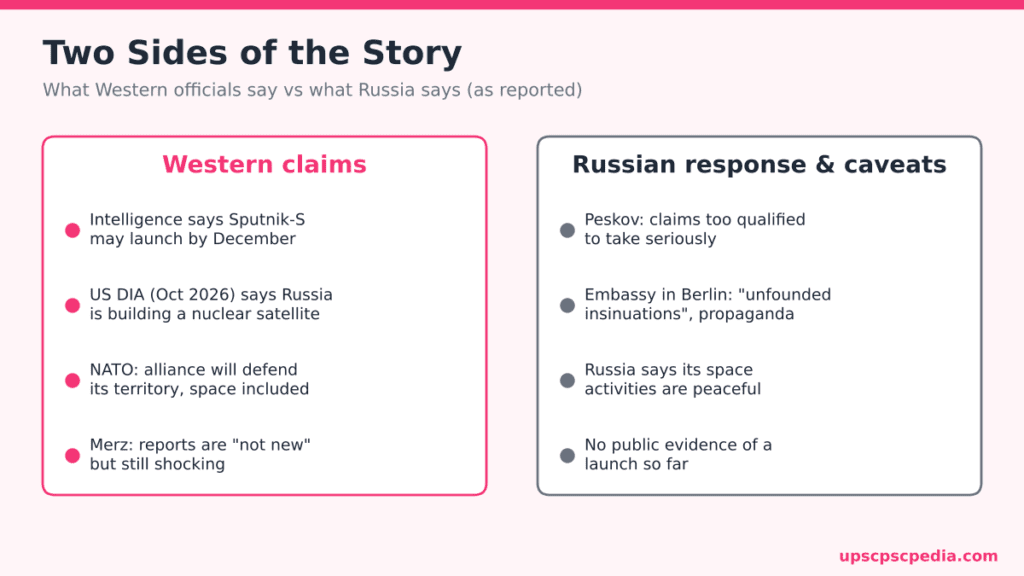
Western leaders treat the claim seriously. NATO chief Mark Rutte said the alliance would defend its territory, space included. German Chancellor Friedrich Merz said the reports were not new but still shocking.
Russia firmly rejects the story. Kremlin spokesman Dmitry Peskov said the claims came with so many caveats that they hardly deserved attention. Russia’s embassy in Berlin called them unfounded and part of a propaganda campaign. Moscow insists its space activities stay peaceful and lawful.
Readers should keep both sides in mind. The intelligence remains unconfirmed in public. At the same time, US officials have raised similar concerns since 2024. Only time, and perhaps the night sky in December, will settle the question.
What Happens Next?
Watch for a few key signals in the coming weeks:
- Any Russian launch from its spaceports in December
- Talks between Rutte and US President Donald Trump, where space threats may come up
- New moves at the UN on space arms control
- European spending on satellite protection and backup navigation
Conclusion
The Russia nuclear space weapon story sits at a tense point between proof and fear. Moscow denies it, and the public has seen no hard evidence. Yet the warnings keep coming from several Western governments.
One lesson already stands clear. Our daily lives now run through space. Protecting that shared sky has become as important as guarding borders on Earth.
What do you think? Should the world build a new, enforceable treaty to keep weapons out of space? Share your view in the comments below. 👇


