

Your retirement money no longer has to leave in one big lump.
That is the simple promise of the new EPFO Systematic Withdrawal Plan, which the top board of the Employees’ Provident Fund Organisation approved on 19 November 2026. Retiring members can now take their provident fund savings in regular instalments, much like a salary that keeps coming after work stops.
The same meeting also loosened two rules that annoyed members for years. You now need to keep only 10% of your contributions in the account, down from 25%. And if you lose your job, you wait just two months, not twelve, for final settlement.
These changes touch crores of salaried Indians. They also signal a shift in how India thinks about old-age income. So let’s break down what changed, who gains, and what questions remain.
What Happened?
The Central Board of Trustees (CBT) of the EPF held its 240th meeting in New Delhi on Thursday, 19 November 2026. Labour and Employment Minister Dr Mansukh Mandaviya chaired it. Representatives of the Centre, the states, employers and employees sit on this board.
The board took several decisions in one sitting. Here are the headline ones:
- Systematic Withdrawal Plan (SWP): retirees can draw PF savings monthly, quarterly or half-yearly.
- Lower minimum balance: members must keep 10% of contributions, not 25%.
- Shorter wait: final withdrawal after job loss now comes after 2 months instead of 12.
- New contribution routes: UAN-linked voluntary and third-party micro-contributions, including customer tips, outside payroll.
- AIF investment: in-principle approval to put up to 3% of fresh accretions into eligible Alternative Investment Funds.
- EDLI relief: a six-month window for establishments to renew expired insurance exemptions.
According to the official PIB release, about 6.32 lakh members aged above 55 with balances above ₹5 lakh will be the first main beneficiaries. PTI’s report adds that the scheme aims to supplement pension income, not replace it.
What Is the EPFO Systematic Withdrawal Plan?

Let’s simplify this.
Until now, most members took their entire PF corpus at once when they retired. Many then struggled to manage a large sum. Some spent it fast. Others parked it in low-return savings.
The EPFO Systematic Withdrawal Plan offers another path. You leave the money with EPFO and draw it in instalments. Meanwhile, the remaining balance keeps earning the EPF interest rate, which stands at 8.25% now, as Onmanorama reported.
Think of it like a water tank on your roof. Earlier, you had to empty the whole tank in one go. Now you can fit a tap and fill one bucket at a time, while the rest stays safe.
Members get three choices:
- Draw the full eligible corpus in instalments.
- Take part as a lump sum and the rest in instalments.
- Withdraw only the interest and leave the principal untouched.
The scheme is entirely voluntary. Members can also stop the instalments and take the remaining amount as a lump sum, subject to the rules. If a member dies during payouts, the nominee or dependant can either withdraw the balance or continue the payments.
What Else Changed for PF Members?

The SWP grabbed the headlines. However, the other changes matter just as much for younger workers.
| Rule | Before | After the 19 Nov 2026 decision |
|---|---|---|
| Minimum balance to keep | 25% of contributions | 10% of contributions |
| Withdrawal limit (members under 55) | 75% | 90% |
| Wait for final settlement after job loss | 12 months | 2 months |
| Retirement payout options | Mostly lump sum | Lump sum or monthly, quarterly, half-yearly |
| AIF investment | Not allowed | Up to 3% of fresh accretions (in-principle) |
The board also reviewed its claims system, CITES 2.0, which C-DAC built. Auto-processing of claims rose from 39% to 71%. The rejection ratio fell from 23% to 7.82%. Average settlement time dropped from 11.15 days to 2.57 days.
In addition, 27 establishments will surrender their PF exemptions, and EPFO will cancel exemptions for 4 more. As a result, about ₹5,996 crore belonging to 1,44,437 members moves under EPFO’s direct management.
Why the EPFO Systematic Withdrawal Plan Matters
India is ageing, and most private-sector workers have no assured pension. For many members, the EPS pension stays small. So, the PF corpus often becomes a retiree’s main safety net.
The EPFO Systematic Withdrawal Plan turns that one-time payout into a steady income stream. This helps in three ways:
- Discipline: retirees spread spending over years instead of months.
- Returns: money left with EPFO keeps earning a government-backed rate.
- Family security: nominees can carry on with payments after the member’s death.
Meanwhile, the micro-contribution idea opens a door for gig and informal workers. A delivery rider, for example, could one day receive tips straight into a PF account. That fits India’s wider push to extend social security to platform workers.
Want the bigger economic picture? Read our post on India’s record exports in October 2026. For the jobs side of the story, see our explainer on Oracle layoffs and fears of AI taking jobs.
Concerns and Open Questions
No reform comes without trade-offs. Several questions still need answers.
- Retirement savings may shrink. A 90% withdrawal limit lets members dip deeper into savings before retirement. Easy access today can mean a thinner cushion at 60.
- Tax treatment is unclear. The Labour Ministry is taking up an Income Tax Act amendment with the Finance Ministry. Until that happens, members cannot know how tax rules will treat each instalment.
- AIF risk. Alternative Investment Funds carry more risk than government bonds. The 3% cap and the route through government-backed entities limit this, but observers will still watch closely.
- No start date yet. The scheme amendments still need ministry approval and formal notification.
A Balanced View
Supporters see a long-overdue upgrade. The changes give members more control, faster money and a pension-like option. Nobody has to switch, since the plan stays voluntary.
Sceptics, however, may ask whether looser withdrawal rules weaken the very purpose of a provident fund. After all, PF exists to protect old age, not to act as a savings account.
Both views hold some truth. The final design, including tax rules and safeguards, will decide which side the outcome favours.
What Happens Next?
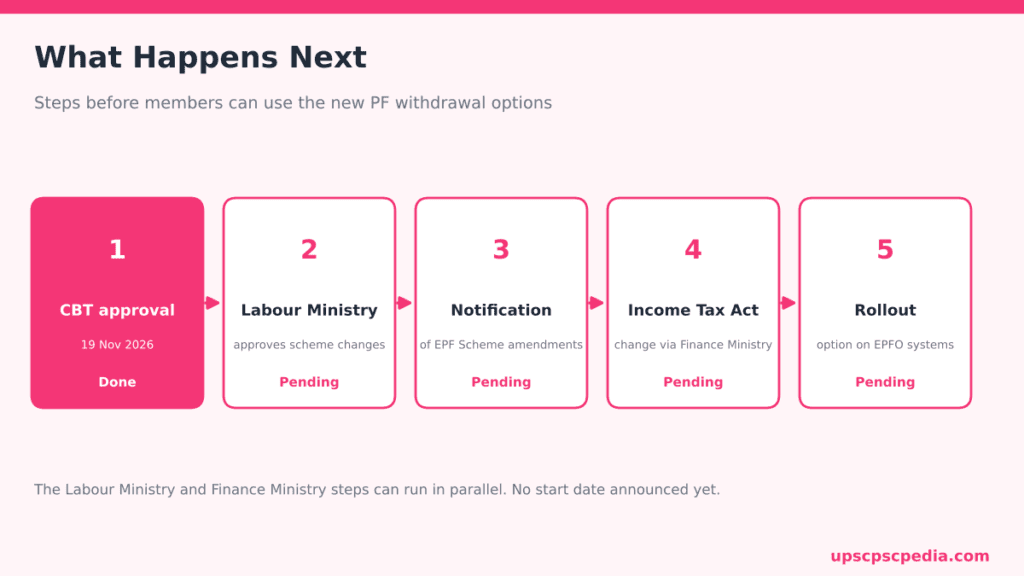
The CBT decision is only the first step. Next, the Labour Ministry must approve the amendments to the EPF Scheme. The government will then notify them. In parallel, the Finance Ministry has to handle the matching Income Tax Act change. Only after these steps will members see the new options on EPFO’s systems.
So, wait for the official notification and clear tax guidance before you sign up for the EPFO Systematic Withdrawal Plan.
Conclusion
The EPFO Systematic Withdrawal Plan gives Indian workers something they rarely had: a choice in how their retirement money reaches them. Together with a lower minimum balance and a two-month wait, it makes PF far more flexible. Still, flexibility works best when people use it wisely and when the tax rules stay simple.
What do you think? Should retirees take their PF as monthly income, or is a lump sum still the smarter choice? Share your view in the comments below. 👇


