
Courts cannot bring back the dead, but they can stop the world from looking away.
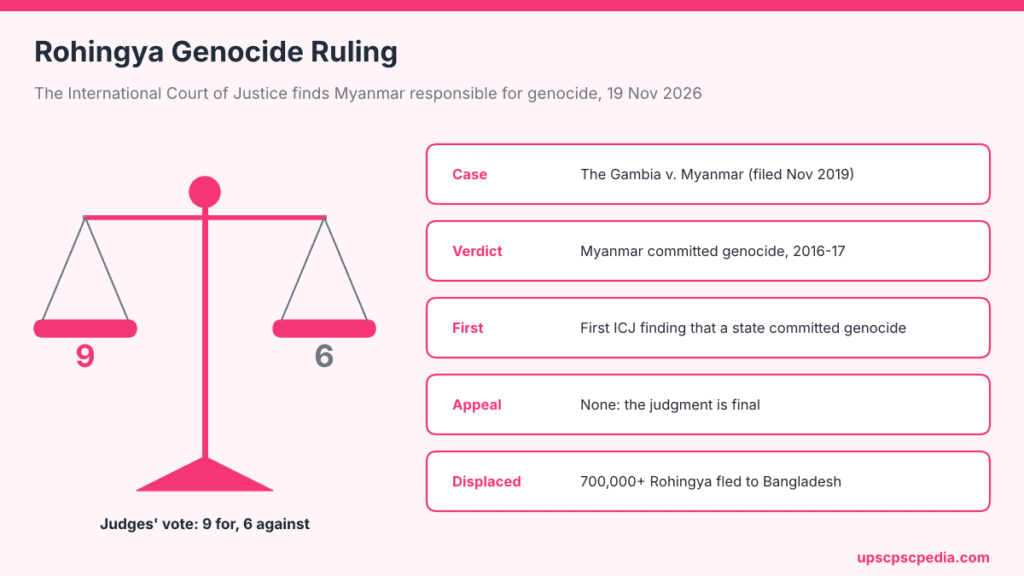
On 19 November 2026, the International Court of Justice (ICJ) delivered a Rohingya genocide ruling that could shape international law for decades. The court found that Myanmar committed genocide against the Rohingya, a mostly Muslim minority.
This is a first. The World Court had never before held a country responsible for committing genocide. The judges voted 9–6, and the judgment is final. Myanmar cannot appeal.
Yet one hard question remains. The ICJ has no police force of its own. So what will actually change for the Rohingya?
What Happened?
The case, The Gambia v. Myanmar, ran for seven years. On Thursday, the court ruled that Myanmar’s security forces and other state bodies committed acts of genocide. These acts took place during the 2016–17 “clearance operations” in Rakhine State.
According to Human Rights Watch, the court found that:
- Myanmar’s forces killed Rohingya and caused them serious bodily and mental harm.
- They imposed measures meant to prevent births within the group.
- Intent to destroy the group was “the only reasonable inference” from the evidence.
- Myanmar breached its duty to prevent genocide and to punish those responsible.
The judges also rejected Myanmar’s claim that the operations were only a counter-insurgency drive. News reports on the ruling cite the court’s finding that Myanmar forces killed about 10,000 Rohingya in 2017.
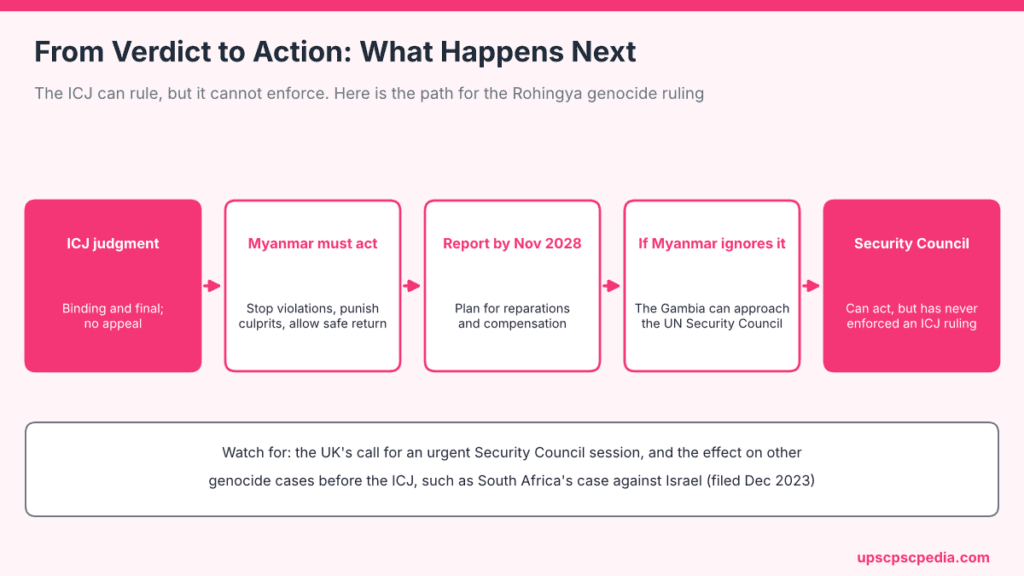
The court ordered Myanmar to stop ongoing violations, prosecute those responsible and guarantee that such acts never happen again. It also ordered reparations, including the safe and voluntary return of Rohingya to their homes. Al Jazeera reports that Myanmar must submit a plan within two years.
What Is the Rohingya Genocide Case?
Let’s simplify this.
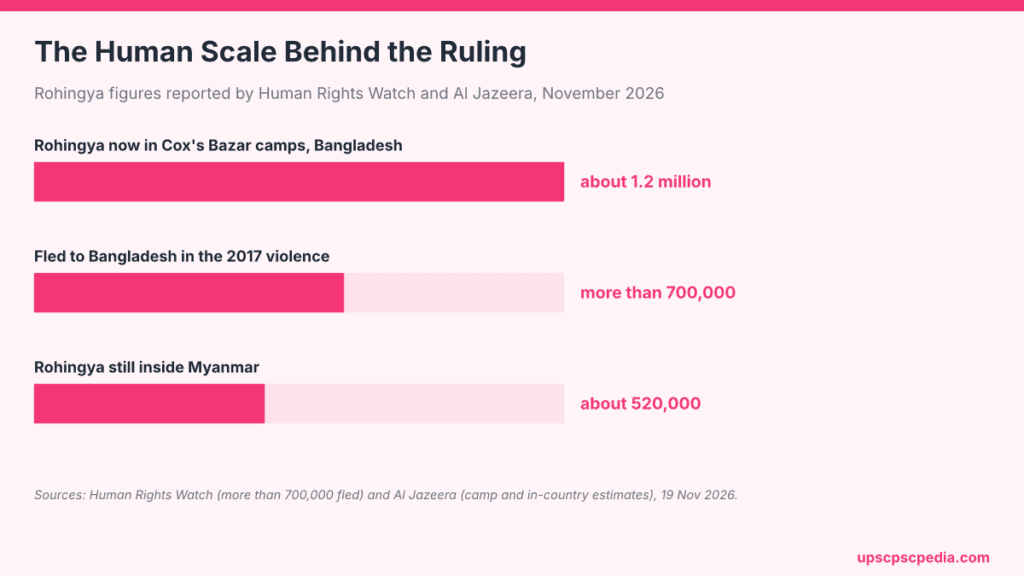
The Rohingya have lived in Rakhine State in western Myanmar for generations. However, Myanmar’s 1982 citizenship law left most of them stateless. In August 2017, a military crackdown drove more than 700,000 of them into Bangladesh.
In November 2019, The Gambia, a small West African nation, took Myanmar to the ICJ. It had no direct link to the crimes. Instead, it used the 1948 Genocide Convention, which both countries have signed. Under that treaty, every member has a stake in stopping genocide anywhere.
Think of it like a neighbour reporting abuse in a house down the street. You do not have to be the victim to ring the alarm.
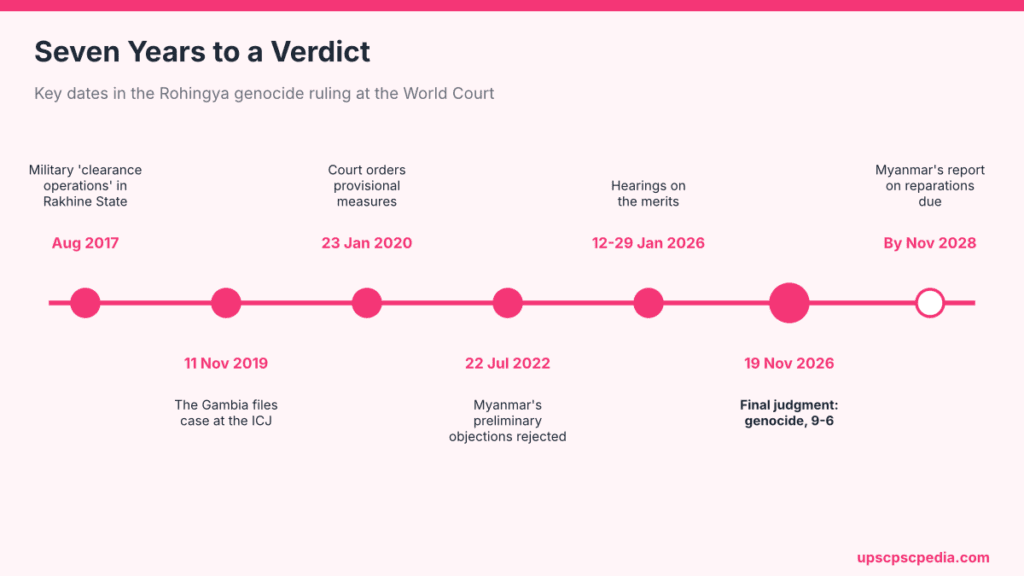
| Date | Event |
|---|---|
| August 2017 | Military operations in Rakhine; mass flight to Bangladesh |
| 11 November 2019 | The Gambia files the case |
| 23 January 2020 | ICJ orders provisional measures to protect the Rohingya |
| 22 July 2022 | Court rejects Myanmar’s preliminary objections |
| 12–29 January 2026 | Hearings on the merits |
| 19 November 2026 | Final judgment: genocide, by 9 votes to 6 |
Eleven other parties to the convention, including the UK, Canada, France and Germany, joined the case on questions of interpretation.
Why the Rohingya Genocide Ruling Matters
A legal milestone. In 2007, the ICJ found that Serbia had failed to prevent the Srebrenica genocide. This time, the court went further and found direct state responsibility.
A precedent for other cases. Human Rights Watch and Al Jazeera both note that the judgment could influence pending cases. These include South Africa’s December 2023 case against Israel.
A human crisis. About 1.2 million Rohingya live in crowded camps in Bangladesh’s Cox’s Bazar. Al Jazeera reports that aid has shrunk, especially after US foreign aid cuts in 2025. About 520,000 Rohingya still live inside Myanmar under heavy restrictions.
India’s neighbourhood. Myanmar shares a long border with India’s northeast. India’s Kaladan transport project also runs through Rakhine. Moreover, Myanmar is an ASEAN member, so the verdict will hang over regional talks like the recent ASEAN-India Summit.
Remember the difference between two courts. The ICJ settles disputes between states. The International Criminal Court (ICC) tries individuals. The ICC itself faced fresh pressure this week, when leaders at the Trump-Xi-Putin summit backed limits on its reach, Democracy Now! reported.
Challenges and Concerns
The Rohingya genocide ruling faces some real limits:
- No enforcement power: The UN Charter lets the Security Council act on ICJ rulings. Yet, as Human Rights Watch points out, the Council has never used that power.
- Veto politics: Any permanent member can block Council action. China and Russia vetoed a Council draft on Myanmar back in 2007.
- Who rules Myanmar: The military seized power in a February 2021 coup. A civil war since then has killed an estimated 100,000 people and displaced more than 3.5 million, Al Jazeera reports.
- Rakhine today: The Arakan Army now controls most of Rakhine State. Al Jazeera reports that it has also targeted the Rohingya.
- A split bench: Six of 15 judges disagreed. That shows how high the bar for proving genocidal intent remains.
A Balanced View
Myanmar has long denied genocide. Its military says it responded to armed attacks in 2017. Reports so far carry no official reaction from Myanmar’s ruling authorities. Meanwhile, the opposition National Unity Government said it respects the court’s authority.
Reactions poured in from elsewhere. The Gambia called it “a historic day for international justice.” UN Secretary-General Antonio Guterres urged Myanmar to comply. The UK expelled Myanmar’s defence attaché and requested an urgent Security Council session.
Still, some experts urge caution. Legal scholar Michael Becker told Al Jazeera the ruling may do little for the Rohingya in the short term.
What Happens Next?
Here is what follows the Rohingya genocide ruling:
- Myanmar must report its plan for reparations within two years, by November 2028.
- If Myanmar ignores the orders, The Gambia can take the matter to the Security Council.
- The UK’s call for an urgent Council session will test global resolve early.
- Any safe return of refugees depends on peace returning to Rakhine.
Conclusion
The Rohingya genocide ruling gives a stateless people something they lacked for years. They now have an official, final finding from the world’s top court. It cannot rebuild a burned village or feed a family in Cox’s Bazar. But it sets a record that no government can easily erase, and it raises the cost of denial. Now the real test begins: will the world turn this Rohingya genocide ruling into action?
What do you think? Can a court ruling without enforcement power still change how states behave? Share your view in the comments below. 👇


