
Four democracies, one table, and a message that needed no names.
The Quad Summit 2026
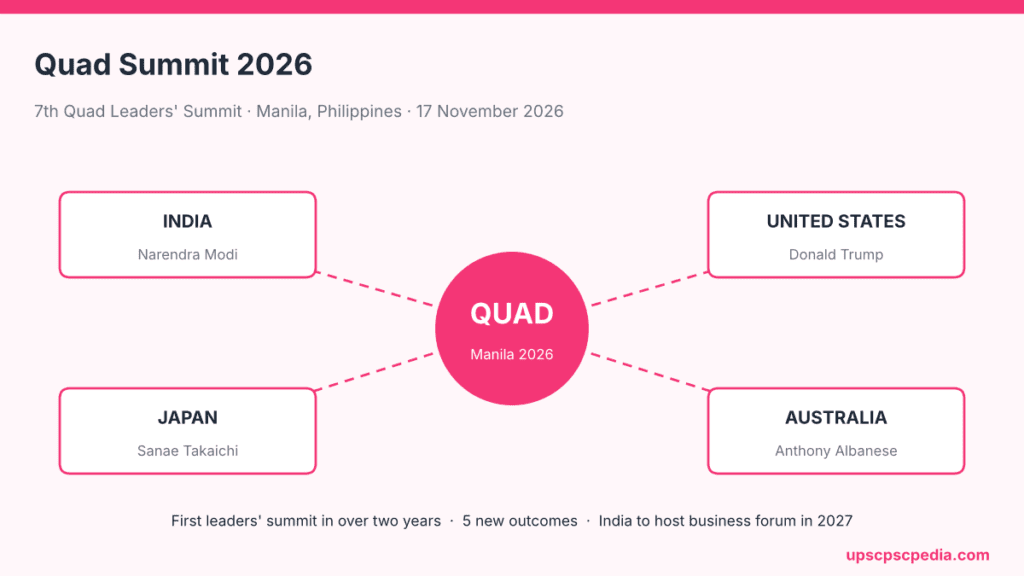
brought the leaders of India, the US, Japan and Australia back together after more than two years. On 17 November 2026, Prime Minister Narendra Modi, President Donald Trump, Prime Minister Sanae Takaichi and Prime Minister Anthony Albanese met in Manila, on the sidelines of the 49th ASEAN Summit.
For a while, many observers wondered if the group had lost its way. India was due to host a summit in late 2025, but it never took place amid strains between Washington and New Delhi, HNGN reported. Trade friction played a part, as our explainer on US tariffs and the WTO shows. So this meeting carried weight well beyond its five announcements.
The timing matters too. Trump flies on to China, where he meets Xi Jinping and Vladimir Putin on 19 November. The Quad’s joint statement landed just two days earlier.
What Happened at the Quad Summit 2026?
This was the 7th Quad Leaders’ Summit, according to ANI via The Tribune. It was also Takaichi’s first. The last in-person summit took place in Wilmington, USA, in September 2024.
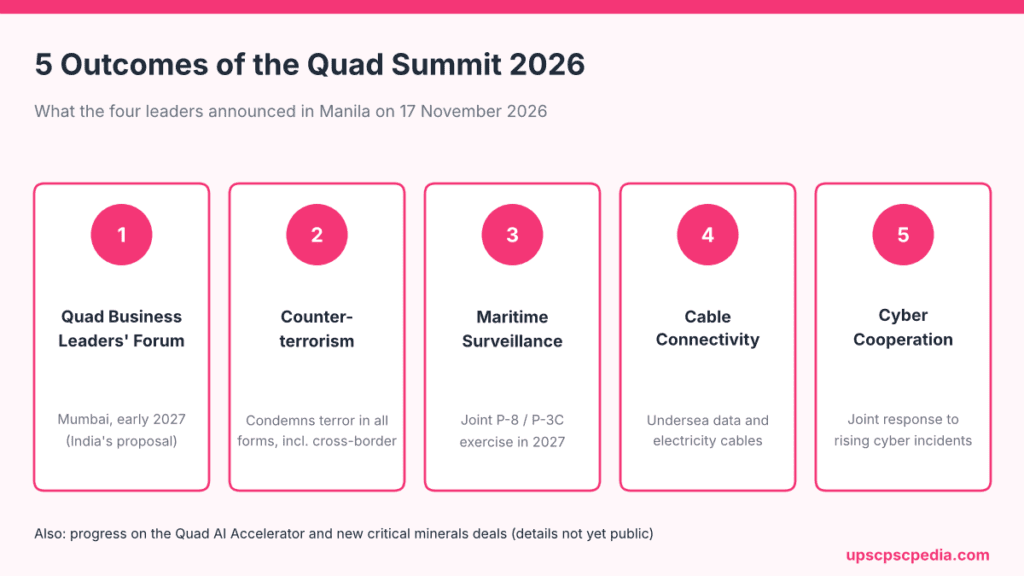
The four leaders signed a joint statement and unveiled five outcomes:
| Outcome | What it does | Key date |
|---|---|---|
| Quad Business Leaders’ Forum | Brings together firms, officials and experts from all four nations | Mumbai, early 2027 |
| Counterterrorism cooperation | Condemns terror in all forms, including cross-border terrorism | Ongoing |
| Indo-Pacific Maritime Surveillance Collaboration | Shares aerial surveillance and sea data | Joint P-8 and P-3C exercise in 2027 |
| Partnership for Cable Connectivity and Resilience | Builds and protects undersea data and power cables | Indian Ocean projects planned |
| Enhanced Quad Cyber Cooperation | Joins forces against a sharp rise in cyber incidents | No fixed timeline |
On top of these, the leaders welcomed progress on the Quad AI Accelerator. Trump said the members had pooled at least $85 million for advanced AI. He also announced critical minerals deals, but he named no partners or figures.
What Is the Quad?
Let’s simplify this. Quad is short for the Quadrilateral Security Dialogue. It is an informal group of four maritime democracies. It has no treaty, no permanent office and no promise to defend one another.
Think of it like a residents’ welfare group in a big housing society. Four neighbours agree to share CCTV footage, fix the street lights together and watch for trouble. They are not a private army. Still, anyone planning mischief knows the neighbours talk to each other.
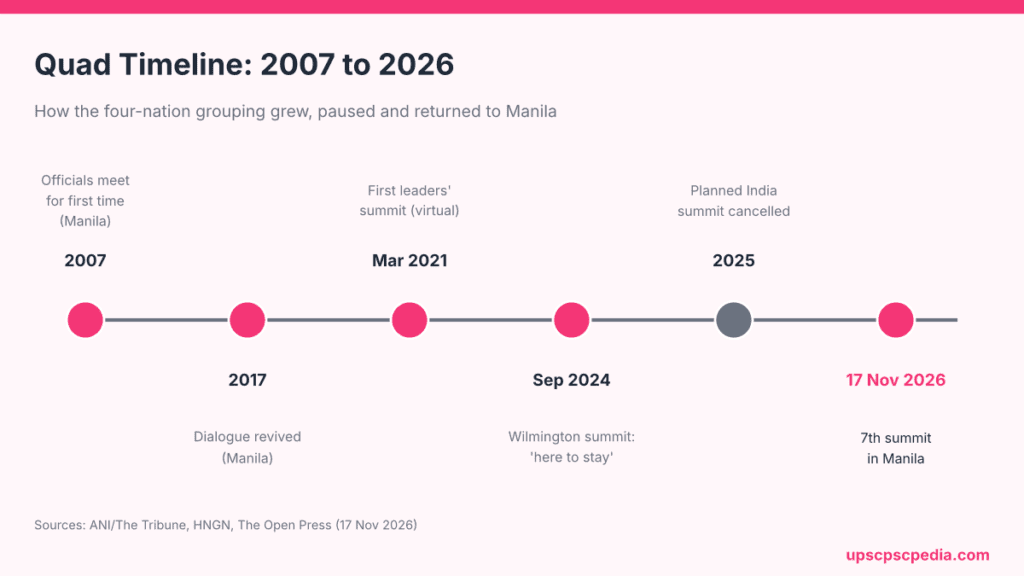
A quick history:
- 2007: Officials from the four countries first met, in Manila.
- 2017: The dialogue came back to life, again in Manila, during Trump’s first term.
- 12 March 2021: Leaders held their first summit, online.
- September 2024: The Wilmington summit declared that the Quad was here to stay.
- 17 November 2026: Manila hosted the leaders after a two-year gap.
Why the Quad Summit 2026 Matters for India
India gains on several fronts at once.
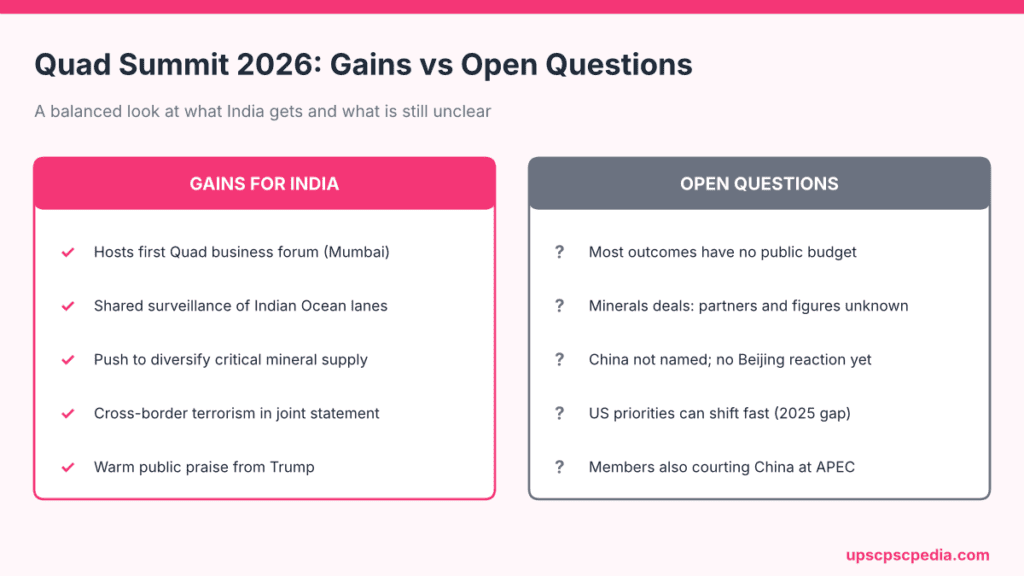
- Supply chains: The Quad Summit 2026 statement voiced concern about economic coercion, “particularly arbitrary export restrictions.” It named no country. However, Beijing dominates much of global mineral processing, HNGN noted. These minerals feed chips, electric vehicles, batteries and defence gear, so India wants other suppliers.
- Business at home: India proposed the business forum and will host it in Mumbai. Indian firms get a direct line to American, Japanese and Australian investors.
- Safer sea lanes: Most of India’s trade travels by sea. Shared surveillance helps partners track illegal fishing and suspicious ships. Modi also pitched a Quad Sea Lanes Safety Initiative for seafarers. The worry is real: this week India condemned an attack on an LPG tanker in the Strait of Hormuz, where rescuers saved 21 Indian crew and one sailor remains missing, All India Radio reported. Our post on oil risks and India’s economy explains why that route matters.
- Terrorism: The statement condemned cross-border terrorism. India has long pressed partners to say exactly that.
- A warmer tone: Trump praised Modi in public and called him “a very tough man.” After the cancelled 2025 summit, that warmth signals a thaw.
Challenges and Concerns
The summit also leaves some hard questions open.
- Promises without price tags: Most outcomes carry no public budget. The minerals deals still have no public details, HNGN pointed out.
- The China factor: India shares a long land border with China. New Delhi has always kept away from anything that looks like a military alliance against Beijing.
- Shifting priorities: The 2025 summit fell through. Washington’s focus can change quickly, and partners know it.
- Same week, another table: Trump meets Xi on 19 November, and Albanese is also due in China for the APEC summit. Each member balances the Quad with its own China ties.
A Balanced View
Supporters say the Quad Summit 2026 shows the group has grown up. It now works on practical public goods: cables, data, minerals, disaster relief and AI. That suits India’s idea of strategic autonomy. New Delhi gains technology and investment without signing a defence pact, as Open Magazine argued in its analysis.
Critics see it another way. They argue that a group which avoids naming China and attaches no money to its plans risks becoming a photo opportunity. Chinese officials have, in past years, described the Quad as an exclusive bloc aimed at Beijing. No Chinese response to the Manila statement had appeared in early coverage.
The truth probably lies in between. Delivery in 2027 will settle the debate.
What Happens Next?
Here is what to watch after the Quad Summit 2026:
- 19 November 2026: Trump holds talks with Xi and a three-way meeting with Xi and Putin in China. Read our take on the Trump Xi Putin summit.
- Early 2027: India hosts the first Quad Business Leaders’ Forum in Mumbai.
- 2027: Patrol aircraft from all four nations join the first Quad maritime surveillance exercise.
- Anytime now: Details of the minerals deals, funding for the new projects and Beijing’s reaction.
Conclusion
The Quad Summit 2026 did not produce a dramatic treaty. Instead, it did something quieter. It proved that the four leaders still want to sit at the same table, and it gave that table a work plan.
For India, the gains look concrete: a business forum in Mumbai, sharper eyes on the sea and a louder voice on supply chains. The real test now is follow-through.
What do you think? Is the Quad turning into a real partnership, or is it still mostly talk? Share your view in the comments below. 👇


