
“India just lit a fire that could burn for a thousand years, and it runs on atoms, not coal.”
The energy story of India has slowly taken shape. As opposed to before, where installation of solar panels and wind turbines was taking place, this time, it has to do with the construction of a nuclear power plant in Kalpakkam. The nuclear power plant has managed to achieve criticality.
The Prototype Fast Breeder Reactor is housed in Kalpakkam, Tamil Nadu, India. And it has achieved criticality, which is a very significant achievement in the history of this facility. Thus, it has become evident that the event has enabled India to move from Stage 1 to Stage 2 of its nuclear program.
Overall, it can be considered a very significant step towards ensuring energy security in India. In turn, it will make India independent of its fossil fuels. Eventually, it is also a significant step towards the realization of thorium nuclear energy sources in the future.
What Happened at the Kalpakkam Nuclear Reactor?
India’s Fast Breeder Nuclear Reactor at Kalpakkam achieved first criticality. This essentially means:
- Nuclear chain reaction becomes self-sustaining
- Reactor begins controlled energy production
- A major operational milestone is reached
The Kalpakkam reactor includes the following features:
- 500 MW capacity
- It uses mixed oxide as its fuel
- Fast breeder technology
As a result, India has officially entered Stage-2 of its nuclear programme.
However, criticality does not mean full power generation yet. Instead, the process moves gradually:
- Low-power testing is required
- Safety validation is essential
- Gradual power increase
- Commercial operation later
So, although this is not the final step. It is a crucial turning point in India’s nuclear journey.
Understanding “Criticality” in a Nuclear Reactor
Let’s simplify this.
A nuclear reactor becomes critical when:
- Nuclear fission becomes self-sustaining
- Neutrons trigger continuous chain reactions
- Reactor reaches stable operation
At this stage:
- Power output remains low
- Engineers carefully monitor systems
- Safety checks continue
Think of it like starting a car engine. You’ve turned the ignition, but you’re not driving yet. Similarly, criticality is the beginning, not the destination.
Therefore, this stage confirms:
- Reactor design works
- Systems operate correctly
- Commercial generation becomes possible
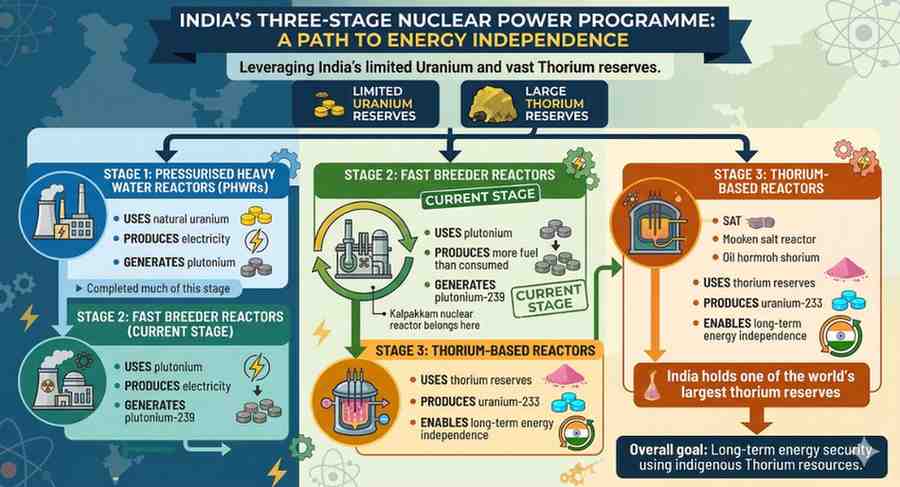
India’s Three-Stage Nuclear Programme Explained
India designed a three-stage nuclear programme because it has limited uranium but large thorium reserves.
| Stage | Reactor Type | Fuel Used | Key Output | Status/Notes |
| 1 | Pressurised Heavy Water Reactors (PHWRs) | Natural uranium | Electricity; Plutonium | Largely completed in India. |
| 2 | Fast Breeder Reactors (FBRs) | Plutonium | More fuel than consumed; Plutonium-239 | Current stage, e.g., Kalpakkam reactor. |
| 3 | Thorium-Based Reactors | Thorium reserves | Uranium-233 | Future stage for long-term energy independence. |
India holds one of the world’s largest thorium reserves. Hence, making this programme extremely important.
Why the Kalpakkam Nuclear Reactor is Important for India
The Kalpakkam reactor matters for several reasons. They are mentioned below:
Energy Security
- Reduces the uranium import requirement
- Ensures long-term fuel availability
- Strengthens strategic independence
Clean Energy Goals
- Nuclear power produces low carbon emissions
- Helps India meet climate targets
- Supports net-zero ambitions
Efficient Fuel Usage
- Fast breeder reactors produce more fuel
- Recycles nuclear waste
- Improves fuel efficiency
Thorium Future
- Enables India’s thorium-based energy strategy
- Supports long-term sustainability
Therefore, the Kalpakkam nuclear reactor is not just another power plant for the country. It has become a strategic energy asset.
What are the Challenges and Concerns Around the Kalpakkam Nuclear Reactor
Despite the achievement, challenges remain.
Major Delay
- Expected completion was around the year 2010
- Achieved criticality in the year 2024-25
- The delay is for over a decade
Cost Overrun
- Original cost was around ₹3,500 crore
- The final cost is around ₹8,181 crore
Technical Complexity
- Fast breeder reactors are complex
- Safety concerns remain
- Testing phase still ongoing
These issues highlight the need for:
- Better planning
- Stronger oversight
- Improved execution
Despite these challenges, the achievement remains significant.
Global Context: Fast Breeder Reactors Worldwide
Only a few countries operate fast breeder reactors:
- Russia
- China
- France (earlier experiments)
Many countries stopped development due to the following reasons:
- High cost
- Safety risks
- Technical challenges
Therefore, India’s success:
- Places India among advanced nuclear nations
- Strengthens technological capability
- Enhance energy independence
What Happens Next After Criticality?
After criticality, the next steps include:
- Low-power testing
- Safety validation
- Gradual power increase
- Commercial operation
- Fuel recycling
- Expansion of breeder reactors
Plans for the future may include:
- More breeder reactors
- Thorium-based reactors
- Expanded nuclear capacity
This stage opens India’s long-term nuclear roadmap.
Why This Nuclear Reactor Matters for India’s Future
The Kalpakkam nuclear reactor supports:
- Energy independence
- Clean energy transition
- Reduced coal dependence
- Climate commitments
- Technological leadership
India’s electricity demand is rising rapidly. Consequently, nuclear power offers:
- Reliable energy
- Sustainable supply
- Scalable solutions
Thus, this reactor becomes a cornerstone of India’s future energy mix.
Conclusion
The fact that the nuclear reactor in Kalpakkam has achieved its critical stage. It marks an important step forward toward India’s energy independence. Even with the challenges of cost overruns and delays. This will prove important to the three-phased nuclear plan of India.
In the long run, it will have an impact on India’s energy production.