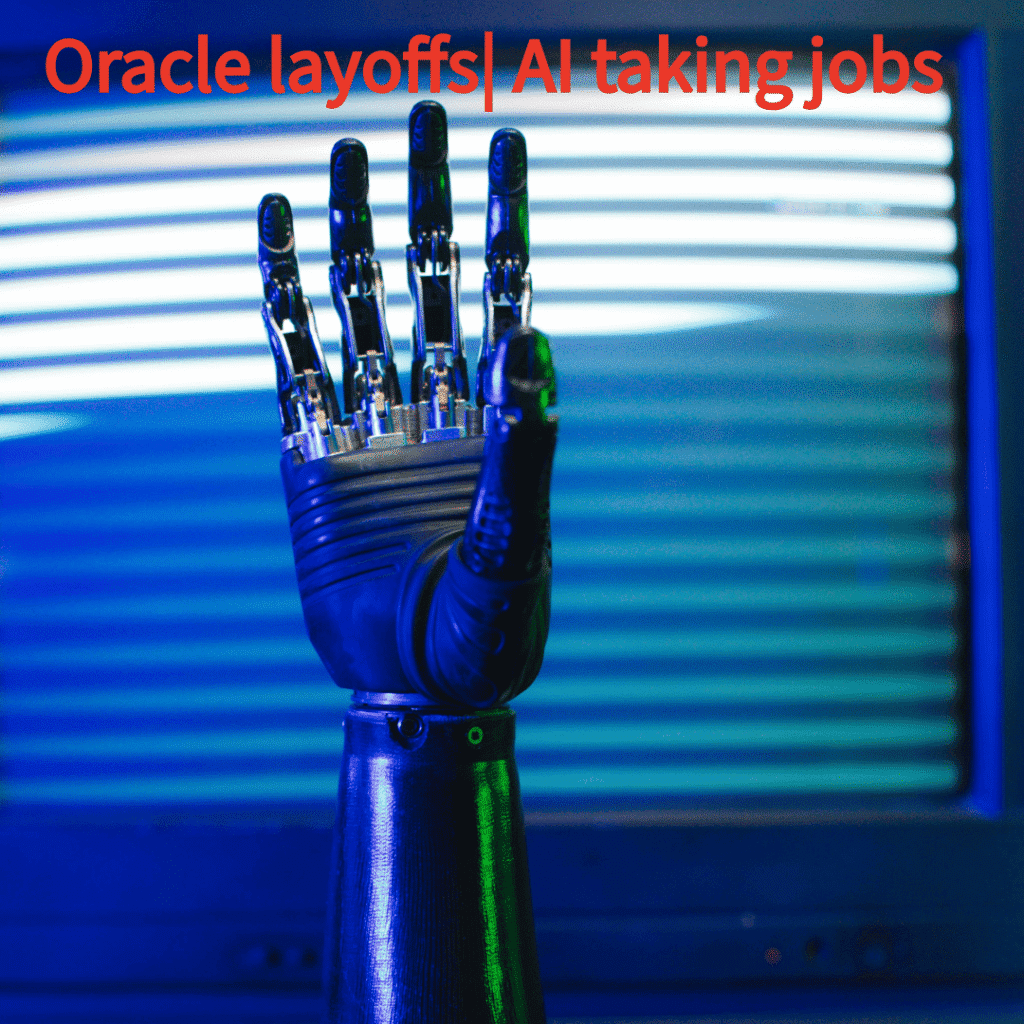

“The machines are not coming. They are already here, and they just took someone’s job at Oracle.”
That is not a dramatic headline. That is what happened. Oracle Corporation recently cut jobs between 1,000 and 12,000 globally. There are around 30,000 Indians who are employed by Oracle. Estimates suggest 3,000 to 4,000 Indian employees could lose their roles.
The reason? Oracle restructured AI and cloud infrastructure. The layoffs did not happen because the business was failing. They happened because AI is replacing the humans who powered it.
That distinction matters enormously.
What Oracle Layoffs Signal for the IT Industry
Oracle’s cuts are not an isolated event. They mirror a broader pattern across global tech.
Companies are trimming traditional roles. Investment is shifting toward AI infrastructure. Firms are reorganizing around automation and cloud platforms. As a result, demand for human-intensive. They are mentioned below:
- IT services
- routine coding
- Software testing and maintenance
The roles hit hardest at Oracle include the following:
- Senior engineers
- Architects
- Operations leaders
- Programme managers
- technical specialists.
In other words, even high-skilled roles are not immune.
Meanwhile, Oracle continues investing billions in its Stargate project. The project is a large-scale AI infrastructure initiative to build next-generation data centres. To support AI workloads. Capital is replacing labour. That shift is structural, not temporary.
Jobs Most Exposed to AI Automation
Research shows certain roles facing significant AI disruption:
| Job Role | AI Exposure |
| Computer programmers | 74.5% |
| Customer service representatives | 70% |
| Data entry clerks | 67% |
| Medical record specialists | 66% |
| Market research analysts | 64% |
| Sales representatives | 63% |
| Financial analysts | 60% |
These are not low-skill roles. Many require years of training. Nevertheless, AI performs its core tasks faster. It is cheaper and available around the clock. Consequently, companies face a straightforward calculation, and humans often lose it.
Will AI Replace Humans Entirely?
Here is where the panic needs perspective.
AI replaces tasks, not entire human beings. Take the case of the Industrial Revolution. Machines eliminated certain manual jobs. However, they simultaneously created railways, factories, and entirely new industries that employed millions more. The same logic applies today.
AI handles repetitively. Humans handle the irreplaceable.
Jobs AI Cannot Replace Easily
Some roles remain firmly human. Specifically, those requiring emotional intelligence and creativity. The role of physical judgment also comes into play. The following roles are mentioned below:
Creative and human-centric roles:
- Teachers and educators
- Psychologists and therapists
- Writers and content creators
- Designers and artists
High emotional intelligence roles:
- Healthcare professionals
- Social workers and counsellors
- HR professionals
Skilled trades:
- Electricians, plumbers, mechanics
- Construction workers
Leadership and strategy:
- Business leaders, managers, entrepreneurs
- Policymakers
AI cannot replicate empathy. It cannot replace a teacher who notices a struggling student. It cannot substitute for a therapist who reads what is unsaid. For that reason, these roles remain resilient regardless of how advanced automation becomes.
How Workers Can Prepare for the AI Future
Adaptation is not optional. It is survival.
Before the next wave of layoffs hits your industry, consider building these skills:
- AI and data literacy: If a person understands how tools work, this can help to a great extent. This can be done even without deep technical expertise
- Problem-solving: AI can execute the given problem. Humans define the problems that are required for the machines to understand
- Communication: The ability to explain and persuade remains uniquely human, and AI is behind in this race.
- Creativity and innovation: ideation cannot be automated; it remains largely for humans.
What’s more, there is a need for workers to learn to use AI as a tool. They should not compete against the AI. Such a worker will thrive. The goal is not to outperform AI. It is to work alongside it effectively.
Conclusion: AI Reshapes Work, But Humans Remain Essential
To sum up, Oracle’s layoffs are an early warning signal. It cannot be termed as the final word. AI is transforming the IT industry. It is eliminating certain roles. However, it is also creating new ones in AI development. Many positions are opening in data management and ethics.
India’s IT sector faces a strategic inflection point. The old model is mainly labour-driven. The service-based growth is under pressure. The new model demands workers who adapt and upskill.
Above all, the fear of AI taking jobs is real. However, so is the human capacity to reinvent. The question is not whether AI will change your work. It already has. The question is, what will you do about it?
Are you upskilling for the AI era? Share your thoughts below. 👇