

Should voting be compulsory in India? Learn about the right to vote, legal provisions, Supreme Court debate, global examples, and the way forward for mandatory voting UPSC & PSC exams.
Here’s a question. It seems simple. But it isn’t as simple as it looks. In other words, should the government be able to force the people to vote?
As we approach Assembly Elections 2026, the question that arises is a grave one. The question of compulsory voting has been raised. The Supreme Court raised it. India is at that crossroads. We are at that juncture. This juncture is between idealism and reality. For all UPSC aspirants out there, this matters. For PSC aspirants, this is important. This question has implications. These implications are for electoral reforms. They are for fundamental rights. They are for constitutional law. All at once. These topics are connected. So, let’s get into the topic point by point.
What Is the Right to Vote in India?
Article 326 of the Constitution governs the voting process in India. It extends the franchise to every citizen who is:
- 18 years or above in age
- Registered in the electoral roll
- Not disqualified under any existing law
Above all, here’s the critical distinction the Supreme Court has repeatedly drawn. The idea is that voting is a statutory right, not a fundamental right. It’s granted by law. However, it is not guaranteed by the Constitution as an enforceable entitlement. You can vote. You’re not required to.
Legal Framework: The Two Acts That Govern Voting
Two legislations form the backbone of India’s electoral system:
| Legislation | Key provision |
| The Representation of the People Act, 1950 | It prescribes qualifications for voters. It prescribes the preparation and qualifications for inclusion in the electoral roll. |
| The Representation of the People Act, 1951 | It grants the right to vote to all persons in the electoral rolls. It prescribes the manner in which elections are to be held. |
Altogether, these Acts create the legal basis for participation. As a result, participation remains voluntary.
Should Voting Be Compulsory? The Big Debate
This is not a new issue, and India has been dealing with it for a long time. For instance, two main reports have come up with very different nuances.
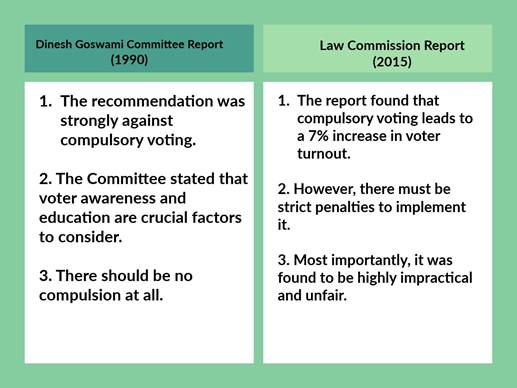
The common consensus is that voter participation must increase. However, compulsion is not the way to go in increasing it.
Countries Where Voting Is Compulsory
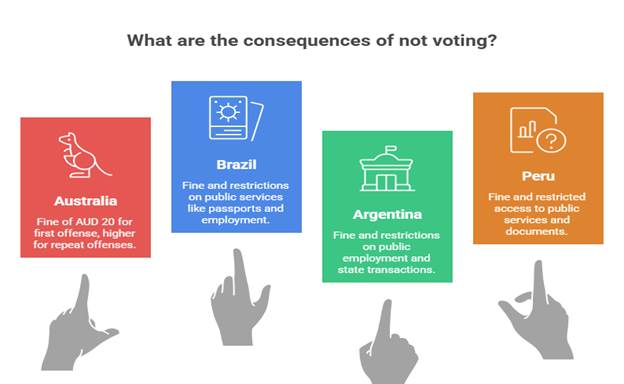
Several democracies around the world have made voting mandatory. For instance, they actually enforce it:
These systems work in their contexts. Most importantly, transplanting them into India, with its 970+ million voters and diverse geography, is challenging. There is also an issue of the migrant population and infrastructure gaps.
Why Compulsory Voting Doesn’t Fit India
Let me be direct. There are three core problems:
1. Implementation is a nightmare.: Managing voluntary turnout across 10 lakh+ polling booths is already a massive exercise. Tracking non-voters and enforcing penalties at scale? Practically impossible.
2. The penalties may affect the vulnerable section of the population: Mostly, the migrant workers and the daily wage earners are affected by this. People in remote areas may not be able to vote even if they want to. Fines imposed on them for the structural flaws in the system would be unfair to the people.
3. It may violate Article 19 (Freedom of Expression): This is the constitutional argument activists make most strongly. Choosing not to vote, which is the concept of NOTA, is itself a form of political speech. In other words, compulsion silences that choice.
The Real Problem: Low Voter Turnout
Low participation has genuine democratic consequences:
- Candidates win on minority vote shares
- Large communities go unrepresented
- Electoral mandates lack moral legitimacy
India’s average national turnout hovers around 65–67%. In conclusion, it means roughly 1 in 3 eligible voters stay home. That’s not a small problem. In conclusion, it’s a structural one.
Way Forward: Encourage, Don’t Force
Instead of compulsion, India should invest in making voting easier and more meaningful:
- Voter Awareness Campaigns: Voter Awareness Campaigns leverage social media. Use regional influencers. Use school programs. Build civic culture. Build it from a young age. Start early
- Support for Migrant Workers: Guarantee a voting-day holiday. Run dedicated buses. Run trains to polling booths. Explore remote voting mechanisms. Make access possible.
- Technological Solutions Pilot remote voting: Pilot digital voting process. This should be done for specific categories. NRIs are one category. Migrants are another. Elderly voters need this. Use secure frameworks. Security matters.
- Better Electoral Management: It improves booth accessibility. Reduce waiting times. Expand assisted voting. This is for people with disabilities. Make the process smooth.
The goal isn’t to drag people to the polling booths. Willingness matters. In other words, it’s all the efforts to make them want to be there.
Conclusion: Democracy Needs Willing Participants
Voting is the most powerful tool. A citizen has this tool. This tool exists in a democracy. But that power only means something. This happens when it’s exercised freely. Making voting compulsory in India is problematic. It is neither practical nor philosophically sound.
In other words, it risks something. It risks converting a democratic right. It converts it into a bureaucratic obligation. The real work lies elsewhere. It lies in building trust. Trust in institutions matters. The candidates matters, too. Trust in the process itself is crucial.
When people believe their vote matters, they show up. No law is required.
Do you think India should make voting compulsory, or is voluntary participation the right path? Drop your thoughts in the comments and share this with a fellow UPSC aspirant! 👇