

The Transgender Rights Bill 2026 shifts from self-identity to medical gatekeeping. Here’s a full breakdown of key changes, provisions, and what’s at stake for trans rights in India.
Imagine being told the identity you’ve lived, fought for, and legally established — doesn’t count anymore. That is the fear that lies at the heart of the Transgender Persons (Protection of Rights) Amendment Bill, 2026. It was introduced in the Lok Sabha on 13th March 2026.
I’ll be honest with you about this bill. This one is a little bit complicated. It’s not a straightforward “step forward.” For UPSC aspirants and students studying Indian politics, this Bill warrants careful, nuanced attention.
Background: How Did We Get Here?
The transgender rights movement in India may be characterized as a slow ascent at best. The NALSA vs. Union of India case of 2014 was a landmark case regarding this issue. The Supreme Court recognized transgender people as a “third gender.” The idea of self-perceived gender identity was supported by the judgment. Consequently, the Transgender Persons (Protection of Rights) Act of 2019 came into the picture. This act had good intentions, while it was highly flawed. The transgender rights movement saw this act as an opportunity to correct the problems with it in the next amendment.
On the other hand, the Bill of 2026 has taken a completely different turn.
The Big Shift: From Self-Identity to Medical Gatekeeping
This is the core of the controversy. The 2026 Amendment doesn’t strengthen self-determination. On the other hand, it replaces it with medical verification.
| Feature | 2019 Act (Earlier) | 2026 Amendment (Proposed) |
| Basis of Identity | Self-perceived gender identity | Biological traits and socio-cultural labels |
| Recognition Process | Administrative declaration to the District Magistrate | Mandatory Medical Board recommendation |
| Surgical Requirement | Explicitly not required | Implicitly required via medical evaluation |
| Identity Scope | Broad—incl. non-binary, genderqueer | Narrow—biological & specific cultural groups only |
| Definition of Transgender | Inclusive, self-determined | Restricted to Hijra, Kinner, Aravani, Jogta, and intersex |
| Privacy Protection | Not explicitly addressed | Hospitals must report surgeries to DM—privacy concern |
| Retrospective Effect | No clause invalidating past certificates | Seeks to nullify ~32,000 existing identity certificates |
| Penalty for “Coercion” | Not defined | 10 years to life imprisonment |
| Penalty for violence against trans persons | 6 months to 2 years | Unchanged—still 6 months to 2 years |
That last row? That says a lot about where the priorities lie.
Key Provisions That Are Raising Alarms
1. Erasure of Self-Identification: The Bill deletes the right to self-perceived gender identity. It directly contradicts the NALSA judgment. Trans men, trans women, and genderqueer individuals outside traditional categories are effectively removed from legal protection.
2. The Medical Board Filter: The Applications now go through a board headed by a Chief Medical Officer. Even after approval, the District Magistrate can demand further medical opinions. Activists point out that there is no medical test that can “prove” gender identity. Contrary to this, it is inherently psychological.
3. Retrospective Nullification: A single clause states trans status “shall not include, nor shall ever have been so included, those with self-perceived identities. This puts 32,000 certificate holders in legal limbo. All this leads to their education records, employment documents, and welfare access suddenly being uncertain.
4. Criminalizing Support Networks: Vague “coercion” provisions could target chosen families, Hijra jamaats, and NGOs that support trans youth with charges of “allurement.” For communities already abandoned by biological families, this is devastating.
India is not at all alone in this trend. The countries like Hungary, the UK, and the US have all seen anti-trans legislative moves in 2026. As a result, analysts are watching India’s move. Whether it follows the steps or charts its own path.
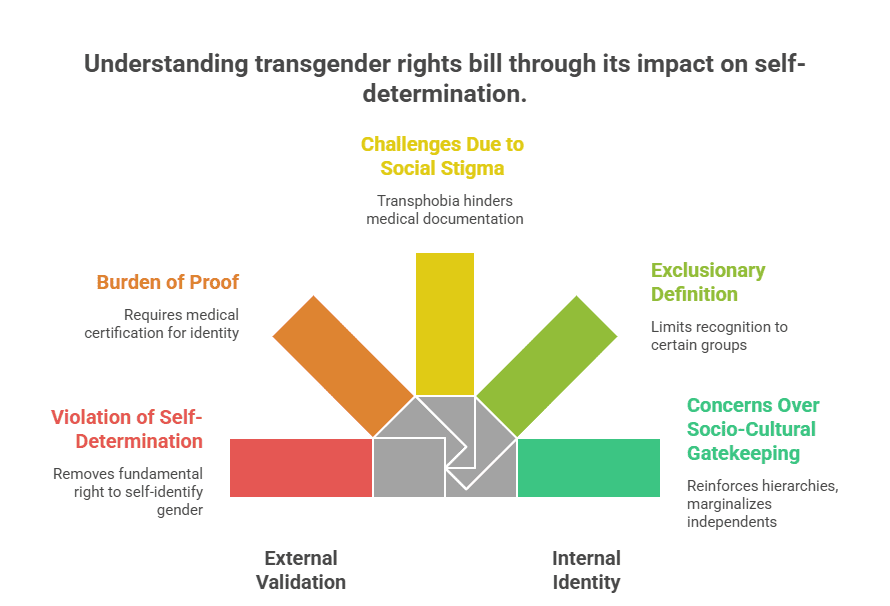
This Bill sits at the intersection of several core constitutional principles:
•Article 14: This is against the Right to Equality
• Article 21: It also goes against the Right to Life and Dignity
• K.S. Puttaswamy v. Union of India (2017): As it focused on the Right to Privacy, the reporting to the hospital is a violation of this right.
• NALSA Judgment (2014): It laid focus on the fact that Self-identification is a fundamental right. This bill is a violation of that.
Any legislation that contradicts Supreme Court jurisprudence is constitutionally vulnerable — and this Bill does so, repeatedly.
The Road Ahead
Implementation was always going to be a challenge. But a bill that walks back right faces an even steeper road. It is going through legal challenges and public protests all around the country. There is a credibility crisis for India’s commitment to inclusive governance, too.
The 2026 Amendment Bill doesn’t protect transgender persons. As activist Daniella Mendonca put it, “It is a Control Act.”
Whether Parliament listens, reconsiders, or refers it to a Standing Committee will define where India stands on dignity and inclusion.
What do you think about the 2026 Bill? Does it strengthen or weaken transgender rights in India? Share your perspective in the comments. 👇