
When Global War Meets Rupee Falling Pressure
Here’s something I’ve been noticing lately: that every time global tensions rise, the rupee starts falling quietly in the background. No headlines screaming panic. No sudden crash. Just a slow, steady slide.
And right now, that’s exactly what’s happening.
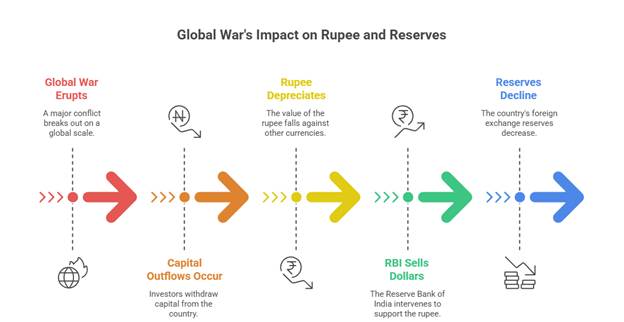
Global war uncertainty is pushing investors toward safe-haven assets like the U.S. dollar. The consequences are being borne by emerging markets like India. The emerging economies are feeling the heat. The rupee falling trend has forced the Reserve Bank of India (RBI) into a difficult position to either defend the rupee or protect forex reserves.
The uncomfortable truth?
RBI cannot do both forever.
So, what’s really happening behind the scenes? Let’s break it down.
What Is Happening Right Now: Forex Reserves Are Declining
Let’s start with the numbers because numbers rarely lie.
India’s forex reserves have dropped:
| Item | Value |
| Period | September |
| Forex Reserves (Peak) | $701 Billion |
| Recent Level | $678 Billion |
| Decline | ~$12.1 Billion |
Why?
Because the RBI is selling dollars to slow the rupee’s falling trend.
This is called currency intervention, and it’s like using your savings to stabilize a falling income. In conclusion, it works… but only for so long.
Why the Rupee is Falling: Three Major Reasons
1. Global War Uncertainty
Whenever geopolitical tensions rise, for example, the US-Iran war:
- Investors move money to safe assets
- U.S. dollar demand increases
- Emerging markets see capital outflows
As a result, the rupee starts falling.
It’s like everyone running to the safest shelter during a storm and leaving others exposed.
2. Strong U.S. Dollar
The Dollar Index (DXY) is rising.
This creates a chain reaction:
- Strong dollar
- Weak rupee
- Costlier imports
- Higher inflation
For India, which imports oil heavily, this becomes a serious concern.
3. Foreign Investors Pulling Out
Foreign investors are:
- Selling Indian stocks
- Moving money to U.S. markets
- Increasing dollar demand
And once again, the rupee continues to fall.
RBI’s Dual Defence Strategy
RBI is doing something quite smart — but also risky.
Strategy 1: Selling Dollars
RBI sells forex reserves:
- Dollar supply increases
- Rupee stabilizes temporarily
But most importantly,
- Forex reserves fall
Strategy 2: Managed Depreciation
RBI is also:
- Allowing gradual rupee weakening
- Preventing sudden collapse
This is called controlled depreciation.
In simple words, RBI is slowing the INR’s fall, not stopping it.
Why RBI Cannot Defend Rupee Forever
Forex reserves are finite.
If RBI keeps selling dollars:
- Reserves decline
- External vulnerability increases
- Import risks rise
So, RBI must choose between the two options:
| Option | Outcome |
| Defend Rupee | Reserves fall |
| Save Reserves | Rupee weakens |
That’s the policy dilemma.
Impact of the Rupee Falling on India
| Negative Effects | Positive Effects |
| Costlier oil imports | Export competitiveness improves |
| Higher inflation | IT exports benefit |
| Current account pressure | Remittances increase |
So yes, the rupee falling isn’t entirely bad, but sharp depreciation can hurt.
RBI’s Likely Policy Direction
Experts believe:
- RBI will allow gradual rupee depreciation
- Preserve forex reserves
- Continue managed depreciation
This is considered the most pragmatic approach.
Conclusion: RBI’s Tough Policy Trade-Off
Let me put it simply.
Eventually, RBI may choose long-term stability over short-term currency defence.
And that means one thing:
Gradual rupee falling may continue.