“For decades, Bastar was a place where the government feared to go. Today, the government declares it free.”
That shift took years of security operations and development initiatives. Tribal outreach also played an important role in reaching this point. On March 30, just one day before his self-imposed deadline, Amit Shah came with an announcement. He declared India “Naxal-free” in the Lok Sabha. He cited three years of intensive paramilitary operations as evidence.
What Is Naxalism? A Quick Background
Naxalism traces its origins to 1967 in Naxalbari in the region of West Bengal. It was inspired by Maoist ideology. The armed peasants rose against landlords and state authority. As a result, the movement spread fast.
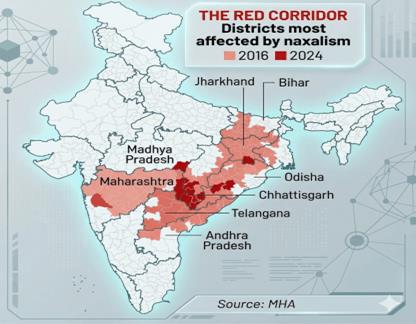
Over the decades, it expanded across central and eastern India. The states most affected were the following. They are mentioned below:
- Chhattisgarh
- Jharkhand
- Odisha
- Maharashtra
- Bihar
- Andhra Pradesh
These areas are specifically known as the “Red Corridor.” At its peak, Maoist influence extended across more than 230 districts. These areas are mostly Tribal-dominated. They are characterized by forest cover. As they are mineral-rich areas, they provide both cover and cause. Bastar division in Chhattisgarh is composed of 42,000 sq. km of dense forest. It instantly became the undisputed epicentre for the movement.
Why Bastar Was a Maoist Stronghold
Bastar was not just geography. It was a governance failure made visible.
- Dense forests: They provided natural cover for the Maoist movement and camps to a larger extent.
- Tribal communities: They faced exploitation and displacement. The neglect continued for generations.
- Limited infrastructure: The lack of roads and poor connectivity can also be cited as a reason.
- Development vacuum: Welfare schemes rarely reached interior villages
The Maoists filled that vacuum. They ran parallel courts and collected taxes. Along with that, they positioned themselves as protectors of tribal rights. Consequently, the local support was sometimes willing. Sometimes it was coerced, too. It has helped in sustaining their presence for decades.
The Dramatic Decline: Numbers That Tell the Story
The scale of the turnaround is significant. In numbers, it looks like this:
| Year | Maoist-Affected Districts |
| 2005 | ~230 districts |
| 2014 | 126 districts |
| 2026 | Only 2 districts (Bijapur & Sukma) |
Three years of intensive operations produced measurable results:
- 4,839 Maoists surrendered
- 2,218 Maoists arrested
- 706 Maoists neutralized in encounters
In 2025, only two mobile tower attacks were recorded across the entire region. Earlier, infrastructure sabotage was routine. The capability of Maoist forces has clearly weakened.
The Strategy That Made It Possible
Security operations alone do not end insurgencies. In addition to force, the government deployed technology and development simultaneously.
| Pillar | Specific Action |
| Technology-driven operations | GPS-tracked patrols and satellite phones. It helps in real-time reinforcement. |
| New security camps | Opened in remote forest areas as governance centers |
| Infrastructure | Roads and mobile towers are a vital aspect. Electricity access in inaccessible areas has helped a lot. |
| Welfare delivery | The disbursement of Aadhaar cards and ration cards has helped a lot in welfare delivery. It has helped in reaching schools and interior villages. |
| Surrender policy | Rehabilitation packages with dialogue for those willing to surrender under the SAMADHAAN strategy. |
Earlier, patrol teams stayed 2–3 days in forests with high casualties and poor coordination. Now, real-time tracking and faster reinforcement have changed the operational equation entirely.
The approach “Security + Development” combined pressure with persuasion. On one hand, security forces neutralised armed cadres. On the other hand, development programmes targeted the grievances that fuelled the movement. This dual strategy is what UPSC answer writers must understand and articulate clearly.
A Balanced View: What Critics Raise
Amit Shah deserves credit for operational success. That said, the strategy did not come without cost or controversy.
The UPA government under Manmohan Singh had described LWE as India’s biggest internal security threat. As a result, Operation Green Hunt (2009-10) was launched under that regime. It was a large paramilitary operation. Although it faced criticism for human rights concerns and coalition pressures.
Amit Shah’s approach was more uncompromising. Critics point out that:
- Academics and activists were labelled “urban Naxals,” broadening the definition of the threat
- Anti-terror laws were applied more expansively
- Human rights concerns were largely overridden
Furthermore, Bastar is mineral-rich. There is a genuine risk that military victory creates space for crony capitalist extraction. It is contrary to genuine tribal welfare. Corporations entering mineral-rich tribal lands without accountability could create new grievances and new reasons for radicalisation.
Challenges Still Remaining
Declaring Bastar Maoist-free is significant. However, it is not the end.
- IED threats persist: Maoists planted landmines before retreating. Hence, de-mining operations continue.
- Residual cadres: Around 7–8 active cadres remain with regrouping potential. So, the government is working on them.
- Tribal land rights: Displacement and land acquisition remain unresolved. Hence, it has become the main focus.
- Long-term governance: The main idea is that state presence must be sustained, not just military presence.
A point often overlooked is that insurgencies do not end with military victory alone. However, they end when the conditions that created them are genuinely addressed.
Conclusion: Victory Is Only Half the Work
To sum up, Amit Shah’s Naxal-free declaration represents a genuine and hard-won milestone. The numbers are real. The operational success is undeniable by the current development.
However, the final chapter depends not on guns but on governance to a greater extent. These include tribal inclusion and land rights. Equitable resource extraction is crucial, too. At the end, consistent development is what determines whether this peace holds.
Military victory clears the ground. Political reconciliation and inclusive development must build what comes next.
What do you think? Is India truly close to ending Naxalism, or does the real challenge begin now? Share your view below. 👇