
“The right to die with dignity is as important as the right to live with dignity.” – Justice D.Y. Chandrachud, Common Cause vs Union of India (2018)
That judgment was a landmark on Indian soil. It was historic. It gave India its legal framework for passive euthanasia. Yet, years later, the Harish Rana case shows that having a law on paper and using it are two very different things.
Why the Harish Rana Case Matters
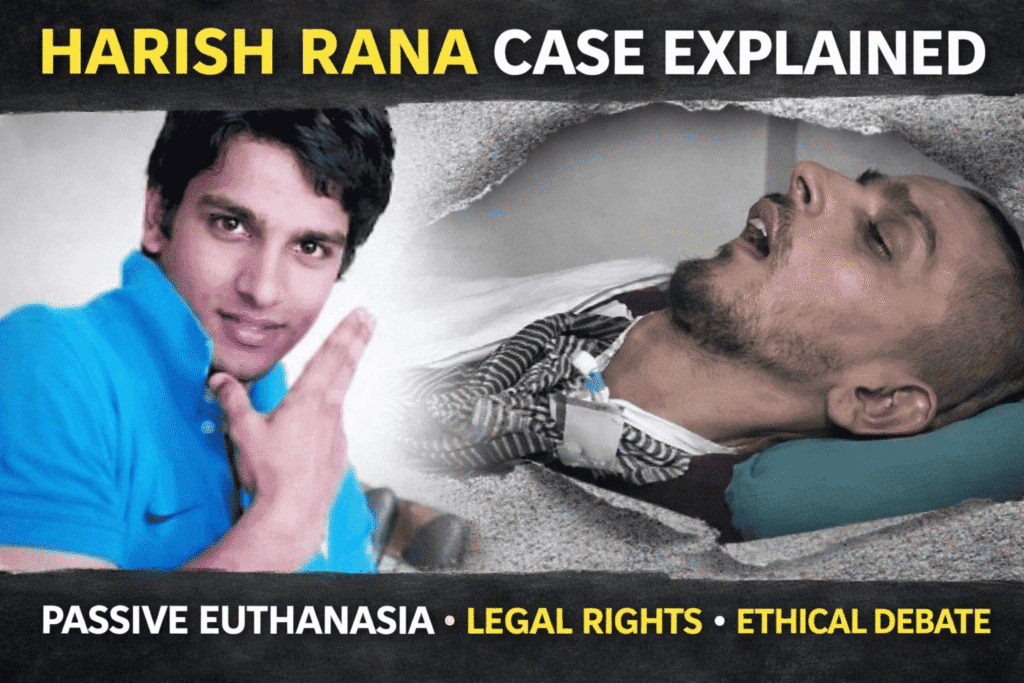
Harish Rana was a student. He was in college when the accident happened. He fell from the fourth floor of his hostel. As a result, he sustained deep injuries due to the accident. These injuries were severe.
After that, his body changed. It was in a persistent vegetative state. He was kept alive. This happened on life support. As a result, he could not communicate. His body could not recover either. Recovery was impossible. He was on life support for the past 13 years. The man’s family was suffering along with him. Their pain was immense to see their son in that condition.
Therefore, they filed a petition. This petition was legal. The petition sought permission. In other words, the permission was for passive euthanasia. Specifically, for the removal of Clinically Assisted Nutrition and Hydration. He was given artificial nutrition and hydration. This is called CANH. This kept him alive.
The case is newsworthy. Not because it is new. Most importantly, it shows difficulty. The difficulty is in using rights. Although these rights already exist. The Supreme Court has recognized them in different judgments. Recognition and implementation differ.
The Harish Rana case is not just about an individual. It is not just about his family who suffer along with the patient. Most importantly, it is about every family that undergoes the same condition.
How India’s Legal Position Evolved: A Quick Timeline
India did not arrive at this point overnight. The decision evolved through various Supreme Court judgments. The journey took decades.
| Year | Case / Event | Key Development |
| 2011 | Aruna Shanbaug Case | Passive euthanasia was allowed. A living will was permitted, too. |
| 2018 | Common Cause Case | Right to die with dignity recognised as part of Article 21 |
| 2023 | Common Cause Update | Process simplified. Judicial approval requirement reduced. |
| 2026 | Harish Rana Case | Permission sought to withdraw artificial nutrition (CANH) |
Each judgment was built on the last. The law moved forward. Implementation, however, struggled to keep pace.
What Is Passive Euthanasia? A Simple Explanation
There is active euthanasia. There is passive euthanasia. They are different. Very different.
| Type | What It Means | Legal Status in India |
| Active Euthanasia | Administering something to cause death | Illegal |
| Passive Euthanasia | Withdrawing life support to allow natural death | It is Legal. It is done under strict conditions |
In other words, passive euthanasia involves:
- Withdrawing ventilator support
- Stopping artificial nutrition and hydration (CANH)
- Withholding life-saving interventions
It does not cause death directly. It allows the natural process to take its course. That distinction matters legally and ethically.
In fact, the Supreme Court itself has noted that “passive euthanasia is an obsolete and incorrect term.” It said the term should not be used in legal writing or common usage. The Court also clarified that withdrawing treatment is not abandonment. However, palliative and end-of-life care must continue for these patients.
The Ethical Framework: Four Principles That Guide the Decision
Ethics here isn’t abstract. For instance there are four specific principles that courts and doctors consider.
1. Autonomy
The patient has rights. Along with them, kin have rights, too. This happens in terminal cases. They have the right to make decisions. This is the most significant principle. Choice matters most in such cases.
2. Beneficence
Doctors must consider the benefit. What is beneficial? This is for the patient. Not just what keeps them alive. Life quality matters. Life duration is secondary.
3. Non-maleficence
The decision to withdraw treatment must be made carefully. It should not cause additional harm. First, do no harm. This principle persists.
4. Justice
No injustice should happen. This is for the patient. No coercion should exist. No financial motivation should drive decisions. Fairness matters in such cases.
In addition, there is a well-known principle. This is known as the Theory of Double Effect. It was proposed by St. Thomas Aquinas.
According to this theory, every action creates two effects. In the Harish Rana case, withdrawing CANH creates two outcomes. First, the death of the patient. Second, relief from suffering. If the decision is taken without malice, the act is considered ethical because the patient is relieved of pain.
Social Implications: The Bigger Picture
The Harish Rana case reflects something larger. India is transitioning. In other words it is moving from protecting life at any cost to valuing quality of life over its length.
Arguments in favour:
- Right to die with dignity is part of Article 21
- Prolonged suffering serves no medical purpose
- Long-term life support creates severe economic stress, especially for middle and lower-income families
- Patient autonomy must be respected
Arguments against:
- Risk of misuse: vulnerable people like the elderly, disabled, and poor may face coercion
- Decisions may be driven by financial constraints, social neglect, or family pressure
- Critics warn it could amount to disguised abandonment
- Religious and cultural values around the sanctity of life
However, the Court has been careful. It has been stated clearly — the patient is not abandoned by withdrawing treatment. Palliative care must continue. That distinction is important.
Implementation Challenges: Where the System Breaks Down
The law exists. The problem is implementation.
1. Lack of awareness: Most families don’t know that a living will exists. Knowledge is limited.
2. Procedural delays: multi-board approvals take time. As a result, waiting is painful.
3. Doctor hesitation: Fear exists. This fear is of legal consequences. Doctors remain passive. Hesitation is common.
4. No standard hospital protocol: Every institution differs in handling the use. Consistency is absent.
5. Emotional burden: Families face impossible choices. These choices can be made under deep grief.
According to legal experts, the Harish Rana case exposed all of these gaps simultaneously. The family knew their rights. They still struggled.
Way Forward: What Needs to Change
The framework is not broken. It needs repair. Above all, it needs simplification.
1. Simplify living will registration: The process is to make it easy. Make it as easy as writing a will. Access matters.
2. Clear timelines for medical board approvals: No open-ended delays. Timelines must exist. Certainty helps.
3. Train hospital staff: Training is needed on end-of-life care protocols. This is on patient rights. Knowledge empowers.
4. Public awareness campaigns: Campaigns must run especially in regional languages. Reach matters. Over time, understanding grows.
5. Legal clarity for doctors: Protection is needed. This is from the prosecution. This happens when following guidelines. Doctors need safety.
However, the most important change is cultural. India needs to talk about death. Openly. Without fear. Without stigma. Because avoiding the conversation doesn’t make the situation disappear — it just makes it harder when it arrives.
Conclusion: Dignity Is Not a Courtroom Luxury
The Harish Rana case is a mirror. It reflects where India’s healthcare, along with the legal and ethical systems, stand on end-of-life care. The Supreme Court has spoken. The law is clear. Yet families still fight for months to exercise rights that are already theirs.
Withdrawing life support is not giving up. It is not abandonment. According to the Court itself, it is a recognition that the patient’s dignity matters more than the continuation of treatment without hope.
That is not a legal question alone. It is a deeply human one.
What do you think? Should India make the passive euthanasia process simpler for families, or are strict safeguards always necessary? Share your thoughts below. 👇