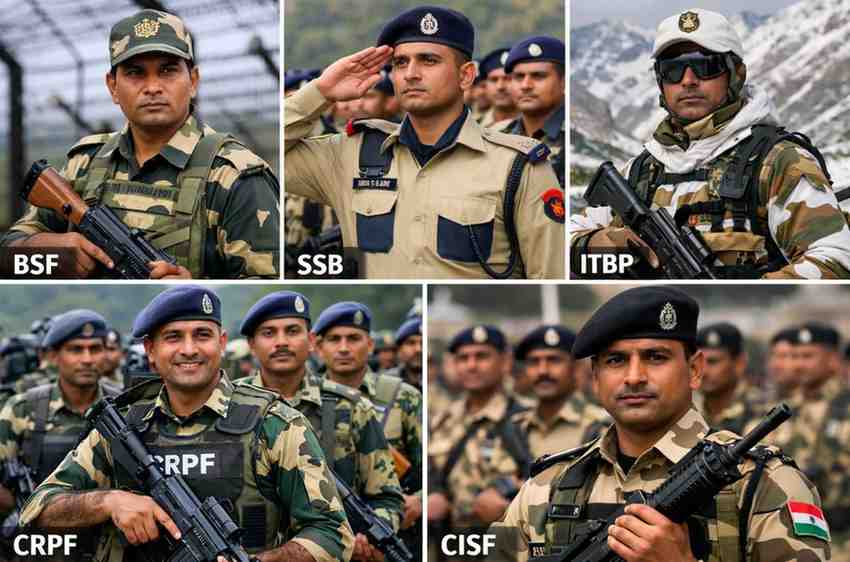

Imagine security forces spend 20 years in the field. They are sent to border postings. They also manage counterinsurgency operations. Their role in riot control cannot be neglected. After that, only to watch a leadership role go to someone from a different service entirely.
That’s the quiet frustration sitting inside many Central Armed Police Forces officers today. For instance, the CAPF Bill 2026 has brought it to a full boil.
Introduced in the Rajya Sabha on March 25, 2026, the Central Armed Police Forces (General Administration) Bill, 2026. It proposes to regulate recruitment and service conditions. It also deals with promotion structures for Group A officers across all five major forces.
These major CAPFs are listed in the First Schedule to the Bill. It includes the Central Reserve Police Force (CRPF), the Border Security Force (BSF), the Central Industrial Security Force (CISF), the Indo-Tibetan Border Police (ITBP), and the Sashastra Seema Bal (SSB).
Although it sounds administrative. It isn’t. It’s political. In other words, it matters for India’s internal security.
The Big Change: IPS Dominance at the Top
Here’s what the Bill actually proposes. There is no sugarcoating.
| Position | IPS Quota | CAPF Cadre Officers |
| Inspector General (IG) | 50% | 50% |
| Additional Director General (ADG) | Minimum 67% | Maximum 33% |
| Special Director General (SDG) | 100% | 0% |
| Director General (DG) | 100% | 0% |
Every single top post. Either half or fully reserved for IPS officers. CAPF cadre officers, the ones who actually served in these forces their entire careers, get pushed down.
This is what the debate is about. Leadership. Not paperwork.
But Wait, Didn’t the Supreme Court Say Otherwise?
Yes. Exactly.
In Sanjay Prakash vs Union of India (May 2025), the Supreme Court delivered a significant verdict. It directed the government to:
- Reduce IPS deputation gradually
- Complete a cadre review for CAPF officers
- Recognize CAPFs as Organized Group A Services (OGAS)
- Reduce deputation up to IG rank within two years
The CAPF Bill 2026 doesn’t just ignore this. It goes in the opposite direction. More IPS. More deputation. Codified into the present law.
That tension between judicial direction and executive legislation is the most important debate this Bill has sparked.
What the Government Says
The government’s argument isn’t without logic. IPS officers, they say, are a “unifying link” between the Union and state governments. CAPFs regularly coordinate with state police forces. IPS officers bring the following:
- National-level training
- Cross-state operational experience
- Administrative exposure at multiple levels
This vision traces back to Sardar Vallabhbhai Patel, who envisioned IPS as India’s national integration force. That legacy continues to justify deputation policies.
And in January 2026, the Ministry of Home Affairs went further, making a 2-year central deputation mandatory for IPS officers seeking empanelment as Inspector General. The Bill formalizes what policy has already been doing quietly.
What CAPF Officers and Critics Are Saying
The criticism is pointed. These are mentioned below:
- CAPF cadre officers have operational ground experience that IPS officers simply don’t accumulate in the same way during their service.
- Career stagnation is real. Promotions slow down. In addition, morale takes a hit.
- The Bill contradicts the Supreme Court’s 2025 directive. Raising serious questions about the judiciary-executive relationship. It brings the tussle to the forefront.
- Critics warn it could affect operational efficiency. When officers feel career ceilings are fixed regardless of performance, motivation suffers
Two supporting court judgments are cited by the government:
- Gazula Dasaratha Rama Rao vs State of Andhra Pradesh (1960): Service conditions are not fundamental rights.
- Indian Ex-Servicemen Movement vs Union of India: courts should not interfere in policy matters.
The argument put forward by the government is that deputation is an executive policy call. According to the government, courts interpret the law. They don’t set service structures.
Conclusion: Reform or Regression?
The CAPF Bill 2026 wants to bring clarity. Standardized rules. Clean hierarchies. In other words, bringing no ambiguity to the deputation.
But clarity built on contested foundations isn’t stability. However, it is a conflict that is deferred.
The real question isn’t whether IPS officers should serve in CAPFs. They should. They do. The question is at what cost to the officers who dedicated their careers to these forces? And what does it mean when Parliament legislates in a direction the Supreme Court explicitly warned against?
That debate on federalism, service autonomy, and institutional respect is far from over.
What’s your take? Should CAPF cadre officers lead their own forces, or is IPS deputation essential for national coordination? Tell us below. 👇